





Improving Packaging Impact Testing with an Incline Impact Tester in Poland
2026/11/04
Share:

Customer Background
The customer is a medium-sized packaging manufacturer located in Poznań, Poland, specializing in the production of corrugated cardboard boxes, honeycomb paperboard, and heavy-duty packaging systems. Its products are exported to EU countries such as Germany and the Netherlands, with downstream customers primarily in the electronics, electrical appliances, and automotive components industries.
Heavy-duty packaging of this type shares a common characteristic: during transportation and logistics, packages frequently encounter oblique impacts caused by sudden braking, sliding down ramps, and collisions during loading and unloading. Impact resistance directly affects customer satisfaction and repeat orders. As a result, PackWell conducts extensive transportation validation tests on its packaging solutions every year, with testing demand increasing steadily.
Problems and Pain Points
Before upgrading its testing equipment, the customer faced several significant limitations in its testing capabilities.
1. High Costs and Long Lead Times for Outsourced Testing
Previously, most transportation validation samples had to be sent to third-party laboratories in Western Europe. Individual test items were relatively expensive, and transportation combined with laboratory scheduling meant that a complete validation cycle typically took two to three weeks. As new product launches accelerated, testing gradually became a bottleneck.
2. Inability to Simulate Incline Impact Conditions with Existing Equipment
The customer's laboratory was equipped only with a basic drop testing platform, which could not reproduce incline impact conditions. However, customer complaints were mainly associated with inclined collision scenarios, such as palletized loads collapsing, packages being thrown off conveyor ends, and impacts during ramp transportation. Drop test data alone could not explain these failure modes, making it difficult to identify effective improvements.
3. Poor Test Repeatability and Consistency
Manual pulling and releasing of samples made it difficult to precisely control impact velocity. Test results for the same batch of samples could vary considerably between repeated tests, reducing the reliability and credibility of the data presented to end customers.
Solution: Incline Impact Tester
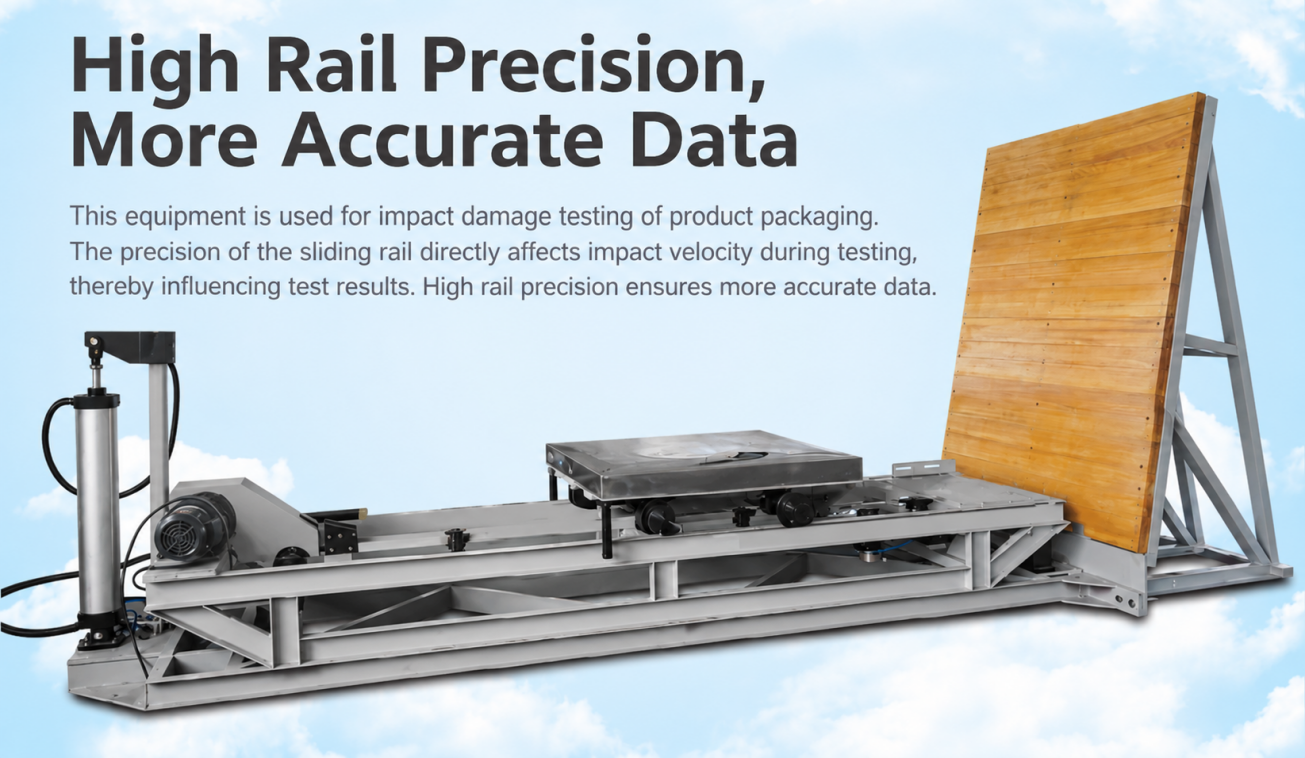
To address these challenges, we supplied the customer with an Incline Impact Tester, carefully selected and configured according to its heavy-duty packaging testing requirements.
The equipment accelerates a trolley carrying the test specimen along a guide rail to a preset velocity before impacting a rigid barrier. It can realistically simulate both horizontal and inclined impact conditions.
At a 0° angle, the equipment performs horizontal impact tests. By adjusting the incline angle, inclined impact tests can be conducted at multiple angles, including 10° and other specified angles.
After installation and commissioning, we provided on-site training for the customer's operating team, covering specimen securing methods, impact velocity settings, and test data analysis.
Equipment Advantages and Application Results
The changes following the commissioning of the equipment were immediate and significant.
Significantly Improved Testing Efficiency
Routine validation projects that previously took two to three weeks to complete can now be finished within a single day. Most tests no longer need to be outsourced, resulting in substantial annual savings in third-party testing costs.
Improved Data Repeatability and Traceability
Impact velocity is reliably controlled through the precision of the guide rail and the release mechanism, significantly improving consistency across repeated tests under identical conditions.
PackWell can now provide in-house laboratory test reports alongside its shipments, increasing end customers' confidence in its packaging solutions. The evaluation and approval process for new packaging designs has also become shorter.
Broader Test Condition Coverage
From horizontal impact to multi-angle incline impact, one piece of equipment now covers testing scenarios that were previously inaccessible. The team's ability to analyze failure modes has improved considerably, enabling the R&D department to make targeted improvements to cushioning structures and packaging designs.
Key Problems Solved
Replaced outsourced testing with in-house testing capabilities, addressing long testing lead times and high costs.
Added incline impact testing capabilities, resolving the challenge of customer complaints that could not be explained by conventional drop test data.
Achieved more precise impact velocity control, overcoming poor consistency in manual testing and improving the credibility of test reports among end customers.
Customer Feedback
The laboratory manager commented:
"Since the installation of this Incline Impact Tester, our entire transportation validation process has been transformed. Previously, we had to wait for laboratory scheduling before evaluating a new packaging design. Now, we can modify a design in the morning and obtain impact test data in the afternoon.More importantly, the improved repeatability of our test results means that our customers are now willing to accept our test reports, something that was difficult to achieve in the past."
The entire project, from equipment confirmation to final acceptance, was completed in less than one month.
If you are looking for an incline impact testing solution for packaging transportation validation, contact us for professional equipment selection advice and technical support.
Previous: Coating Continuity Tester Serves Chile's Coating Industry
N e x t : the last page
