




Search keywords:
product name, product type, model number,
test method, manufacturer, technique, application
-
Cone Calorimeter
The import of American VTEC, cone calorimeter ultra high cost performance
more
-
Digital Elmendorf Tearing Tester
Pendulum method test material tear strength, operating more simple, more accurate data
more
-
ZwickiLine Materials testing machines
Top of the world's leading universal material testing machine
more
Cabin Air Filter Test System(Particle removal & Gas adsorption)
BACK

Standards:
GB/T 32085.1 — Automotive Air Conditioning Filters, Part 1: Dust Filtration Test GB/T 32085.2 — Automotive Air Conditioning Filters, Part 2: Gas Filtration Test DIN 71460-1 — Road Vehicles, Cabin Air Filters, Part 1: Particulate Filter Test DIN 71460-2 — Road Vehicles, Cabin Air Filters, Part 2: Gas Filter Test ISO/TS 11155-1 — Road Vehicles, In-Cabin Air Filters, Part 1: Dust Filtration Test ISO 11155-2 — Road Vehicles, In-Cabin Air Filters, Part 2 ISO 10121-1 / ISO 10121-2 — General Methods for Air Filter Performance Testing
Applications:
Fractional efficiency according to ISO 11155-1 (DIN 71460-1)
Gas adsorption tests according to ISO 11155-2 (DIN 71460-2)
Adsorption/desorption tests
Research and development tasks on automotive cabin air filters
Product Information:
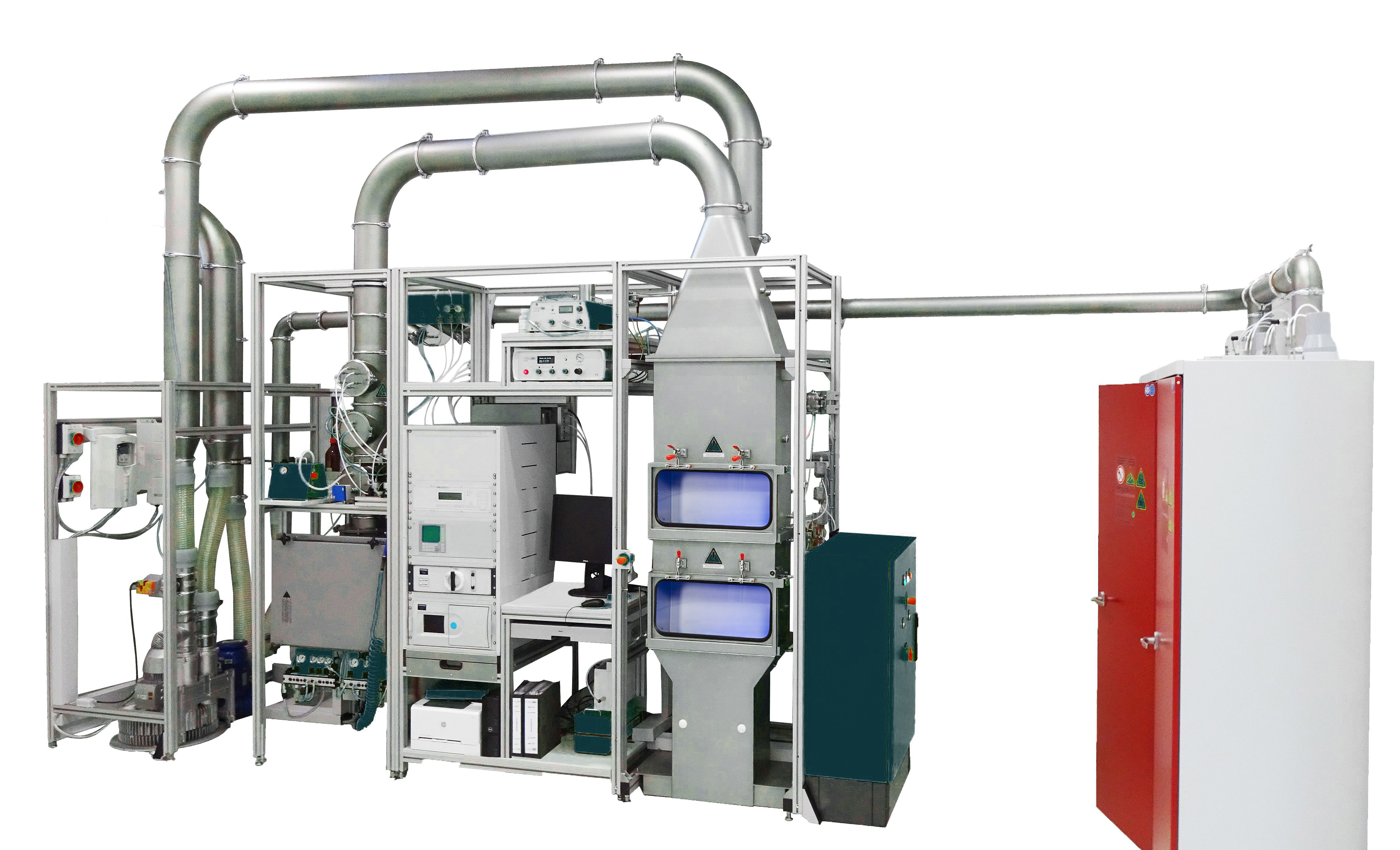
Test System for both particle separation and gas absorption/desorption of of air filters for passenger compartments (DIN 71460-1/2, ISO 11155-1/2). It povides a maximum of paramater testing for cabin air filters.
Features
standard compliant testing of filter media and filter elements
combined testing with particles and with gases
very flexible system configuration possible
Technical Data
| Parameter | Unit | Value |
|---|---|---|
| Test flow rate | m³/h | 70 … 700 |
| Test aerosol | – | DEHS, DOP, PAO, KCl, NaCl, etc. |
| Test gases | – | n-Butane 80 ppm, Toluene 80 ppm, Sulfur dioxide 30 ppm, Hydrogen sulfide 10 ppm |
| Measuring range, differential pressure | Pa | 0 … 1000 (± 2 %) |
| Test specimen dimensions | mm | max. 600 × 300 |
| Operating medium (gas/air) | – | Room air at standard test conditions (23°C ± 2 K; 50 % ± 2 % RH) |
| Power supply | – | 400 VAC / 3P / 75 A / 50 … 60 Hz and 3 × 230 VAC / 2P / 16 A / 60 Hz |
| Aerosol generation technology | – | Dust disperser SAG 410/L, Atomizer ATM 220, etc. |
| Aerosol conditioning technology | – | Electrostatic Aerosol Neutralizer EAN 581 |
| Aerosol measurement instruments | – | Aerosol spectrometer LAP 322 |
| Gas analysers | – | FID, NDIR |
| Sensors (others) | – | Temperature, relative humidity, absolute pressure |
| System dimensions (W × H × D) | mm | 3700 × 3000 × 3700 |
Principle of Operation
Defined airflow passes through the HEPA inlet filter and the test duct.
The test filter is installed in the adapter, ensuring easy insertion and observation.
Particle aerosols and specific gases are injected upstream of the filter.
Downstream, laser aerosol analyzers and gas analyzers measure particle concentrations and gas composition.
The system calculates fractional efficiency, dust loading, and adsorption/desorption curves.
The exhaust system ensures stable gas conditions and safe operation during filter replacement.
Software allows automated, repeatable testing and data recording/analysis.
Operating Instructions
Install the test filter using the dedicated adapter to ensure airtight sealing.
Set aerosol and gas flow rates and concentrations according to standards.
Turn on the exhaust system to maintain stable gas dosage and safe operation.
Calibrate sensors and gas analyzers before first use.
Use software-guided automated test procedures, or manual mode for research and calibration.
Maintain stable temperature and humidity to ensure accurate gas adsorption measurements.
Testing Procedure
Mount the filter in the adapter and confirm airtight sealing.
Set particle and gas flow rates/concentrations; start the exhaust system.
Start the automated test via software control.
Measure differential pressure, dust accumulation, and fractional efficiency.
Gas analyzers record downstream concentrations to generate adsorption/desorption curves.
After the test, move the filter to a safe area; the software generates a test report.
Export data for long-term analysis, statistics, and compliance verification.
FAQ
1.What is this product?
This system is an integrated test platform for automotive cabin air filters and filter media, capable of evaluating particle filtration efficiency, dust holding capacity, and gas adsorption/desorption performance.
2.What is this product used for?
It is used for R&D, quality control, production verification, and standard compliance testing of cabin air filters and filter media, covering both particulate and gaseous contaminants.
3.Why is this product important?
Ensures that cabin air filters provide effective protection against particles, VOCs, and harmful gases, supporting passenger health and meeting regulatory standards.
4.What industries is this product suitable for?
Automotive manufacturers, filter suppliers, third-party testing laboratories, and research institutions focused on HVAC, filtration, and air quality.
5.What types of this product are available?
The system is modular and configurable, supporting different filter designs, sizes, and testing modes including particle-only, gas-only, or combined particle and gas testing.
