




Search keywords:
product name, product type, model number,
test method, manufacturer, technique, application
-
Cone Calorimeter
The import of American VTEC, cone calorimeter ultra high cost performance
more
-
Digital Elmendorf Tearing Tester
Pendulum method test material tear strength, operating more simple, more accurate data
more
-
ZwickiLine Materials testing machines
Top of the world's leading universal material testing machine
more
Air Intake Filter Test System
BACK

Standards:
(1) ISO 5011 – Air filter test for combustion engines and industrial machinery. (2) ISO 12103-1 – Test dust (fine and coarse) for filter efficiency evaluation. (3) ISO 10263 – Dust retention testing and gravimetric efficiency.
Applications:
This system is used for:
Engine Air Intake Filters: Testing filtration performance according to ISO 5011.
Industrial Air Filters: Performance testing for machinery intake filters.
Customer-Specific Standards: Flexible adaptation for custom test requirements.
Quality Control & R&D: Evaluating filter efficiency, dust holding capacity, and airflow restriction.
Product Information:
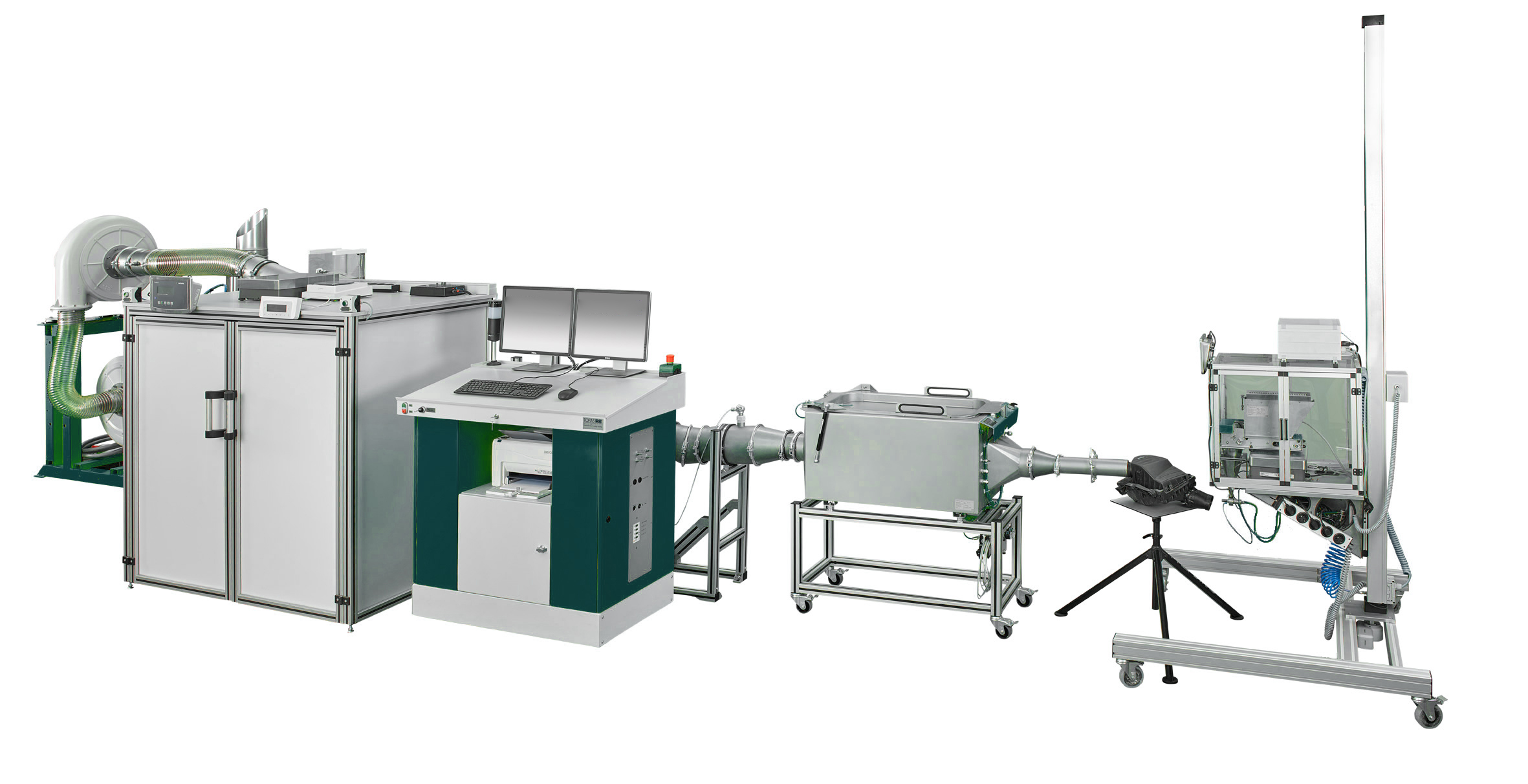
The Air Intake Filter Test System is designed for testing industrial air filters and engine air filters according to ISO 5011. It evaluates filters’ performance for combustion engines and industrial machinery, providing precise measurements of pressure, dust loading, and particle filtration efficiency. The system supports both standard ISO testing and customer-specific protocols.
Parameters
| Parameter | Unit | Value |
|---|---|---|
| Test Flow Rate | m³/min | 2 … 50 (at 20°C and 1013 hPa) |
| Differential Pressure Measuring Range | Pa | ≤ 15,000 |
| Compressed Air Supply | bar | 6 |
| Power Supply | – | 400 VAC, 125 A |
| Test Aerosol | – | ISO 12103-1 A2 (fine), ISO 12103-1 A4 (coarse) |
Features
Powerful Two-Stage Flow Generation: Provides stable and adjustable airflow for a wide range of filters.
Precise Flow Rate Measurement: Flow adjustable for each application and standard.
Mass Flow Regulated Dust Dosing: Ensures accurate dust loading for consistent testing.
High Automation: Test runs are mostly automated, including data collection, operator guidance, and report generation.
Comprehensive Filter Evaluation: Measures differential pressure, airflow restriction, dust loading, gravimetric efficiency, and downstream particle size distribution.
Accessories
| Accessory | Description |
|---|---|
| Water Injection System | For humidification and testing under specific conditions |
| Water Separators | Ensures clean airflow and prevents moisture interference |
| Additional Pressure Sensors | Measure complete air inlet system pressure |
| Particle Measurement | Downstream particle counting for efficiency assessment |
| Scavenging Line | Removes residual dust and ensures safe operation |
Test Principle
The system draws a controlled airflow through the filter sample while injecting standardized dust (ISO 12103-1). Differential pressure, airflow restriction, dust loading, and gravimetric efficiency are continuously measured. Downstream particle counters monitor the filtration efficiency in real time. The system automatically adjusts dust dosing and flow rate to achieve repeatable and standardized results.
Operation Instructions
Safety:
Ensure proper connection of electrical and compressed air supplies.
Maintain ventilation during aerosol use.
Use personal protective equipment when handling dust or testing high-flow systems.
Setup:
Mount filter sample securely using the appropriate adapter.
Select aerosol type and configure flow and differential pressure settings.
Calibrate sensors before each test cycle.
Testing:
Start the automated test sequence.
The system regulates flow, dust dosing, and monitors differential pressure.
Data are recorded and saved automatically for analysis.
Post-Test:
Analyze differential pressure curves, dust loading, gravimetric efficiency, and particle size data.
Generate standardized reports for quality control and certification purposes.
Maintenance Information
Regularly inspect dust generation and dosing systems.
Calibrate differential pressure and flow sensors periodically.
Clean the scavenging line and filter holder to prevent contamination.
Ensure automation software and data logging systems are updated.
FAQ
1.What is this product?
It is a test system for engine and industrial air intake filters, evaluating airflow, dust loading, and filtration efficiency.
2.What is this product used for?
It tests filters for compliance with ISO 5011 and other custom standards, supporting R&D and quality control.
3.How does the test system work?
Standardized dust is injected into airflow passing through the filter; differential pressure, dust loading, and particle efficiency are measured continuously.
4.Why is this product important?
Ensures filters meet airflow and filtration requirements, protecting engines and industrial machinery while supporting regulatory compliance.
5.Which industries use this product?
Automotive, heavy machinery, industrial equipment, and filtration component manufacturers.
