




Search keywords:
product name, product type, model number,
test method, manufacturer, technique, application
-
Cone Calorimeter
The import of American VTEC, cone calorimeter ultra high cost performance
more
-
Digital Elmendorf Tearing Tester
Pendulum method test material tear strength, operating more simple, more accurate data
more
-
ZwickiLine Materials testing machines
Top of the world's leading universal material testing machine
more
Filter media test rig according to ISO 16890
BACK

Standards:
The system can execute and complies with: (1) ISO 16890 – Air filter classification standard. (2) ISO 29463 – High-efficiency filter performance standard (EPA/HEPA/ULPA). (3) ISO 5011 – Engine and industrial machinery air filter testing. (4) ISO/TS 11155-1 – Automotive air filter performance testing. (5) ISO 11057 – Clean air filter media performance testing. (6) VDI 3926-2 – Characterization of cleanable filter media. (7) EN 779 – High-efficiency air filter testing. (8) ASHRAE 52.2 – Air filter performance standard. (9) DIN 71460-1 – Automotive intake filter performance testing.
Applications:
The system is applicable for:
(1) Cleanable Filter Media: Testing in accordance with VDI 3926-2.
(2) Air Filter Testing:
- General air filters (ISO 16890, EN 779, ASHRAE 52.2)
- High-efficiency filters (EPA, HEPA, ULPA, ISO 29463)
- Cabin air filters (DIN 71460-1 / ISO/TS 11155-1)
- Engine intake filters (ISO 5011)
(3) Filter Media Development and Optimization: Laboratory and R&D testing.
(4) Quality Assurance: In-line production monitoring and final inspection.
(5) Flat Media Quality Control: Pre-processing or post-production inspection of planar media.
Product Information:
The Filter Media Test Rig is designed for characterization of filter media and small-scale filter elements according to various standards. It measures key parameters such as differential pressure, gravimetric separation efficiency, fractional efficiency, and dust loading capacity. Reliable and repeatable testing is critical for development, optimization, and quality assurance of filter media.
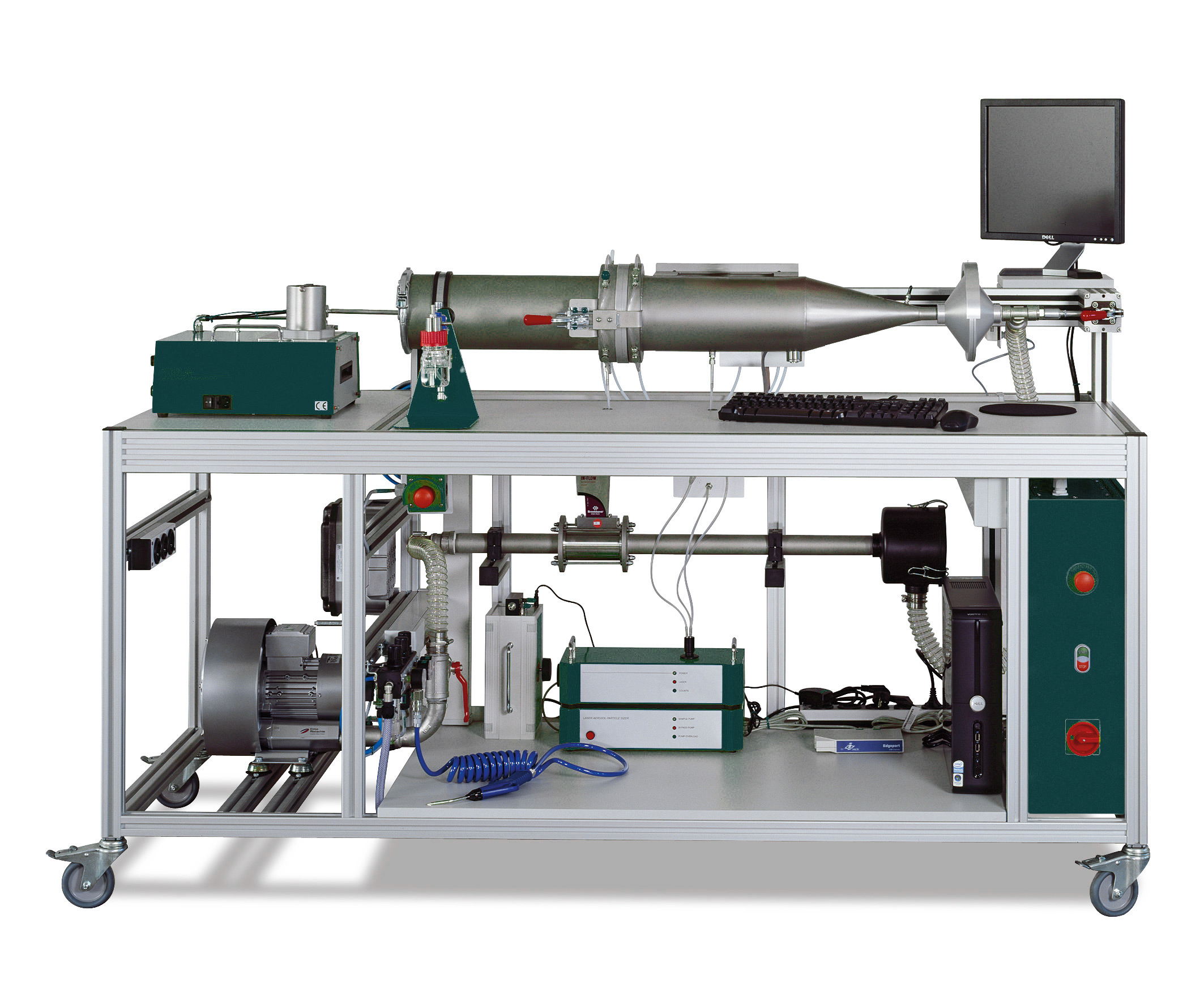
Parameters
| Parameter | Unit | Value |
|---|---|---|
| Test Flow Rate | m³/h | 0.4 … 40 or 2 … 64 |
| Test Aerosol | – | Custom (DEHS, paraffin oil, NaCl, PSL, etc.) |
| Test Specimen Dimensions | mm | Diameter ≤ 150 |
| Operating Gas/Air Supply | – | Laboratory air; compressed air 6 bar |
| Power Supply | – | 400 VAC, 16 A |
| Ambient Temperature | °C | 0 … 50 |
| Relative Humidity | % | 0 … 100 |
| System Dimensions (W × H × D) | mm | 2100 × 1400 × 850 |
| Weight | kg | approx. 300 |
Features
Multi-Aerosol Capability: Supports solid (DEHS, NaCl) and droplet aerosols (paraffin oil).
Flexible & Expandable Design: Rapid modification and future upgrades.
Variable Flow Range: Adaptable for different media sizes and types.
Optimized Component Matching: Ensures peak system performance and compatibility.
User-Friendly Control Software: Win-based interface for easy data acquisition and test control.
Accessories
| Accessory | Quantity |
|---|---|
| Dust Generator | 1 |
| Aerosol Generator | 1 |
| Laser Aerosol Spectrometer | 1 |
| Particle Counter | 1 |
| Additional Aerosol Generator | 1 |
Test Principle
Differential Pressure Testing: Filter media is securely mounted in a test fixture. Differential pressure across the filter is measured to determine filtration efficiency and dust loading.
Fractional Efficiency Measurement: Optical particle counters measure filtration efficiency from 0.2 to 10 µm. Sample switching units ensure single-device measurement.
Dust Loading & Capacity: Measures pressure increase under varying dust loads; filter weight is recorded electronically to ensure accuracy.
Operation Instructions
System Startup:
- Verify all connections (air, power, aerosol generator) and calibrate equipment.
- Configure test parameters (aerosol type, flow range) and start the system.
Safety:
- Avoid direct contact with aerosols; wear gloves and safety glasses.
- Monitor differential pressure, flow rate, and system status.
Filter Replacement:
- Use the fixture to remove or replace filter media safely and efficiently.
Experimental Procedure
Preparation:
- Set test conditions according to selected standards (ISO 16890, EN 779, etc.).
- Install and secure filter media in the test fixture.
Testing:
- Start the system; automated measurement of differential pressure, fractional efficiency, and dust loading.
- System adjusts flow and aerosol concentration as needed.
Data Recording & Reporting:
- After completion, generate test reports including differential pressure curves, fractional efficiency, and dust loading.
- Export data for analysis and documentation.
Maintenance Information
Regularly clean and calibrate aerosol generators and particle counters.
Check airflow and differential pressure sensors periodically.
Keep system components free of dust and contamination.
FAQ
1.What is this product?
It is a test system for characterization of filter media and small-scale filter elements.
2.What is it used for?
For evaluating filtration efficiency, dust loading, and fractional efficiency for R&D, production, and QA.
3.Which standards does it support?
ISO 16890, ISO 29463, ISO 5011, ISO/TS 11155-1, ISO 11057, VDI 3926-2, EN 779, ASHRAE 52.2, DIN 71460-1.
4.Why is this product important?
Ensures consistent, repeatable filter media performance, crucial for product development and quality control.
5.Which industries use this product?
HVAC, automotive cabin filtration, engine intake filters, industrial air cleaning, and laboratory R&D.
