




Search keywords:
product name, product type, model number,
test method, manufacturer, technique, application
-
Cone Calorimeter
The import of American VTEC, cone calorimeter ultra high cost performance
more
-
Digital Elmendorf Tearing Tester
Pendulum method test material tear strength, operating more simple, more accurate data
more
-
ZwickiLine Materials testing machines
Top of the world's leading universal material testing machine
more
Aerosol Sensor Test System
BACK

Standards:
This system complies with and supports: (1) GB/T 14295-2019 – Air filters. (2) GB/T 13554-2020 – High-efficiency air filters. (3) GB/T 6165-2021 – HEPA filter performance: efficiency and resistance. (4) ISO 11057 – Filter media performance testing. (5) EN 1822-4 – HEPA filter testing. (6) ISO 29463-4 – High-efficiency air filter performance. (7) ASTM D6830 – Evaluation standard for air filters.
Applications:
(1) PM Sensor Calibration and Quality Assurance: For production-line calibration and quality control of PM sensors.
(2) PMx and PNx Sensor Development: Supports development and performance testing of fine particle sensors.
(3) Sensor Aging Studies: Investigation of long-term performance and aging behavior of sensors.
(4) Aerosol Technology Research: Supports fundamental research in aerosol measurement and instrumentation.
Product Information:
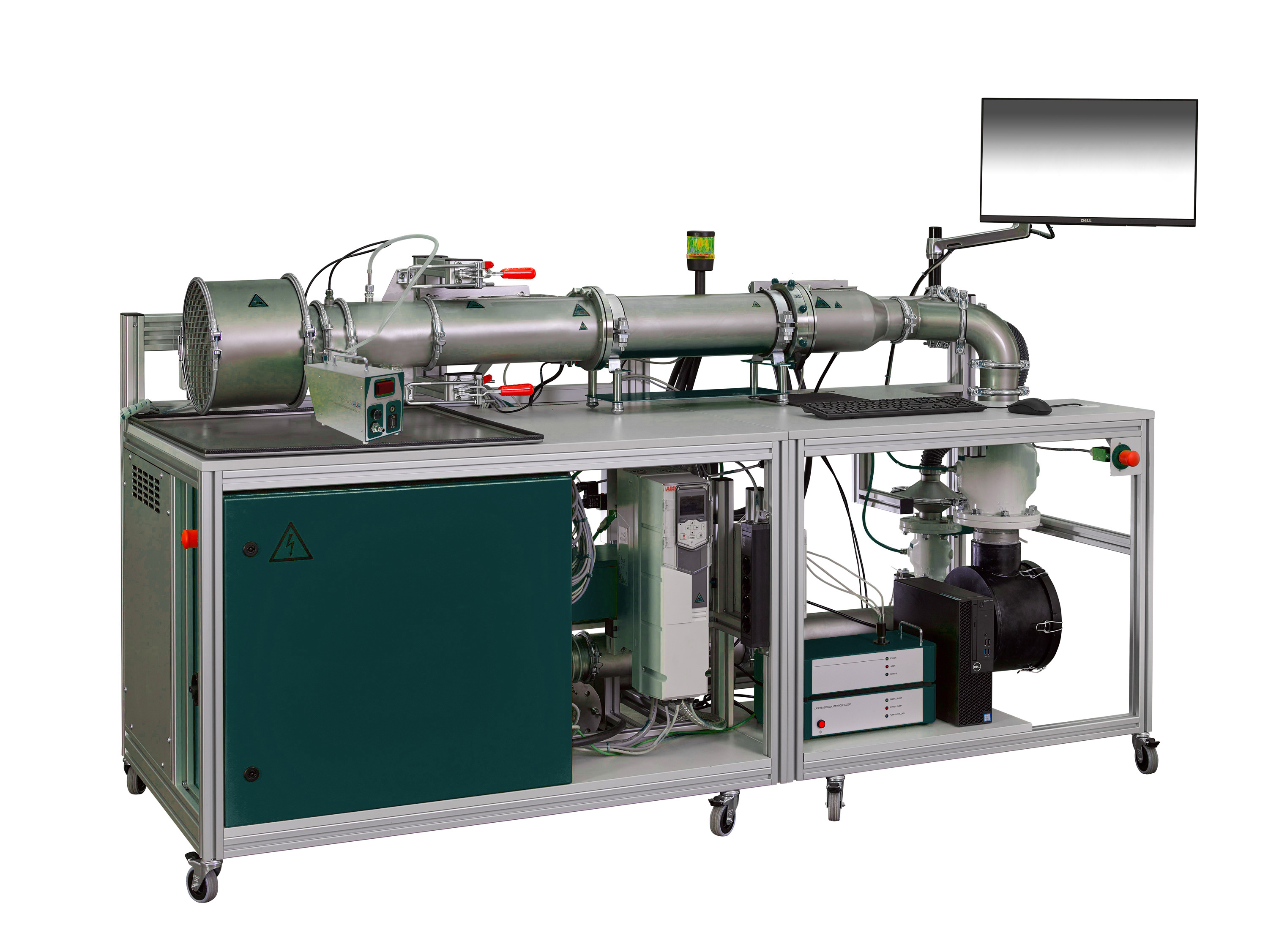
The Aerosol Sensor Test System is designed for development, testing, and calibration of active and passive aerosol sensors, including PM and PN sensors. It combines features from filter media test systems with flexible sensor integration and broad flow ranges, enabling accurate evaluation of particle mass or number concentration. The system can be configured with two measurement sections to cover flow rates from 0.8 m³/h to 450 m³/h.
Parameters
| Parameter | Unit | Value |
|---|---|---|
| Test Flow Rate | m³/h | 0.8 – 450 |
| Test Concentration | µg/m³ | 5 – 1000 (at 100 m³/h) |
| Test Medium Differential Pressure | Pa | ≤ 10000 (for 450 m³/h) |
| Gas/Air Supply | – | Compressed air, max. 10 bar |
| Power Supply | – | 400 VAC, 25 A |
| Particle Measurement | – | Customer-specified (e.g., LAP 323) |
| Sensors | – | Differential pressure, temperature, relative humidity, absolute pressure |
| Duct Diameter | mm | 150 (internal) |
| System Dimensions (W × H × D) | mm | 2300 × 1500 × 900 |
| Weight | kg | approx. 400 |
Features
Stable and Adjustable Aerosol Generation: Provides consistent aerosol concentrations across variable flow rates.
Solid and Liquid Aerosol Capability: Supports both types of aerosols to meet diverse test requirements.
Customer Customization: Adapts to different sensors, sample holders, and measurement configurations.
Broad Application Range: Suitable for PM and PN sensor calibration, testing, and development.
Fully Integrated System: Seamless integration with external equipment for optimal performance.
User-Friendly Software Control: Win-based interface for simplified operation, data acquisition, and result analysis.
Accessories
| Accessory | Quantity |
|---|---|
| Aerosol Generator | 1 |
| Laser Aerosol Particle Spectrometer | 1 |
| Sample Holder | As required |
| Customer-Specified Sensors/Equipment | As required |
Test Principle
Aerosol Generation: Aerosol is generated via a dedicated generator and distributed evenly in the measurement duct.
Sensor Integration and Testing: Customer PM sensors are integrated and tested, with reference measurements using laser aerosol spectrometers.
Aerosol Concentration Measurement: Upstream and downstream particle concentrations are monitored in real time.
Multi-Segment Measurement: Optional dual-section configuration supports different flow ranges for comprehensive sensor evaluation.
Operation Instructions
System Startup:
- Check power, air supply, and aerosol generator.
- Configure test parameters including flow rate, aerosol type, and sensor setup.
Testing Process:
- Install sensors into sample holders.
- Start the test; the system automatically generates aerosol, measures particle concentrations, and evaluates sensor performance.
Data Recording and Reporting:
- Win software records all test data and generates detailed reports for quality control and further analysis.
Experimental Procedure
Preparation Stage:
- Configure all devices, including aerosol generator, sensors, and flow measurement instruments.
- Ensure ducts and sample holders are correctly installed.
Testing Stage:
- Start the system; automated measurement of particle concentrations, sensor calibration, and performance evaluation occurs.
Result Analysis and Reporting:
- Software generates reports including sensor efficiency, differential pressure response, and other key parameters.
Maintenance Information
Regularly check aerosol generators, sensors, and measurement devices.
Ensure calibration of flow and particle measurement instruments.
Keep ducts and sample holders clean to maintain consistent results.
FAQ
1.What is this product?
A test system for calibration, development, and quality control of aerosol sensors.
2.What is it used for?
For PM and PN sensor testing, including efficiency, particle concentration, and aging studies.
3.Which standards does it support?
ISO 11057, EN 1822-4, ISO 29463-4, ASTM D6830, and GB/T 14295-2019.
4.Why is this product important?
It ensures accurate, repeatable evaluation of sensor performance under controlled aerosol conditions.
5.Which industries use this product?
Environmental monitoring, automotive, HVAC, cleanroom instrumentation, and aerosol research laboratories.
