




Search keywords:
product name, product type, model number,
test method, manufacturer, technique, application
-
Cone Calorimeter
The import of American VTEC, cone calorimeter ultra high cost performance
more
-
Digital Elmendorf Tearing Tester
Pendulum method test material tear strength, operating more simple, more accurate data
more
-
ZwickiLine Materials testing machines
Top of the world's leading universal material testing machine
more
Automated Filter Element Test System
BACK

Standards:
(1) GB/T 14295-2019 – Air filters. (2) GB/T 13554-2020 – High-efficiency air filters. (3) GB/T 6165-2021 – HEPA filter performance testing: efficiency and resistance. (4) ISO 29463-4 – High-efficiency air filter performance. (5) ISO 16890 – Air filter performance standard. (6) EN 1822 – HEPA and ULPA filter performance testing. (7) ISO 5011 – Engine air intake filter testing.
Applications:
production control of integral separation efficiency of exhaust particle filters (GPF, DPF)
quality control of HEPA filters or filter cartridges of e.g. industrial vacuum systems
research and development on any small air filter elements
Product Information:
Test System for production control of filter elements (e.g. exhaust filter, HEPA filter)
For the purpose of 100% inspection of the integral filter separation efficiency during production, especially for exhaust filters and HEPA filters used in vacuum cleaners and mobile air cleaners.
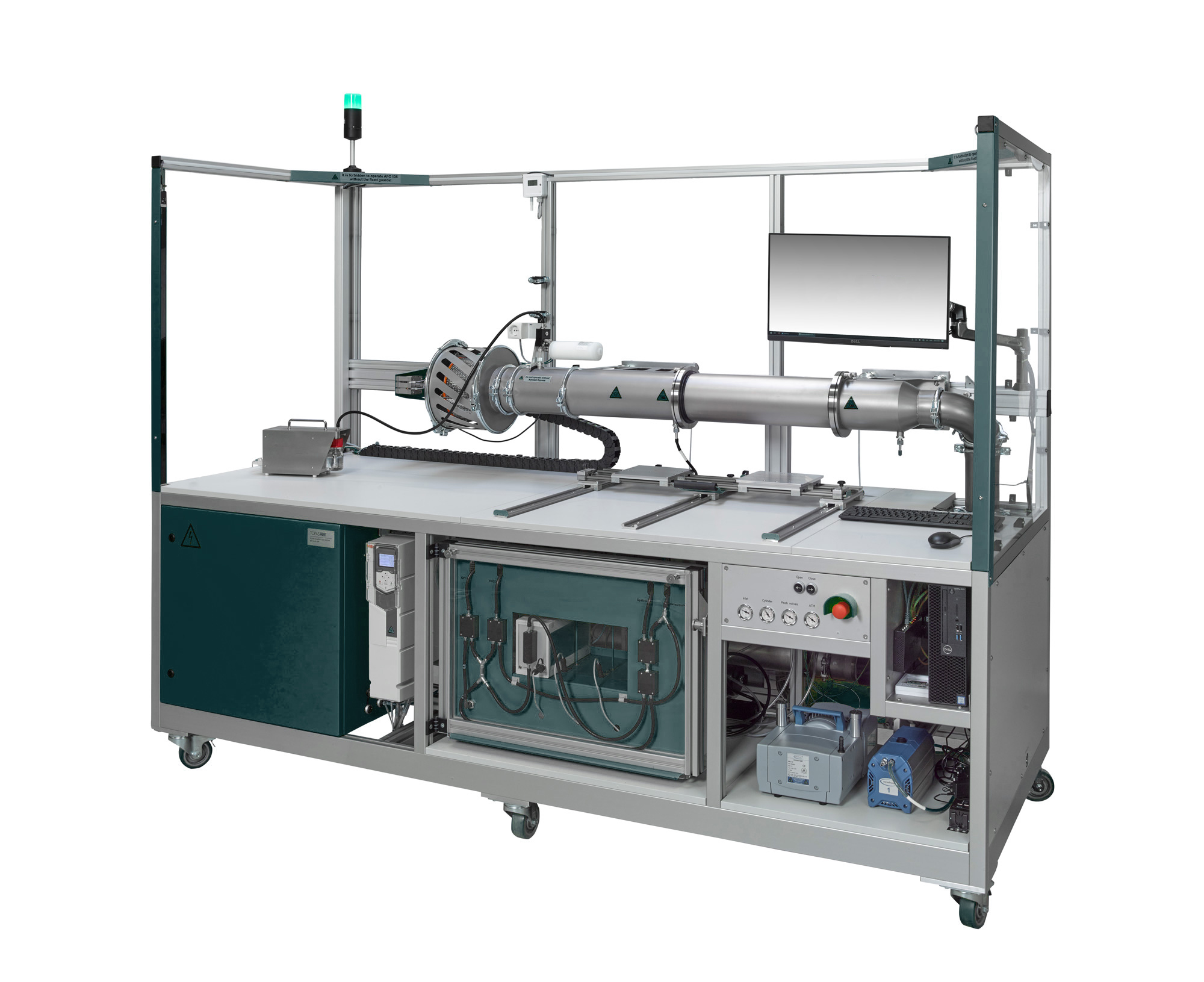
Production control demands for short test cycles while using robust, compact, service-reduced and safe technologies. A test cycle includes therefore the supply, the analytical characterisation and the re-moval of the test specimen. Due to its measurement concept and high degree of automatisation, the system enables reliable testing with measurement times of 30 s.
To ensure a full traceability, determined test data can be integrated directly into in-house databases by combining the filter test system with techniques for test specimen identification (e.g., bar code or QR code scanner).
Principle
A defined volumetric flow rate is sucked by a controlled blower from the environment through a HEPA inlet filter, the test duct and a safety filter. The test duct is composed of three functional sections, i.e., sections for i) the generation and characterisation of the test aerosol (upstream aerosol), ii) the incorporation of the test specimen (specimen adapter) and iii) the characterisation of the downstream aerosol.
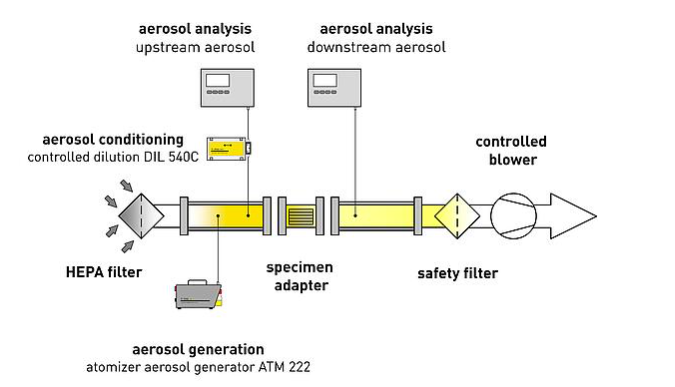
Technical data
| Parameter | Unit | Value |
|---|---|---|
| Test flow rate | m³/h | 40 … 440 (up to 1200 optional) |
| Measuring range, particle size (OPC) | µm | 0.1 … 1.0 |
| Measuring range, particle size (CPC) | µm | 0.001 … 1.0 |
| Test cycle duration | s | approx. 30 |
| Test aerosol | – | Customer-specific (e.g., DEHS or others) |
| Dimensions of test specimen | – | Diameter ≤ 300 mm; Length ≤ 850 mm |
| Compressed air supply | bar | 4.0 … 6.0 |
| Power supply | – | 3 × 400 VAC, hard-wired; rated current 30 A; pre-fuse 32 A |
| Inner diameter of duct | mm | 150 |
| Aerosol-analytical instruments | – | Customer-specific (e.g., OPC, CPC, etc.) |
| Integrated sensors | – | Temperature, relative humidity, air pressure |
| Dimensions (W × H × D) | mm | 2800 × 2100 × 1200 |
| Weight | kg | approx. 800 |
Features
24/7 Operation: Automated safety features for continuous production.
Short Test Cycle: Complete aerosol supply, analysis, and sample removal within ~30 seconds.
Flexible Quality Standards: Adjustable separation efficiency and pressure drop thresholds.
Minimal Sample Load: Reduces stress on test samples, extending product life.
High Automation and Efficiency: Minimizes operator intervention, improves throughput.
Full Traceability: Barcode/QR code integration ensures complete production tracking.
Benefits
test system designed for 24/7 operation with automated safety functions
short test cycles (supply, analysis, removal) for separation efficiency and pressure drop
quality criteria for separation efficiency and pressure drop are freely configurable
minimal loading of test specimen (higher lifetime of products)
Accessories
| Accessory | Quantity |
|---|---|
| Aerosol Particle Spectrometer | 1 |
| Custom Filter Adapter | 1 |
| Test System Software | 1 |
Operation Instructions
System Startup:
- Ensure all devices are operational (aerosol generator, particle counters, fans).
- Calibrate aerosol measurement instruments and configure test parameters.
Testing Process:
- Start the test; the system automatically generates aerosol and measures separation efficiency and pressure drop.
Data Recording and Reporting:
- The system software generates and stores test reports, including separation efficiency, pressure drop, and relevant quality data.
Experimental Procedure
Preparation Stage:
- Verify all instruments and devices are ready and calibrated.
- Install the filter element in the custom adapter and confirm settings.
Testing Stage:
- Automated measurement of aerosol concentration, particle filtration efficiency, and pressure drop occurs.
Result Analysis and Reporting:
- Reports are automatically generated, including key metrics and compliance with production quality standards.
Maintenance Information
Regularly check aerosol generators, particle counters, and sensors.
Ensure software and database connections are functioning properly.
Maintain clean ducts and adapters to guarantee measurement accuracy.
FAQ
1.What is this product?
A fully automated test system for production control of filter elements, including exhaust and HEPA filters.
2.What is it used for?
To measure overall separation efficiency, pressure drop, and ensure quality during production.
3.Which standards does it support?
ISO 29463-4, ISO 16890, EN 1822, ISO 5011, GB/T 14295-2019, GB/T 13554-2020, GB/T 6165-2021.
4.Why is this product important?
It ensures fast, reliable, and traceable quality control of filter elements in production.
5.Which industries use this product?
Automotive, industrial air purification, vacuum cleaner production, and HEPA filter manufacturing.
