




Search keywords:
product name, product type, model number,
test method, manufacturer, technique, application
-
Cone Calorimeter
The import of American VTEC, cone calorimeter ultra high cost performance
more
-
Digital Elmendorf Tearing Tester
Pendulum method test material tear strength, operating more simple, more accurate data
more
-
ZwickiLine Materials testing machines
Top of the world's leading universal material testing machine
more
Oil Thread Leak Test System
BACK

Standards:
This system complies with or supports testing according to the following international standards: (1) ISO 16890-2: Air filters for general ventilation – Part 2 (2) ISO 16890-3: Air filters for general ventilation – Part 3: Efficiency testing (3) ISO 16890-4: Air filters for general ventilation – Part 4 (4) ASHRAE 52.2: Method of Testing General Ventilation Air-Cleaning Devices (5) EN 779: Particulate air filters for general ventilation (6) ISO 10121-3: Cleanroom air filter testing
Applications:
integral visual leak testing of HEPA/ULPA filters
Product Information:
Test System for oil thread leak test of HEPA filter according to ISO 29463-4 (EN 1822-4). The oil thread test mentioned in ISO 29463-4 (1822-4), annex A is used for visual proof of the absence of leakage of HEPA filters. This simple quality test procedure may be an alternative to the scan method.
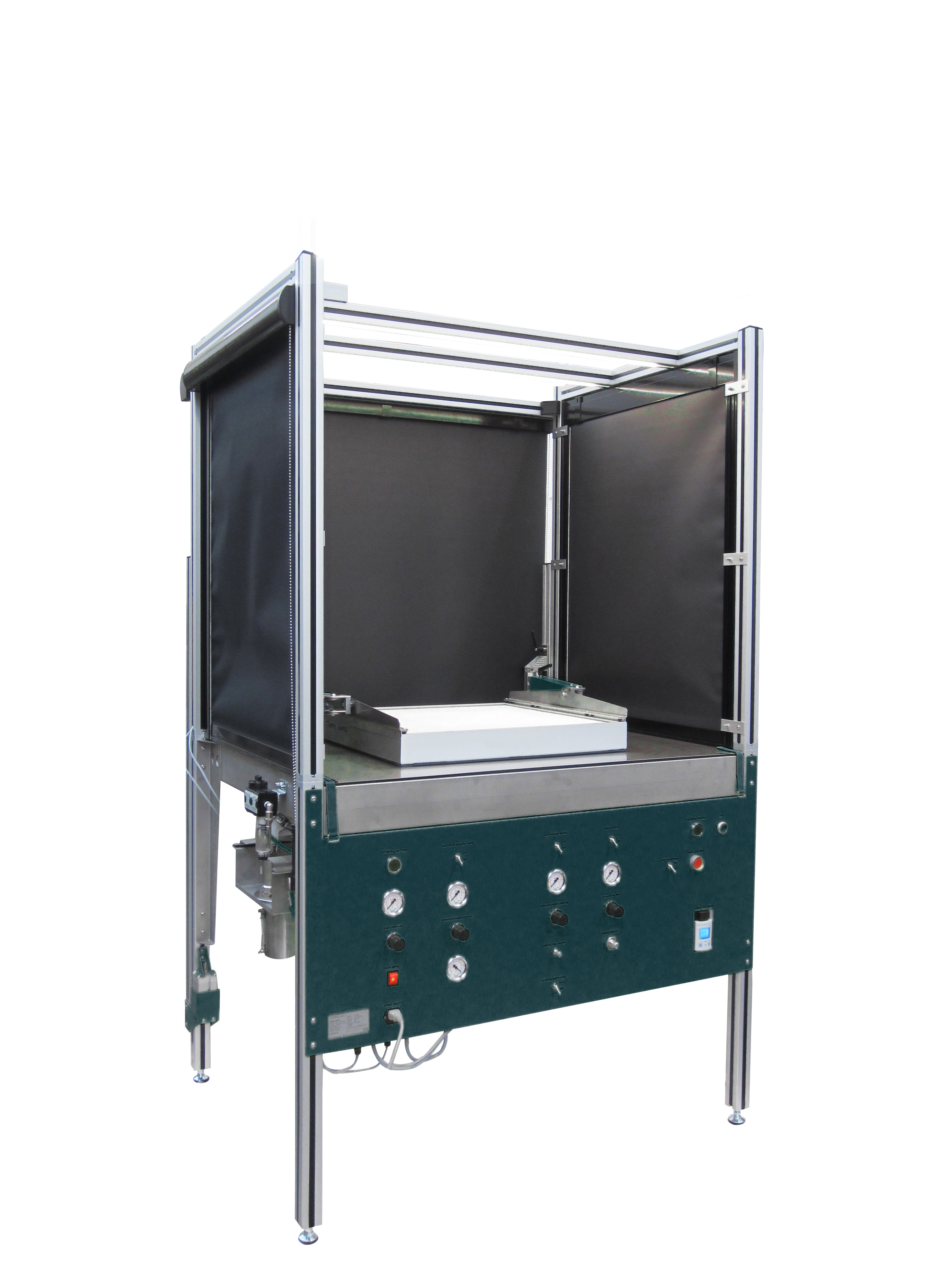
The oil thread test (DOP Test) is also applicable if the scan method is not fully applicable because of the filter design (e.g. V-shaped arrangements).
Benefits
cost-effective solution for leak testing of filters ranging up to group H (filter class H13 and H14)
easy manual operation
constant test conditions due to pre-adjustable test parameters
effective testing of larger numbers with pre-adjusted test parameters
flexible and easily configurable filter holder for different filter dimensions
Principle
The filter element (sample) is mounted horizontally with the upstream side down on the test bench and secured with a pneumatically operated fixing device. For testing, the filter is then exposed to a flow of a polydisperse aerosol of oil droplets (DEHS).
An existing leak is made visible on a rising oil thread on the downstream side (upper side) of the filter.
Technical data
| Parameter | Unit | Value |
|---|---|---|
| Test flow rate | L/min | 50 … 600 |
| Dimensions of test specimen (W × H × D) | mm | min. 305 × 305 × 30 / max. 915 × 800 × 300 |
| Operating medium (aerosol substance) | – | DEHS |
| Compressed air supply (operating gas/air) | bar | 6 |
| Power supply | – | 230 VAC, 1 A |
| System dimensions (W × H × D) | mm | 1200 × 610 × 910 |
| Weight | kg | approx. 100 |
Accessories
Housing and Lightning
Operation Instructions
System Setup: Mount filter horizontally in the pneumatic holder. Confirm compressed air and electrical supply.
Parameter Adjustment: Set aerosol flow and test duration according to filter size.
Test Execution: Apply DEHS aerosol to the upstream side. Observe downstream for rising oil threads indicating leaks.
Data Recording: Record visual inspection results manually; optionally photograph for documentation.
Safety: Ensure aerosol is contained, and personnel avoid direct contact.
Experimental Procedure
Preparation: Install filter and confirm all connections.
Testing: Start aerosol flow; monitor for visual leak indications.
Observation & Analysis: Inspect downstream side for oil threads; identify leak positions.
Reporting: Document results and store for quality control or production records.
Post-Test: Clean system, prepare for next sample.
Maintenance Information
Check pneumatic holder functionality and seals regularly.
Clean aerosol generator and bench after each test.
Replace DEHS supply and consumables as needed.
Inspect lighting and protective housing to maintain clear visibility.
FAQ
1.What is this product?
A manual visual leak test system for HEPA and ULPA filters.
2.What is it used for?
Detects leaks visually using an oil thread (DOP) on the downstream side of filters.
3.Which standards does it support?
ISO 29463-4 (EN 1822-4), ISO 16890, ASHRAE 52.2, EN 779.
4.Why is this product important?
Provides a simple, fast, and cost-effective alternative to scanning methods for filter leak testing.
5.Which industries use this product?
Cleanrooms, laboratories, HVAC, air purification, and filter manufacturing.
