




Search keywords:
product name, product type, model number,
test method, manufacturer, technique, application
-
Cone Calorimeter
The import of American VTEC, cone calorimeter ultra high cost performance
more
-
Digital Elmendorf Tearing Tester
Pendulum method test material tear strength, operating more simple, more accurate data
more
-
ZwickiLine Materials testing machines
Top of the world's leading universal material testing machine
more
Cabin Air Filter Test System(Particulate Filtration)
BACK

Standards:
(1) GB/T 32085.1 — Automotive Air Conditioning Filters — Part 1: Dust Filtration Test (2) ISO/TS 11155-1 — Road Vehicles — Cabin Air Filters — Part 1: Dust Filtration Test (3) DIN 71460-1 — Road Vehicles — Passenger Compartment Air Filters — Part 1: Particulate Filter Test Methods
Applications:
Differential pressure test
Analysis of fractional separation efficiencydust loading tests
Combined analyses according to DIN 71460-1 (ISO/TS 11155-1)
Customised tests
Product Information:
Test system for testing particle separation of air filters for passenger compartments (DIN 71460-1, ISO/TS 11155-1). With the test system for cabin air filters acc. to DIN 71460-1 (particle filtration) all relevant filter performance parameters such as differential pressure drop, gravimetric or fractional filtration efficiency and dust holding capacity are determined.
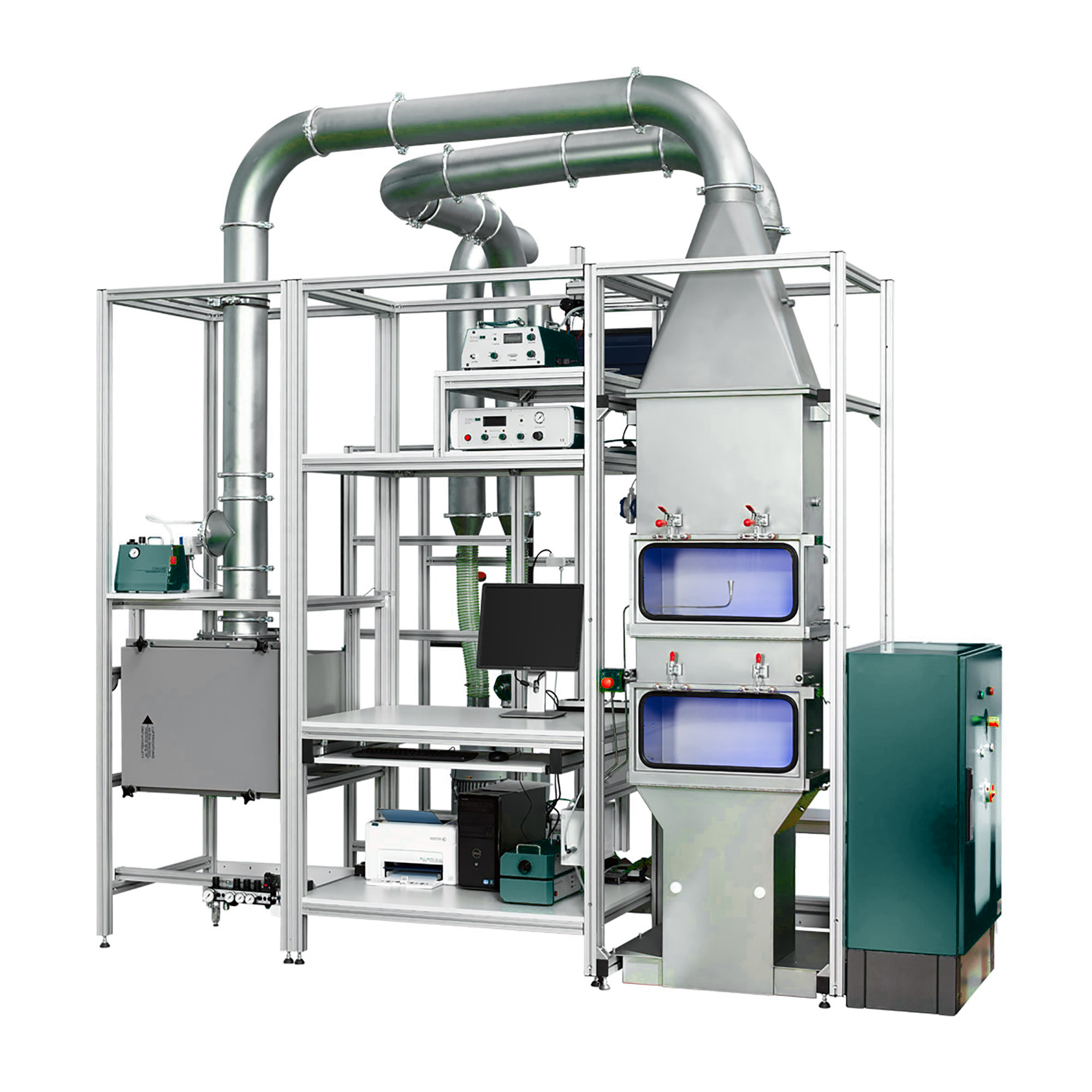
The setup and configuration of the test system as well as the required test procedures are described in the standards DIN 71460-1 and ISO/TS 11155-1 for motor vehicle passenger compartment particle filtration.
Tests acc. to standards DIN 71460-2 and ISO 11155-2 can be carried out using PAF 112 test system for adsorptive cabin air filters.
For filter tests acc. to standards DIN 71460-1, ISO/TS 11155-1 and DIN 71460-2, ISO 11155-2 Topas has designed PAF 113 filter test system combining all features of test systems PAF 111 and PAF 112.
Features
Standard compliant testing of filter elements and filter mediamodular setup and instrumentation
Design on different flow rate and differential pressure ranges
High degree of automation
Traceable test documentation
Technical data
| Parameter | Unit | Value |
|---|---|---|
| Test flow rate | m³/h | 70 … 700 (higher flow rates on request) |
| Measuring range, differential pressure | Pa | 0 … 1000 |
| Compressed air supply (operating gas/air) | bar | 6 |
| Power supply | – | – |
| Test specimen dimensions | – | max. 300 × 600 mm |
| Aerosol generation technology | – | Dust disperser SAG 410/L, Atomizer ATM 220 |
| Aerosol conditioning technology | – | Electrical Aerosol Neutralizer EAN 581 |
| Aerosol measurement technology | – | Aerosol spectrometer |
| Sensors | – | Differential pressure, absolute pressure, temperature, relative humidity |
| System dimensions (W × H × D) | mm | 4600 × 3400 × 1200 |
Accessories
Atomizer Aerosol Generator
Dust disperser
Laser Aerosol Spectrometer
Dilution system
Electrostatic Aerosol Neutralizer
Filter media adapter with sampling system
Additional pressure sensors
PAF111Win - test system control, data acquisition and processing software
Test Procedures
(1) Install the filter element or filter media sample and verify airtight sealing to prevent bypass leakage.
(2) Set the required test airflow according to the selected standard and allow the system to stabilize.
(3) Activate the aerosol generation system and adjust the concentration to the specified level.
(4) Measure upstream and downstream particle concentration and size distribution to calculate fractional filtration efficiency.
(5) Record the pressure drop across the filter simultaneously.
(6) For dust holding capacity tests, continuously load standard dust while monitoring pressure drop increase.
(7) Terminate the test when the specified end condition is reached and save all data.
(8) Generate and review the test report for performance evaluation and comparison.
Maintenance Information
Regularly calibrate airflow sensors, particle measurement instruments, and pressure transducers to maintain measurement accuracy.
Clean the test duct and aerosol paths after dust loading tests to prevent cross-contamination.
Inspect seals, adapters, and connections periodically to ensure system airtightness.
Replace protection filters and consumables according to usage conditions and standard recommendations.
Maintain the aerosol generators and neutralization devices in accordance with manufacturer guidelines.
FAQ
1.What is this product?
It is a laboratory test system for evaluating particulate filtration performance of automotive cabin air filters and filter media.
2.What is this product used for?
You use it to measure pressure drop, fractional filtration efficiency, dust holding capacity, and airflow characteristics under standardized conditions.
3.What is the working principle of this product?
The system introduces controlled airflow and standardized aerosols into a test duct, measures particle concentrations upstream and downstream of the filter, and calculates filtration performance while monitoring pressure drop.
4.Why is this product important?
It provides reliable and repeatable performance data essential for filter development, quality control, and compliance with automotive standards.
5.Which industries is this product suitable for?
It is suitable for automotive OEMs, cabin air filter manufacturers, material developers, research institutes, and third-party testing laboratories.
