




Search keywords:
product name, product type, model number,
test method, manufacturer, technique, application
-
Cone Calorimeter
The import of American VTEC, cone calorimeter ultra high cost performance
more
-
Digital Elmendorf Tearing Tester
Pendulum method test material tear strength, operating more simple, more accurate data
more
-
ZwickiLine Materials testing machines
Top of the world's leading universal material testing machine
more
Cabin Air Filter Test System(Gas Adsorption)
BACK

Standards:
(1) GB/T 32085.2-2015 — Automotive Air Conditioning Filters, Part 2: Gas Filtration Test (2) DIN 71460-2 — Road Vehicles — Cabin Air Filters, Part 2: Gas Filtration Test (3) ISO 11155-2:2009 — Road Vehicles — In-Cabin Air Filters, Part 2 (4) ISO 10121-1 / ISO 10121-2 — General Methods for Testing Air Filter Performance
Applications:
Evaluating gas adsorption and desorption performance of cabin air filter elements
Research and development of new filter media and performance optimization
Quality control and production inspection of cabin air filtration systems
Testing filters of various sizes and types
Simulating laboratory conditions for different gases (e.g., volatile organic compounds, sulfur compounds, ammonia)
Product Information:
The Filter Test System for gas adsorption/desorption of air filters for passenger compartments (DIN 71460-2, ISO 11155-2). The Adsorption Test Stand for air filters for passenger compartments is used for quantification of adsorption capacity or desorption behaviour of filters.
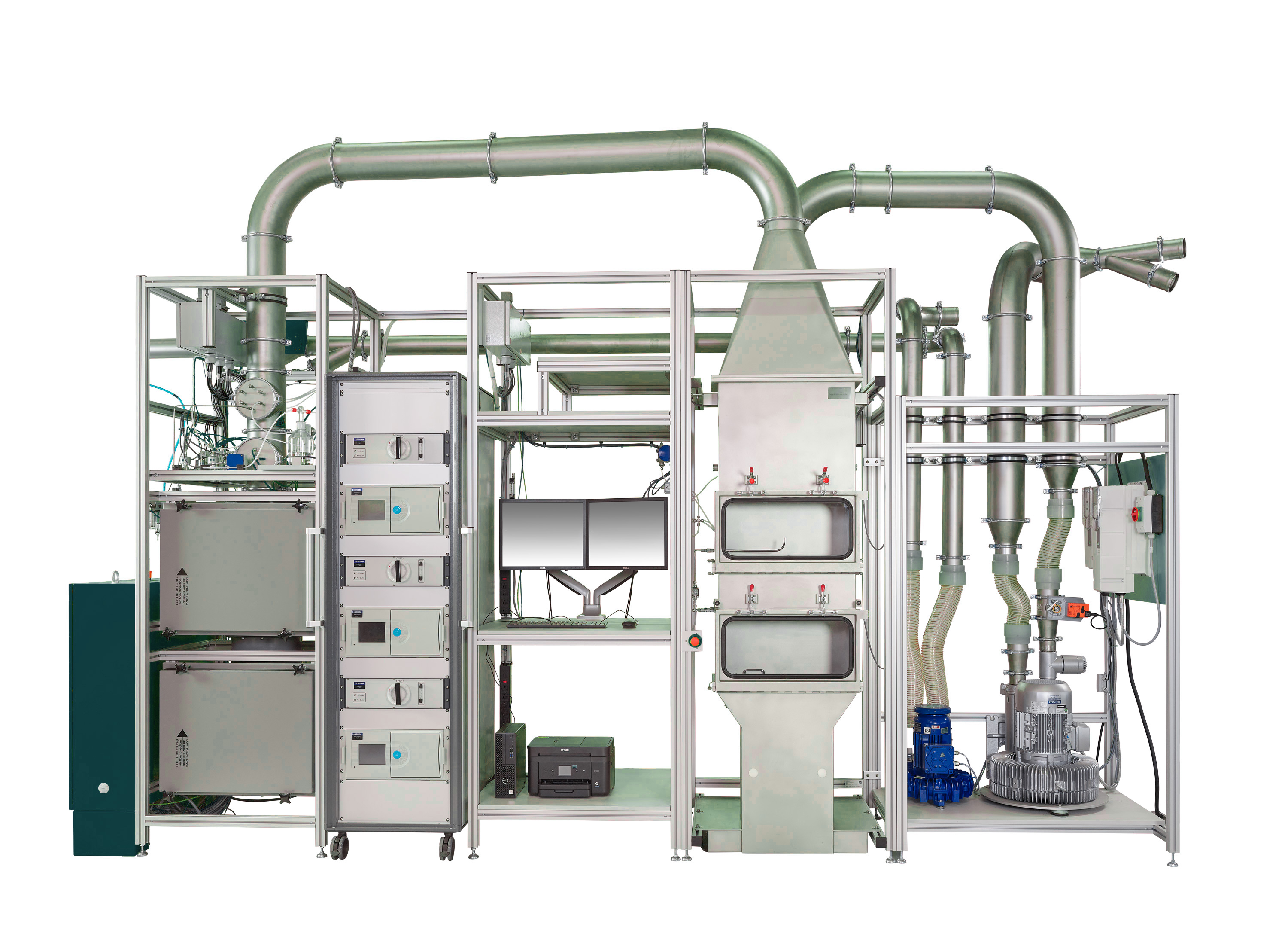
The design of the Adsorption Test Stand, the test procedure and data acquisition have been based on the draft standard DIN 71460-2 and ISO 11155-2 standard for measuring the dynamic gas adsorption.
The test section and associated ductwork are fabricated from stainless steel. Different sizes of filter media samples and elements can be tested and are mounted in a special adapter. A window in front of the test section allows visual observation of the sample during the test. A pair of mass flow controllers is used for dosing gaseous components from gas cylinders and a new, sophisticated, dosing unit for liquid gas components has been developed specifically for this application. This is based on evaporation of a droplet spray atomized by means of a two-stream nozzle fed from a µl-dosing pump. The gas concentration can be measured downstream of the filter. An exhaust system bypassing the test channel facilitates maintaining a very stable gas dosing.
Test acc. to standards DIN 71460-1 and ISO/TS 11155-1
For filter tests both acc. to standards DIN 71460-1, ISO/TS 11155-1 and E DIN 71460-2, ISO 11155-2
Features
standard compliant testing of filter elements and filter mediaoperator is guided through test routines
modular system and instrumentation
versatile
Technical Data
| Parameter | Unit | Value |
|---|---|---|
| Test flow rate | m³/h | 70 … 700 |
| Measuring range, differential pressure | Pa | 0 … 1000 |
| Test gases | – | n-Butane 80 ppm (C₄H₁₀), Toluene 80 ppm (C₆H₅CH₃), Sulphur dioxide 30 ppm (SO₂), Ammonia 30 ppm (NH₃), Nitrogen (purging) |
| Power supply | – | 3 × 230 VAC, 16 A |
| Test specimen dimensions | mm | max. 300 × 600 |
| Gas analysers | – | Hydrocarbons with FID, Sulfur oxides with NDIR, Nitrogen oxides with CLD |
| Sensors (others) | – | Temperature, relative humidity, absolute pressure |
| System dimensions (W × H × D) | mm | 1800 × 2500 × 1100 |
Accessories
test channel and rig
gas dosing system
exhaust system
flowmeter
gas analyser
sensors
test stand control software
Principle
Integral parts of test procedures
- Differential-Pressure measurement
- Adsortion tests according standard ISO 11155-2 (DIN 71460-2)
- Adsorption/Desorption measurement
- user-defined test procedures
Maintenance Information
Regularly calibrate gas analyzers and flow meters to maintain accuracy.
Inspect seals, adapters, and tubing for leaks before each test.
Clean and maintain the gas dosing and exhaust systems according to manufacturer instructions.
Replace consumables, such as filters and gas lines, as required.
Ensure software and firmware are up to date for accurate data acquisition and analysis.
FAQ
1.What is this product?
It is a laboratory system for measuring gas adsorption and desorption performance of automotive cabin air filters and filter media.
2.What is this product used for?
You use it to evaluate filter gas adsorption capacity, desorption behavior, and pressure drop under standardized laboratory conditions.
3.What is the working principle of this product?
The system supplies controlled test gases upstream of the filter; downstream gas concentrations are measured with analyzers to calculate adsorption and desorption performance. Differential pressure is monitored simultaneously.
4.Why is this product important?
It provides reliable, repeatable performance data essential for R&D, quality control, and compliance with automotive air filter standards.
5.Which industries is this product suitable for?
It is suitable for automotive OEMs, filter manufacturers, research institutions, and third-party testing laboratories.
