




Search keywords:
product name, product type, model number,
test method, manufacturer, technique, application
-
Cone Calorimeter
The import of American VTEC, cone calorimeter ultra high cost performance
more
-
Digital Elmendorf Tearing Tester
Pendulum method test material tear strength, operating more simple, more accurate data
more
-
ZwickiLine Materials testing machines
Top of the world's leading universal material testing machine
more
Filter cartridge pore size tester
BACK

Standards:
ISO 2942:2004 — Hydraulic transmission: Filter element — Verification of structural integrity and determination of initial bubble point GB/T 14041.1-2007 — Hydraulic filter element Part 1: Structural integrity verification and initial bubble point determination ISO 4003:1990 — Determination of void size for the bubble test of permeable sintered metal materials GB/T 5249-2013 — Bubble test pore size of permeable sintered metal materials JB/T 5089.3 — Test Methods for Internal Combustion Engine Paper Filter Element Oil Filter Part III QC/T 794-2007 — Internal combustion engine industry standard: Filter paper test CFS/T 8002-2011 — Oil filtration materials — Pore size testing
Applications:
This instrument is widely used in fields such as determining the effective pore size of geotextiles, testing filter performance, and analyzing the pore structure of catalysts. It complies with standards such as ISO2942-2004 and GB/T14041.1-2007. and features resistive touchscreen operation, temperature compensation, and data storage capabilities. It supports rapid testing and applications in multiple scenarios.
Product Information:
A filter cartridge pore size tester is an industrial testing device primarily used to measure the pore size distribution of filter materials such as filter cloths and membranes. It can output parameters such as maximum pore size, average pore size, and pore size distribution diagrams. Its core principle is based on the gas-liquid or liquid-liquid ejection method, calculating the maximum pore size by detecting the pressure value of bubbles generated when high-pressure side gas penetrates the sample impregnation liquid.
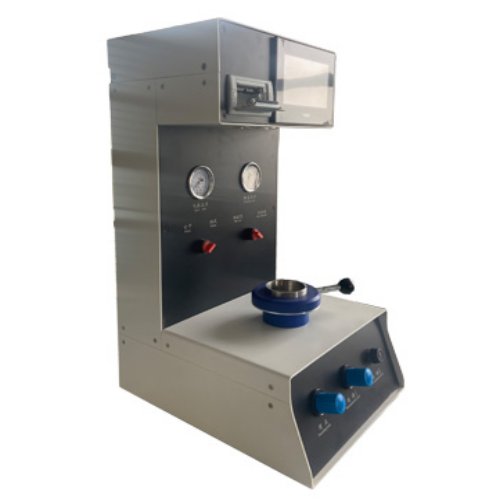
Features
1. Appearance material: stainless steel panel, aluminum alloy profile frame, laser engraved logo, not easy to fall off.
2、Display: it is resistive touch screen.
Operating system: the new version of Android system, as if the smart phone operation.
3. test data a key to lock, an interface to complete all operations, easy to get started, 10 minutes to get started.
4. stability: ergonomic design, the use of Germany Festo regulator control valve, improve the stability of the equipment in the operation of the pressure rise rate.
5、"Blow dry" function: reduce the loss of test liquid, shorten the drying time of the test piece, protect the test cartridge.
6、The test state of filter element and filter material can be switched by one key.
7、The machine itself is small and easy to move. Office personnel on the desk that can be used (placed in a position to avoid resonance).
8. temperature compensation: surface tension in the temperature range (18-37 ℃), the program can be self-compensating arithmetic, the test results are not affected by changes in external temperature.
9. built-in 6 kinds of filter material optional reference filtration accuracy.
10、Mass storage: test data can be saved in millions, convenient for querying at any time.
11. print mode: according to the test results, three modes of printing, and can query the historical data and printing at any time.
12. calibration function: comes with calibration port, you can calibrate the error value of the pressure sensor at any time.
Technical Parameters
| Item | Parameter |
|---|---|
| Maximum Test Pressure | 14.99 kPa |
| Pore Size Test Range | 5–120 μm |
| Filter Thickness Range | 0.1–3 mm (custom clamps required for thicker samples) |
| Clamp Outer Diameter | Φ(88 ± 1) mm |
| Clamp Inner Diameter | Φ(72 ± 0.2) mm |
| Sample Liquid Height | (12.5 ± 0.2) mm |
| Test Medium | Isopropyl alcohol, industrial ethanol, or other standard liquids |
| Applicable Sample Forms | Sheet filter material, filter cartridges, filter elements |
| Working Medium | Compressed air (external, powers automatic start/stop) |
| Pressure Adjustment Accuracy | 5–50 Pa |
| Measured Filter Media Diameter | 88 mm |
| Bubble Point Range | 5.8–100 μm |
Accessoriess
1. Test tank exterior material: 304 stainless steel alloy structure, aesthetically pleasing.
2. Rotation device: Manual operation.
3. Clamping device: Pneumatic clamping.
4. Liquid tank dimensions: 450mm x 300mm x 300mm (L x W x H)
5. Test filter element dimensions:
Maximum outer diameter: φ250mm; Minimum inner diameter: φ15mm; Minimum length: 50mm; Maximum length: 300mm
6. Non-standard liquid tanks can be customized according to customer requirements.
Test Procedures
1. Preparation Stage
Connect the device to a stable power supply and compressed air source (as per the working medium requirement).
Select the test liquid (e.g., isopropyl alcohol, industrial ethanol) matching the filter cartridge type, and soak the filter cartridge sample completely in the liquid (ensure no air bubbles remain in the pores).
Install the soaked sample into the test chamber of the instrument, and ensure the chamber is sealed tightly.
2. Parameter Setting
Turn on the instrument, select the corresponding standard (e.g., ISO 2942-2004. GB/T 14041.1-2007) via the Android touch screen.
Set test parameters (e.g., pressure adjustment range, data recording interval) according to the sample specification and test requirements.
3. Test Operation
Start the pressure supply system (controlled by the German Festo regulator valve), and gradually increase the pressure in the test chamber.
Monitor the touch screen for the first bubble point pressure (recorded as the maximum pore size corresponding value).
Continue adjusting the pressure to collect data on bubble point distribution, and calculate the average pore size (for group bubble point tests).
For structural integrity testing: Check if the sample has cracks, seal defects, etc., during the pressure application process.
4. Post-Test Process
Stop the pressure supply, release the pressure in the test chamber slowly.
Remove the filter cartridge sample, clean the test chamber and liquid storage parts.
Export the test data (e.g., bubble point pressure, pore size values) via the instrument interface, and generate a test report.
FAQ
1. What is this product?
An instrument for measuring pore size distribution and structural integrity of filter cartridges and sheet materials.
2. What is this product used for?
To determine maximum pore size, average pore size, and bubble point distribution for filter evaluation, quality control, and R&D.
3. Why is this product important?
Ensures filter performance, reliability, and compliance with international standards.
4. What industries is this product suitable for?
Industrial filtration, automotive, hydraulic systems, catalyst research, laboratory testing, and filter manufacturing.
5. What types of this product are available?
Supports both filter cartridges and sheet filter materials, with customizable liquid tanks and optional reference calibration materials.
