




Search keywords:
product name, product type, model number,
test method, manufacturer, technique, application
-
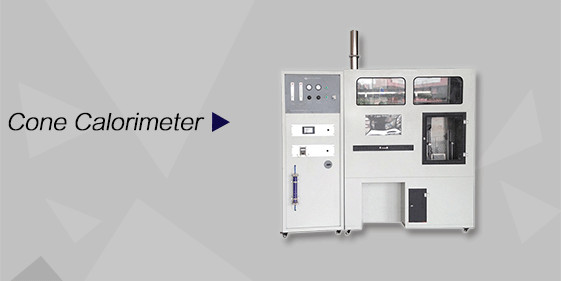
Cone Calorimeter
The import of American VTEC, cone calorimeter ultra high cost performance
more
-
Digital Elmendorf Tearing Tester
Pendulum method test material tear strength, operating more simple, more accurate data
more
-
ZwickiLine Materials testing machines
Top of the world's leading universal material testing machine
more
Cone Calorimeter / Cone calorimetric test equipment
BACK

Standards:
The system complies with major international fire-reaction standards, including: ASTM E1354 – Heat and Visible Smoke Release Rates ISO 5660-1 – Heat release, smoke production, and mass loss rate ASTM E1474 – Flame spread evaluation ASTM F1550 – Flame spread of plastics in furniture ASTM E1740 – Large-panel cone calorimeter testing ASTM D6113 – Fire performance of materials IMO MSC 40(64) – Marine fire test procedures BS 476-15 – Fire tests for building materials NFPA 264 / NFPA 271 – Fire and smoke measurement standards ULC-S135-04 – Canadian fire test standard CSN EN 45545-2+A1 – Railway vehicle fire protection CSN EN 13501-1+A1 – Classification of building products
Applications:
The Cone Calorimeter is widely used to evaluate fire performance of materials and products under controlled heat-flux exposure. It provides accurate characterization of heat release, smoke generation, ignition properties, toxic gas production, and combustion behavior.
Common applications include building materials, foams, plastics, composites, textiles, cable insulation, transportation materials (railway, maritime, automotive interiors), aerospace composites, polymer research, and fire-retardant development.
Its measurement data is essential for predicting fire hazards, conducting flame-retardant assessments, verifying regulatory compliance, and supporting fire-safety engineering analysis.
Product Information:
The Cone Calorimeter is a precision fire-testing instrument designed to evaluate material combustion behaviors based on oxygen-consumption calorimetry. It measures critical fire-reaction parameters such as heat release rate (HRR), mass loss, ignition time, smoke production, CO/CO₂ generation, and gas flow.
Using a modular design, the system allows users to begin with essential components—such as heat-release measurement or smoke analysis—and expand later into a full-feature fire-testing platform. This flexibility makes it ideal for research, certification, and quality-control laboratories across industries including construction, rail transit, marine, aerospace, automotive, and polymer materials.
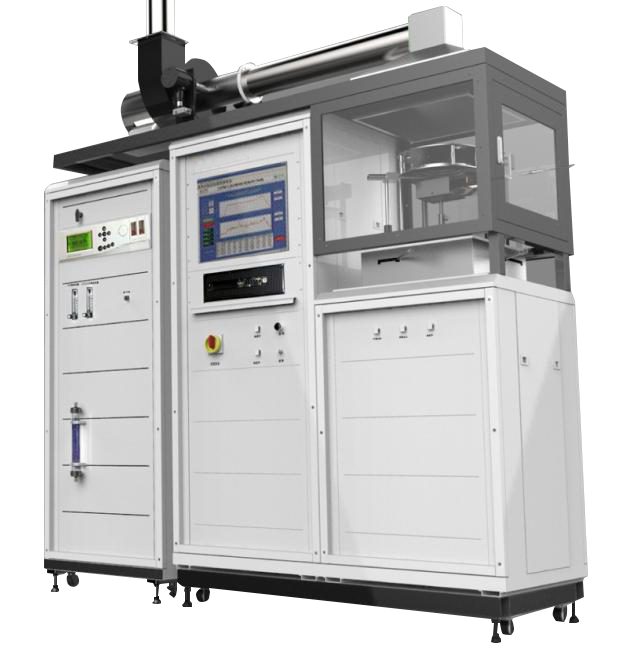
Features
Ignition System
10 kV spark igniter with fire-off safety system; position automatically detected via mechanical linkage.
Fully automated ignition, timing, gas control, and flame-off functions.
Exhaust System
Stainless-steel design including hood, pipes, diffusion plate, orifice flow meter, and axial-flow fan.
Long-life stainless-steel smoke collection cover, sampling needle, and exhaust fan.
Gas Sampling System
Ring sampler with 12 evenly distributed pores opposite airflow direction.
Three-stage 0.5 μm precision filtration with particle filter, CO₂ filter, and water trap.
Refrigerated cold trap with 0–5 °C temperature control.
Dust filter installed 685 mm from smoke-collecting hood.
Measuring System
Paramagnetic O₂ analyzer (0–25%), Servomex sensor with linear response.
Laser system for smoke-density measurement.
High-precision load cell for dynamic mass-loss monitoring.
PID temperature control with three thermocouples for cone-heater measurement.
User Operating System
LabVIEW-based professional control platform; intuitive and user-friendly.
PID temperature controller integrated with programmable control module.
PLC-based acquisition and airflow regulation; automatic sample ID management and database recordkeeping.
Technical Parameters
| Item | Parameter | Value |
|---|---|---|
| Power supply | – | 208–230 V, 50/60 Hz, 50 A, single phase |
| Cone heater | – | 5000 W Inconel heater, 0–120 kW/m² |
| Sample size | – | 100 mm × 100 mm × ≤50 mm |
| Ignition | – | 10 kV automatic spark igniter |
| Temperature control | – | PID, 3× K-type thermocouples |
| Exhaust system | – | Stainless-steel hood, duct, orifice meter, axial fan |
| Gas sampling | – | 12-pore ring sampler, 0.5 µm triple filtration, 0–5 °C cold trap |
| Gas analyzers | – | O₂ paramagnetic (0–25%); CO₂ NDIR (0–10%); CO NDIR (0–1%) |
| Smoke measurement | – | He-Ne laser photometric system |
| Load measurement | – | Sartorius load cell, 0.01 g resolution |
| Data acquisition | – | 16-bit A/D, 4 scans/sec |
| Control system | – | LabVIEW + PLC, touchscreen control |
| Data output | – | Excel reports, customizable formats |
| System configuration | – | 19" rack modules; customizable full-system layout |
Accessories
• 10 kV electronic igniter
• Stainless-steel exhaust hood and ducting
• Orifice plate flow-measurement module
• Laser smoke-density measurement system
• Paramagnetic oxygen analyzer
• CO and CO₂ NDIR analyzers
• Load-cell weighing module
• Cold trap (0–5 °C)
• Gas-sampling ring with 12 sampling ports
• LabVIEW control software and PLC system
• Sample holder and retainer frame
• Data-acquisition platform and reporting package
Test Procedures
Place the specimen in the sample holder and input test parameters via the touchscreen control system.
The system automatically performs ignition, heat-flux adjustment, and timing.
Real-time measurement of HRR, oxygen consumption, smoke density, mass loss, CO/CO₂ concentration, and temperature.
Data acquisition system stores all curves and numerical results in the integrated database.
Export test report through automated Excel reporting functions.
After testing, allow system purge and remove combusted residue.
Maintenance Information
Regularly inspect ignition electrode, spark generator, and flame-off mechanism.
Clean the exhaust hood and ducting to prevent soot buildup.
Calibrate oxygen, CO, and CO₂ analyzers periodically for accuracy.
Check load cell, thermocouples, and flow-measurement system for stability.
Inspect cold trap and refrigeration unit to ensure correct 0–5 °C operation.
Replace filters in the gas-sampling train as required.
Back up database files and update the LabVIEW system regularly.
Ensure all stainless-steel components remain clean and corrosion-free for long service life.
Conclusion
The Cone Calorimeter provides accurate, standards-compliant evaluation of material fire behavior through oxygen-consumption calorimetry. With modular system architecture, advanced gas and smoke analysis, and automated data acquisition, it delivers reliable, repeatable fire-reaction parameters. Its flexibility and wide industry applicability make it an essential instrument for fire safety research, regulatory compliance, material development, and quality control across diverse sectors.
FAQ
(1) What is this product?
The Cone Calorimeter is an instrument used to evaluate fire performance of materials by measuring heat release, mass loss, and smoke production during combustion.
(2) What is this product used for?
You can use it to assess building materials, furniture, textiles, plastics, and fire-retardant materials for fire behavior, heat release rate, and smoke generation.
(3) How does this product work?
It ignites samples in a controlled environment and measures heat release, mass loss, smoke, and gas concentrations using thermocouples, load cells, gas analyzers, and data acquisition systems.
(4) Why is this product important?
It provides precise, standardized, and repeatable fire performance data, supporting safety assessment, regulatory compliance, and material development.
(5) Which industries is this product suitable for?
This instrument is suitable for building materials, furniture, textile, plastics, fire-retardant material development, research laboratories, and certification agencies.
