




Search keywords:
product name, product type, model number,
test method, manufacturer, technique, application
-
Cone Calorimeter
The import of American VTEC, cone calorimeter ultra high cost performance
more
-
Digital Elmendorf Tearing Tester
Pendulum method test material tear strength, operating more simple, more accurate data
more
-
ZwickiLine Materials testing machines
Top of the world's leading universal material testing machine
more
Conveyor Belt Flammablity and Flame Propagation Characteristics Tester
BACK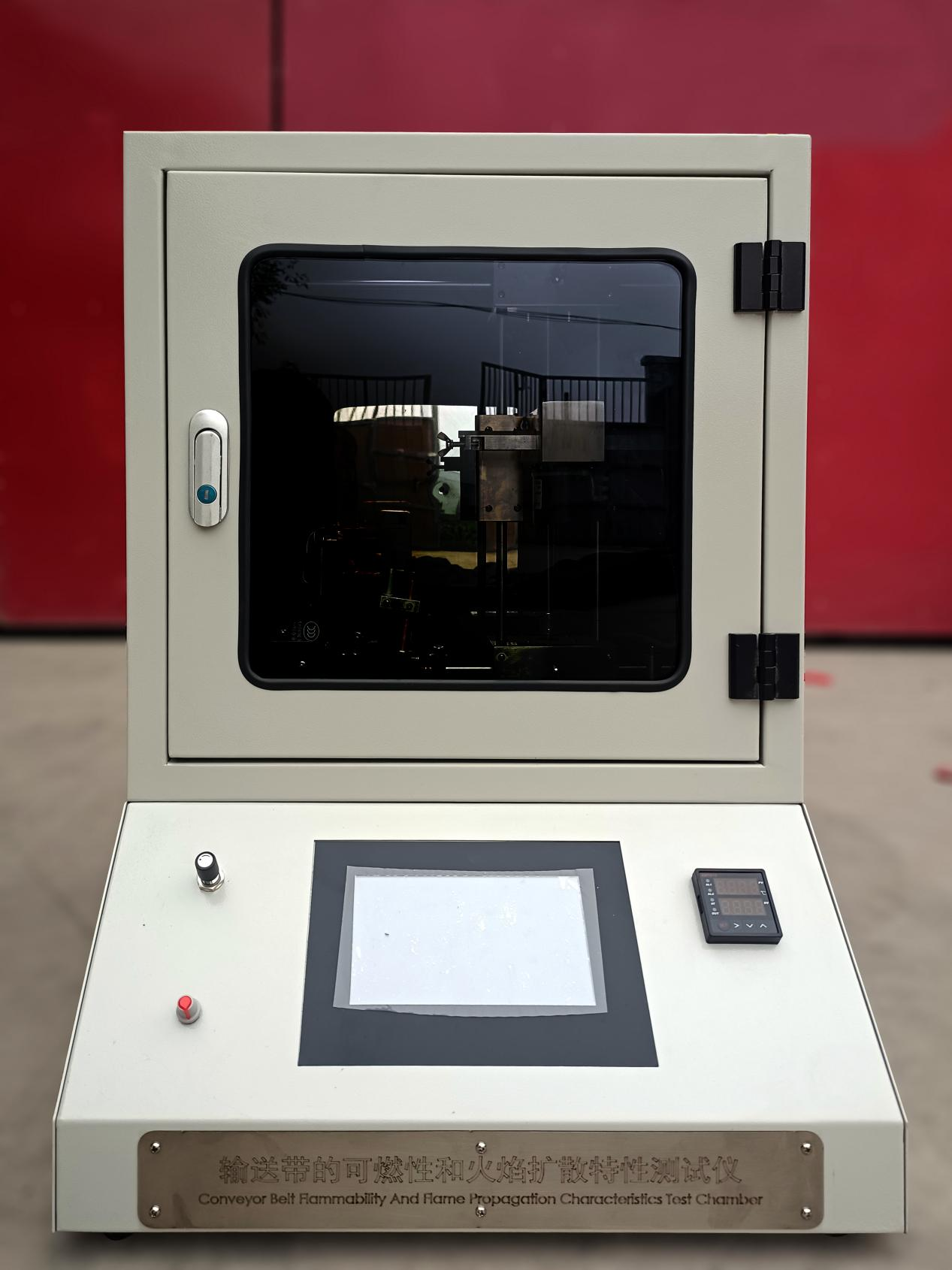


Standards:
Applications:
This testing machine is applicable for determining the flammability and flame propagation characteristics of horizontally oriented conveyor belt specimens.
During the test, one end of the horizontally positioned conveyor belt specimen is exposed to a flame from a specified gas burner for a defined period. The duration of flame persistence after removal of the burner flame is measured. After flame extinction, an air flow is passed over the specimen to measure the duration of afterglow.
In general, these test results alone do not indicate the fire hazard of a material or product under actual fire conditions. Therefore, they should not be used for fire hazard assessment without considering additional supporting information.
This test can be used to determine the flammability and flame propagation characteristics of conveyor belt materials. However, it must be emphasized that this test does not indicate the fire hazard of the material in actual use. The fire hazard of the final product depends on how the material is used and modified during manufacturing. This test may be used to specify flammability and flame propagation requirements in raw material or conveyor belt product standards.
Product Information:
 The Conveyor Belt Flammablity And Flame Propagation Characteristics Test Chamber is designed to automatically conduct tests according to preset test durations. It offers a high level of automation, accurate timing, data storage capability, and the ability to retrieve historical test records. The equipment features a well-structured design, comprehensive functions, and is simple to operate, making it easy to learn and use.It is developed in accordance with the technical requirements specified in AS 1334.10. “Method for Determination of Flammability and Flame Propagation Characteristics of Conveyor Belts.”
 Features
One-touch operation for greater simplicity;
Intelligent and user-friendly operation;
Ignition method: automatic high-voltage ignition;
PLC + touchscreen control system;
Easy and fast operation.
Parameters
|
Technical Parameter |
Specification |
|
Power Supply |
AC 220V, 52Hz, total power approx. 100W |
|
Fan Speed |
Controllable (1.5 ± 0.15) m/s |
|
Anemometer |
Accuracy ± 0.1 m/s |
|
Timer |
Accuracy error < 1 s/h |
|
Gas Source |
≥95% propane gas |
|
Combustion Chamber |
Made of 304 stainless steel |
|
Test Tunnel Dimension |
L × W × H: 500 mm × 500 mm × 500 mm |
Specimen Preparation
Acceptance Test
Four specimens shall be prepared from the full thickness of the conveyor belt, each measuring 150 mm in length and 13 mm in width. Two specimens shall be cut parallel to the longitudinal direction of the belt, and two specimens shall be cut parallel to the transverse direction of the belt.
Type Approval
Ten specimens shall be prepared from the full thickness of the conveyor belt, each measuring 150 mm in length and 13 mm in width. Five specimens shall be cut parallel to the longitudinal direction of the belt, and five specimens shall be cut parallel to the transverse direction of the belt.
 Test Procedure
The test shall be carried out under conditions free from external air flow.
Press “Exhaust” and rotate the airflow control knob to adjust the air velocity to (1.5 ± 0.15) m/s, then turn off “Exhaust”.
Ignite the burner and adjust the gas flow rate, as well as the position of the nut beneath the Bunsen burner, to control the air intake so that the flame temperature reaches 1000 ± 50°C at 25 mm above the burner top. The thermocouple shall be positioned 25 mm above the flame.
Before each test, thoroughly clean and inspect the glass and mirrors.
Place the specimen in the fixture with the pulley side facing downward, and clamp the metal gauze horizontally 6 mm below the specimen holder. Press “Position Adjustment” to align the proximity switch so that the burner is directly beneath the specimen. Adjust the specimen holder so that it is positioned more than 25 mm above the burner top.
Close the test door and set the test time to 60 s. Press “Start” to begin the test. After 60 s, the burner automatically moves away from the specimen, and T1 timing starts automatically. Observe and record the duration of flame persistence.
After the flame extinguishes, turn on “Exhaust” and press “Timer 2” to start T2 timing.
During the afterglow period, periodically inspect the specimen from both front and rear sides using a mirror. If the specimen ignites again during the afterglow period, press “Timer 1” to record the event.
Determine the average total flame duration and total afterglow duration for four specimens or ten specimens (two or five longitudinal specimens, and two or five transverse specimens).
Evaluation of Test Results
These test results alone do not indicate the fire hazard of a material or product under actual fire conditions. Therefore, they should not be used for fire hazard assessment without considering other supporting information.
