




Search keywords:
product name, product type, model number,
test method, manufacturer, technique, application
-
Cone Calorimeter
The import of American VTEC, cone calorimeter ultra high cost performance
more
-
Digital Elmendorf Tearing Tester
Pendulum method test material tear strength, operating more simple, more accurate data
more
-

ZwickiLine Materials testing machines
Top of the world's leading universal material testing machine
more
Shoe Abrasion Tester
BACK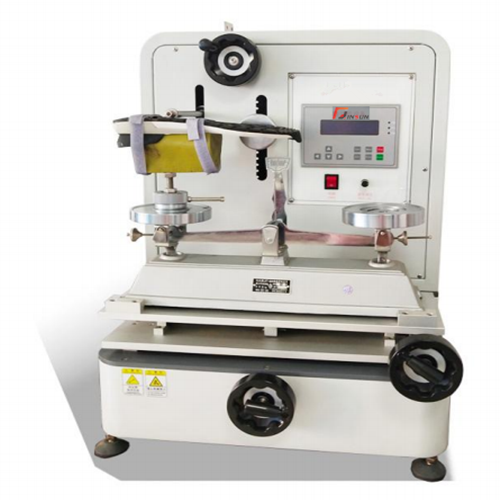


Standards:
Applications:
This tester is suitable for:
(1) Footwear Manufacturers: To verify the durability of finished soles and sole materials.
(2) Quality Inspection Laboratories: For conformity testing according to national standards.
(3) R&D Centers: To evaluate new sole materials or designs under controlled wear conditions.
(4) Material Testing: For evaluating abrasion resistance of rubber, thermoplastic, or composite sole materials.
Product Information:
The Shoe Abrasion Tester is designed to evaluate the wear resistance of shoe soles and sole pieces. The instrument uses a rotary grinding head that applies a controlled vertical load on the sample while rotating at a standardized speed. After testing, the wear length or mass loss of the sample is measured to assess its durability, providing quantitative data for quality control, product development, and standard compliance.
Standards
(1) GB/T 3903.2-2017 – Testing of shoe wear resistance
(2) QB/T 4329-2012 – Shoe sole abrasion testing
(3) Applicable international or regional standards for abrasion resistance upon request
Parameters
| Parameter | Specification |
|---|---|
| Rotary Speed | 191 ± 5 r/min (adjustable) |
| Load Applied | 500 g (optional: 5 g–500 g) |
| Test Duration | 20 min (adjustable) |
| Grinding Wheel Dimensions | Diameter 20 ± 0.1 mm, Thickness 4 ± 0.1 mm |
| Grinding Wheel Material | T12 Steel, 72 teeth, Tooth angle 90° ± 5°, Tip width 0.2 ± 0.05 mm, Tip roughness Ra = 3.2 μm, Hardness HRC ≥ 55. Coaxiality 0.03 mm |
| Balance | 5000 g range, 0.5 g accuracy |
| Sample Volume (L×W×H) | 560 × 510 × 830 mm |
| Net Weight | 70 kg |
| Power Supply | AC 220V, 10A |
| Environmental Conditions | Temperature 23 ± 2 °C, Standard humidity |
Features
(1) Quantitative Wear Measurement: Provides wear length or mass loss for precise evaluation of sole durability.
(2) Standard-Compliant Grinding: Uses a precisely specified grinding wheel to ensure consistent abrasive action.
(3) Controllable Test Parameters: Adjustable speed, load, and time for flexible testing.
(4) Integrated Balance: Facilitates mass-based wear assessment with high accuracy.
(5) Robust Construction: Designed for repeated use in laboratory or quality control environments.
(6) Sample Holder: Ensures secure positioning of soles or sole pieces during testing.
(7) User-Friendly Operation: Timer and control system allow reliable, repeatable testing.
Test Procedures
(1) Secure the shoe sole or material sample in the sample holder.
(2) Set the load, speed, and test duration according to the test requirements.
(3) Start the rotary grinding head and conduct the abrasion test.
(4) Upon completion, measure the wear length or mass loss using the integrated balance.
(5) Record and analyze the results to evaluate material durability.
Maintenance Information
(1) Clean the grinding wheel and sample holder regularly to remove debris.
(2) Inspect the grinding wheel for wear or damage, and replace when necessary.
(3) Verify balance calibration periodically for accurate mass measurement.
(4) Ensure electrical connections and motor performance are maintained for consistent operation.
Conclusion
The Shoe Abrasion Tester provides accurate, repeatable evaluation of footwear sole durability, enabling manufacturers and laboratories to ensure product quality, compliance with national standards, and support material development.
FAQ
1. What is this product?
A laboratory instrument for testing wear resistance of shoe soles and sole materials, providing quantitative abrasion data.
2. What is it used for?
Used for durability evaluation, material quality control, and R&D of footwear and sole materials according to GB/T 3903.2 and QB/T 4329.
3. How does it work?
A rotary grinding head applies a controlled load on the sample while rotating at 191 ± 5 r/min. Wear is measured by sample length or mass loss using the integrated balance.
4. Why is it important?
Ensures soles meet durability standards, supports material selection, predicts product lifespan, and reduces returns or failures.
5. Which industries use it?
Footwear manufacturers, material suppliers, testing laboratories, and R&D institutes.
6. How is accuracy ensured?
Standardized grinding wheel, adjustable load/speed/time, and integrated 5000 g balance with 0.5 g accuracy, under controlled lab conditions.
