




Search keywords:
product name, product type, model number,
test method, manufacturer, technique, application
-
Cone Calorimeter
The import of American VTEC, cone calorimeter ultra high cost performance
more
-

Digital Elmendorf Tearing Tester
Pendulum method test material tear strength, operating more simple, more accurate data
more
-

ZwickiLine Materials testing machines
Top of the world's leading universal material testing machine
more
Ross Flexing Fatigue Tester
BACK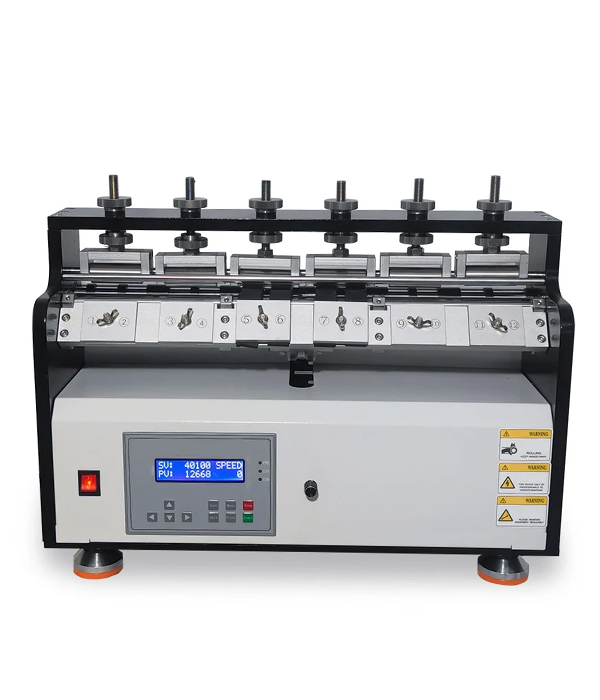


Standards:
Applications:
(1) Sole strips of sports shoes: EVA, PU, rubber, or TPR soles used in athletic footwear.
(2) Casual shoe soles: Leather, synthetic, or composite materials.
(3) Work shoe soles: Polyurethane, rubber, or thermoplastic soles.
(4) Footwear R&D: Evaluating new sole materials or surface treatments for flex durability.
(5) Quality control in production: Checking consistency and durability of sole strips before assembly.
(6) Laboratory testing: Comparing notch growth and flex cracking among different materials.
Product Information:
The Ross Flex Tester evaluates the zigzag resistance and flex fatigue performance of sole materials. Pre-cut sole test pieces are mounted on the tester and subjected to repeated 90° zigzag bending. The notch growth rate is measured after testing to quantify the flex cracking resistance of the material, providing an objective assessment of sole durability.
Standards
(1) GB/T 2099-2007 — Footwear Test Methods
(2) ASTM D1052 — Standard Test Method for Flexing Endurance of Sole Materials
(3) ISO 5423 — Rubber and Plastics — Determination of Flex Cracking
(4) SATRA TM60 — Ross Flex Test
(5) HG/T 2411 / HB-T2411 — Footwear Sole Flexing Test Methods
(6) EN ISO 20344 — Footwear — Test Methods
Features
(1) Measures sole material flex fatigue and notch growth, key indicators of durability.
(2) Supports simultaneous testing of 12 sole test pieces for high throughput.
(3) Provides objective data based on notch growth rate.
(4) Adjustable bending angle (90 ± 2°) and flexing speed (0–100 r/min) for precise testing.
(5) Automatic stop function when preset cycles or time is reached.
Technical Parameters
| Item | Specification |
|---|---|
| Simultaneous measurement | 12 test pieces |
| Bending angle | 90 ± 2° |
| Speed | 0–100 r/min (switchable) |
| Controller | LED-SLD806 integrated display control |
| Hole punch diameter | 2.5 mm |
| Test mode | Automatic stop after preset cycles/time |
| Fixture features | Can test sole strips and individual pieces simultaneously |
| Zigzag shaft diameter | 10 mm |
| Sample method | Sole test piece |
| Sample size | 152 × 25 mm |
| Power supply | AC 220V, 10A |
Accessories
(1) 1 Knife die
(2) 1 Cutting knife
(3) Power cable
(4) Instruction manual
(5) Delivery note
Test Procedures
(1) Cut sole strips to the standard size (152 × 25 mm) and pre-cut notch (2.5 mm).
(2) Mount the test pieces on the Ross Flex Tester, aligning the notch above the zigzag shaft center.
(3) Adjust bending angle to 90 ± 2° and set flexing speed (0–100 r/min).
(4) Set the number of test cycles or time on the controller.
(5) Start the test; the machine performs repeated zigzag flexing on the samples.
(6) Measure the notch growth after completion of the test.
(7) Record results and compare against material standards for flex resistance.
Maintenance
(1) Keep the machine clean and free of dust or debris.
(2) Lubricate zigzag shafts, bearings, and moving parts monthly or after 1000 hours of operation.
(3) Inspect knife dies, cutting knives, and fixtures for wear or deformation and replace if necessary.
(4) Verify speed and bending angle calibration periodically.
(5) Check the controller and electrical connections regularly.
(6) Store the machine in a dry and stable environment to prevent corrosion and mechanical damage.
