




Search keywords:
product name, product type, model number,
test method, manufacturer, technique, application
-
Cone Calorimeter
The import of American VTEC, cone calorimeter ultra high cost performance
more
-

Digital Elmendorf Tearing Tester
Pendulum method test material tear strength, operating more simple, more accurate data
more
-

ZwickiLine Materials testing machines
Top of the world's leading universal material testing machine
more
Shoes Thermal Insulation Tester
BACK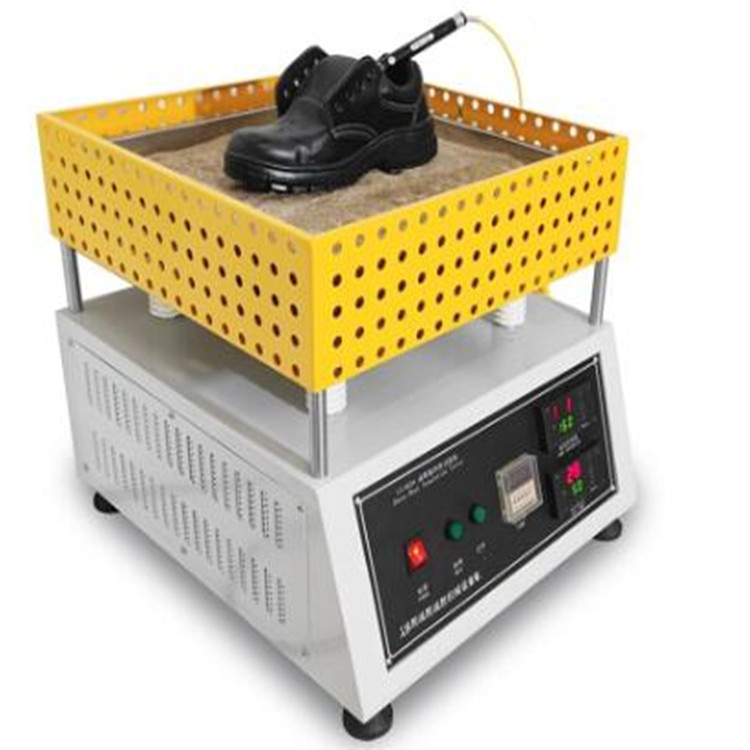


Standards:
Applications:
(1)Testing safety shoes with rubber soles used in foundries, kitchens, or metalworking plants.
(2)Evaluating casual leather shoes for thermal insulation in hot climates.
(3)Assessing sports shoes with EVA or PU midsoles for heat resistance during outdoor activities.
(4)Testing rubber boots and waterproof footwear for high-temperature work or hot surface exposure.
(5)Quality control of children’s shoes and school shoes for compliance with heat resistance standards.
(6)R&D of high-temperature resistant sole materials, such as heat-resistant thermoplastics or composites.
(7)Evaluation of industrial and military boots for thermal protection under extreme conditions.
Product Information:
The Shoe Sole Heat Resistance Tester is designed to evaluate the thermal insulation and heat resistance performance of finished footwear soles. By simulating exposure to high-temperature surfaces using sand or steel balls as a heat medium, the tester provides objective measurements of temperature rise at the insole, ensuring the footwear meets safety requirements for hot environments.
Standards
(1)EN ISO 20344 — Personal Protective Equipment — Footwear — Test Methods
(2)EN ISO 8782-1 — Footwear — Evaluation of Heat Resistance
(3)GB/T 20991-2007 — Footwear Test Methods
(4)ANSI — American National Standards for Footwear Safety
(5)JIS — Japanese Industrial Standards for Footwear
(6)CSA — Canadian Standards Association Footwear Standards
(7)GB 12017-1989 — Safety Footwear Heat Resistance Test
(8)LD50-1994 — Footwear Heat Resistance Evaluation
Product Features
(1)Simulates real-world high-temperature exposure using a heated sand or steel ball medium.
(2)Measures actual insole temperature rise, providing objective evaluation of thermal insulation.
(3)Controlled heating system maintains precise test temperatures at 150℃ or 250℃.
(4)Supports finished shoes and various sole materials, including rubber, EVA, PU, and leather.
(5)Robust construction suitable for repeated high-temperature testing in laboratory or production environments.
Technical Parameters
| Item | Specification |
|---|---|
| Sand Bath Box Size | 40 ± 2 cm × 40 ± 2 cm, height 8 cm |
| Sand Height | ≥5 cm |
| Sand Particle Size | 0.3 – 1.0 mm |
| Sand Volume | 5000 ± 250 cm³ |
| Test Temperature | 150 ± 5℃ or 250 ± 5℃ |
| Heating Power | ≥2500 ± 250 W |
| Heat Transfer Medium | 5 mm steel balls, total mass 4 kg |
| Temperature Measurement | Copper/copper-nickel thermocouple with copper disc, 2 ± 0.1 mm thick, 15 ± 1 mm diameter |
| Test Duration | 30 minutes |
| Accuracy | ±0.5℃ |
| Power Supply | AC 220V |
Accessories
(1)Sand bath box
(2)Steel balls (5 mm, 4 kg total)
(3)Copper/copper-nickel thermocouple with copper disc
(4)Fixture for placing finished shoes
(5)Instruction manual
Test Procedures
(1)Preheat the sand bath to the specified test temperature (150℃ or 250℃).
(2)Fill the sand bath to a minimum height of 5 cm or place steel balls as the heat medium.
(3)Position the finished shoe on the fixture ensuring contact between the sole and sand/balls.
(4)Start the test and record the insole temperature over 30 minutes.
(5)Analyze the maximum temperature rise to evaluate the sole’s heat resistance.
Maintenance Information
(1)Clean the sand or steel balls and bath after each test to remove debris.
(2)Check the thermocouple and copper disc for wear and ensure accurate readings.
(3)Inspect the heating system and control panel periodically.
(4)Store the machine in a dry environment to prevent corrosion.
(5)Verify sand particle size and volume before each test to maintain consistency.
