




Search keywords:
product name, product type, model number,
test method, manufacturer, technique, application
-
Cone Calorimeter
The import of American VTEC, cone calorimeter ultra high cost performance
more
-
Digital Elmendorf Tearing Tester
Pendulum method test material tear strength, operating more simple, more accurate data
more
-
ZwickiLine Materials testing machines
Top of the world's leading universal material testing machine
more
AKRON Rubber Abrasion Tester
BACK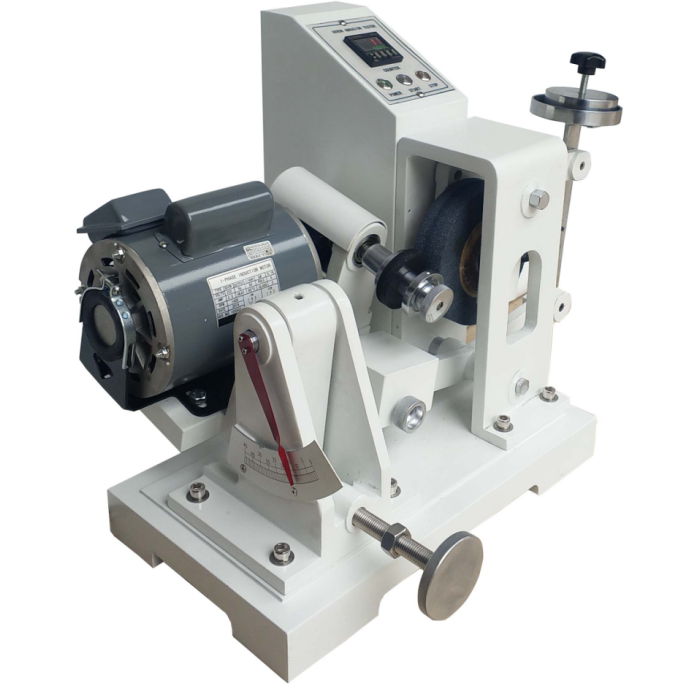


Standards:
Applications:
This machine is developed in accordance with BS903 and GB/T 1680 standards and is used together with an electronic balance. It is specially designed for testing the abrasion volume loss of rubber products such as shoe soles, tires, and tank tracks.
The counter adopts an electronic automatic control system, allowing the user to preset the abrasion rotation cycles. The machine will automatically stop once the preset number of revolutions is reached.
Product Information:
Working Principle
The circular sole test specimen is fixed onto the AKRON Rubber Abrasion Tester at a specified inclination angle. A certain weight is then applied on the specimen tray of the tester, so that the circular sole specimen is subjected to a specified pressure and comes into close contact with the abrasive wheel of the AKRON Rubber Abrasion Tester.
The tester drives the circular sole specimen to perform rotational friction against the abrasive wheel. After a specified number of abrasion cycles, the mass loss of the sole specimen before and after friction is measured. Based on the density of the specimen, the volume abrasion loss of the sole test piece is calculated.
The abrasion resistance performance of the tested sole is evaluated according to the volume loss of the specimen.
Reference Standards
This testing machine complies with the requirements of the following standards:
BS 903、GB/T 1689、JIS K6264、CNS 743
Technical Parameters
Specimen Inclination Range: 0–35°
Counter: LCD Display, 0–99.999.999
Speed: 33 cpm
Stroke: 36 mm
Dimensions: 53 × 43 × 43 cm
Weight: 55 kg
Power Supply: Single-phase, AC 220 V, 3 A
Structure Description
Counter: Adjustable from 0–99.999.999.
Power Switch: Main power switch of the instrument.
Drive Motor: High-precision, low-noise transmission motor.
Specimen Mounting Fixture: Secures the test specimen in close contact with the abrasive wheel.
Angle Handwheel: Adjustable angle range from 0–35°.
Horizontal Adjustment Rod: Used to adjust alignment between the specimen and the abrasive wheel.
Start/Test Switch: One-button operation to start the test.
Stop Switch: Allows manual termination of the test during operation.
Weights: Standard calibration weights for testing.
Steel Brush: High-hardness steel brush that automatically cleans debris from the abrasive wheel during testing.
Abrasive Wheel: Standard #36 abrasive test wheel.
Operating Procedure
1. Specimen Preparation
Whenever possible, place the specimen in an environment at a temperature of (23 ± 2)°C for conditioning for at least 3 hours. This is particularly important for specimens that may have undergone prior aging.
Remove the conditioned specimen and use a grinding machine to grind it to the required thickness of (2.5 ± 0.5) mm. Then place the specimen again in an environment at (23 ± 2)°C for conditioning for at least 16 hours, but not more than 72 hours.
Using the supplied rectangular cutting die, cut the conditioned specimen into test strips of (12.5 ± 0.5) mm × (220 ± 20) mm. Then attach the test strip onto the specimen fixture of the instrument using high-adhesion adhesive.
Note:
When attaching the test strip, ensure that the ground/contact surface faces outward.
2. Test Procedure
2.1Take the prepared test specimen and weigh it in air using an electronic balance with an accuracy of 0.001 g. Record the weight as M1. accurate to 0.001 g.
2.2Install the test specimen strip onto the Akron Abrasion Tester. Adjust the inclination angle of the specimen so that the angle between the specimen and the horizontal plane meets the test requirements.
Generally, the test angle is 15°; however, specific test angles shall comply with the relevant product standard requirements.
2.3Adjust the distance between the abrasive wheel of the Akron Abrasion Tester and the test specimen until they are just in contact with each other.
2.4After installation is completed, place the corresponding test weight onto the tray of the instrument.
2.5Turn on the instrument power, set the required test cycle count, and start the test.
The instrument will automatically stop after the specimen has been pre-abraded for 500 revolutions.
2.6Remove the test specimen and clean off any loose debris from the surface.
Then weigh the specimen again using an electronic balance accurate to 0.001 g, and record the mass as M2. accurate to 0.001 g.
2.7Calculate the mass loss after 500 revolutions:
G1=M1−M2
2.8Calculate the average value of the mass loss obtained from five measurements of the test specimen, recorded as W, with the unit mg/kc, accurate to 1 mg/kc.
2.9Determine the specific gravity (density) of the test specimen:
D=Weight in air/(Weight in air−Weight in water)
Where:
D=Specific gravity density (g/cm3)
3.0Calculate the abrasion volume loss of the test specimen:
V=W/D
Where:
V = Abrasion volume loss (mm³)
W = Mass loss value (mg/kc)
D = Specimen density (g/cm³)
Maintenance Procedure
1.The surface of the machine should be cleaned before and after each test.
2.If the machine will not be used for an extended period, it should be cleaned, properly packed, and stored appropriately.
