





What is Wheelchair Testing Manikin?
2025/11/18
Share:

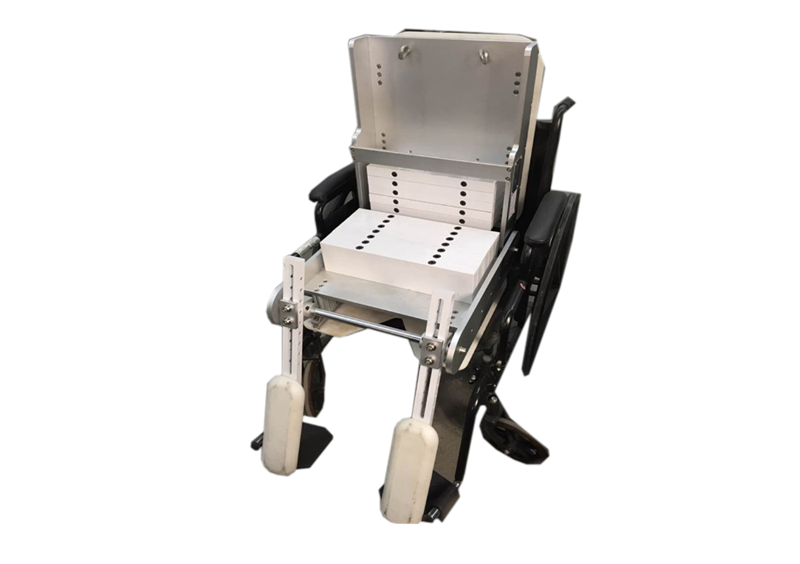
Wheelchair testing dummies are typically used to evaluate the safety, comfort, and suitability of wheelchairs. They simulate various parts of the human body and possess specific weight and dimensions, aiming to provide the most realistic testing environment for wheelchairs. By using wheelchair test dummies, it's possible to simulate various situations encountered by users of different body shapes, weights, and sizes when using a wheelchair. This helps wheelchair designers, manufacturers, and researchers understand how wheelchairs perform under different conditions, leading to improvements in product design and enhanced user experience.
Working Principle
In static stability testing, a standard-compliant dummy is fixed to a wheelchair, and the test platform is adjusted to the standard-specified slope (e.g., forward/backward tilt, side tilt). Posture sensors monitor the balance between the wheelchair and the dummy to determine if tipping occurs, verifying the static safety boundary. In dynamic strength testing, the drive system simulates the wheelchair's movement on bumpy roads (electric wheelchairs use rollers to simulate movement, while manual wheelchairs use a loading mechanism to simulate hand force). Force and displacement sensors collect force and deformation data of the frame and seat, comparing it to standard thresholds to determine if the structural strength meets the standards. Seat load-bearing capacity testing uses a dummy to simulate long-term seating, pressure sensors collect pressure distribution data, and a static load is applied to observe whether the seat exhibits excessive deformation or structural damage. In braking performance testing, the wheelchair is driven to a standard-specified speed, and the braking system is activated. Speed and distance sensors record speed changes and braking distance during braking to evaluate the braking effect. In handling performance testing, the control system issues control commands, monitoring the wheelchair's response speed and trajectory deviation to verify handling accuracy. Throughout the testing process, the control system monitors the data in real time and automatically generates a test report containing various indicators to ensure that the test results comply with the GBT 18029.1-2008 standard.
Operating Precautions
1. Operators must undergo professional training, be familiar with the content of GBT 18029.1-2008 standard, the structural characteristics of wheelchairs, and the equipment operation procedures. They must master the use of safety protection devices (such as emergency stop buttons and anti-tipping guardrails) and pass the assessment before being allowed to operate the equipment. Improper operation can lead to deviations in test data or safety accidents (such as dummy tipping over or wheelchair collisions).
2. Before each startup of the GBT 18029.1-2008 wheelchair dummy testing machine, check the dummy's fixation (whether it is secure and the sensors are functioning properly), the operation status of the drive and loading system (whether there are abnormal noises or jamming), and the integrity of the safety protection devices (whether the emergency stop button is sensitive and the guardrails are stable). After confirming that there are no abnormalities, start the equipment according to the standard procedure.
3. During testing, operators are strictly prohibited from entering the safety warning area. If it is necessary to adjust the wheelchair position or dummy posture, the equipment must be stopped and the power to the drive and loading systems disconnected to prevent equipment malfunction that could cause personal injury or equipment damage. Simultaneously, monitor the test data in real time. If overload or abnormal wheelchair deformation occurs, immediately press the emergency stop button.
4. After using the equipment, clean the test platform of impurities (such as dust and debris), clean and maintain the dummy (such as checking the sensitivity of the pressure sensors and repairing surface wear), lubricate and maintain the drive system (such as the motor and rollers) and loading mechanism (such as hydraulic components), and regularly calibrate all sensors to ensure the equipment operates accurately over the long term.
5. If the equipment experiences drive failure (such as the motor not turning, insufficient loading), abnormal data acquisition (such as no data from sensors, excessive data fluctuations), or failure of the safety protection system, the operator should immediately stop using the equipment, disconnect the main power supply, and contact professional maintenance personnel to troubleshoot the problem. Operating the equipment with a malfunction is strictly prohibited to avoid safety accidents or affecting the accuracy of the test results.
Specific performance indicators for testing
The specific performance indicators that can be tested include:
1. Static stability: Simulating the balance of a wheelchair when the user is stationary (e.g., parked on a slope or side-tilting surface) to detect whether the wheelchair will tip over and verify static safety boundaries;
2. Dynamic strength: Simulating the forces acting on the wheelchair during movement (e.g., over bumpy roads or turning) to test the impact resistance and fatigue resistance of key structures such as the frame, seat, and wheel assembly;
3. Seat load-bearing capacity: Using dummies to simulate long-term use by users of different weights to test the durability and deformation of the seat support structure, preventing safety hazards caused by seat damage;
4. Braking performance: Testing the braking effect of the wheelchair's braking system (e.g., braking distance, braking stability) under passenger conditions to ensure reliable stopping in emergencies;
5. Handling performance: Simulating the user controlling the wheelchair using joysticks, handwheels, etc., to test the accuracy and stability of the control response, preventing safety issues caused by control failure.
Application Scenarios
1. Manufacturers: Suitable for the quality inspection and R&D stages of wheelchair manufacturers' production lines. On the production line, the GBT 18029.1-2008 wheelchair dummy testing machine allows for sampling and testing of each batch of products. This quickly identifies substandard products with poor static stability, insufficient structural strength, or brake failure, preventing inferior products from entering the market, ensuring user safety, and maintaining the company's reputation for quality. During the R&D process, the equipment can verify the performance compliance of new wheelchair designs (such as lightweight frames, new braking systems, and comfortable seats), optimize product structure and material selection, shorten the R&D cycle, and enhance the market competitiveness of new products (e.g., meeting the stringent safety requirements of medical wheelchairs).
2. Quality Inspection Agencies: Third-party testing agencies can utilize the GBT 18029.1-2008 Wheelchair Dummy Testing Machine to provide clients with certification testing services that meet national standards, issuing authoritative test reports. This helps companies pass market access audits (such as medical device registration, e-commerce platform entry, and government procurement bidding), while also providing data support to industry quality supervision departments (such as the Market Supervision Administration), standardizing wheelchair product quality, and combating substandard products.
3. Research Institutions: When research institutions conduct wheelchair safety technology innovation (such as intelligent anti-tipping technology and shock absorption structure optimization), revise standards for assistive devices for the disabled, and develop wheelchairs for special scenarios (such as off-road wheelchairs and indoor narrow-space wheelchairs), the GBT 18029.1-2008 Wheelchair Dummy Testing Machine can serve as an experimental tool to simulate changes in wheelchair safety performance under different working conditions (such as extreme slopes and complex road surfaces). This provides accurate experimental data for technological innovation, standard optimization, and the development of special wheelchairs, promoting the development of the assistive device industry towards a safer, more comfortable, and smarter direction.
In conclusion, wheelchair testing dummies, with their rigorously standardized design and manufacturing, precise and comprehensive testing functions, meticulous operational requirements, and wide range of application scenarios, play an indispensable and crucial role in the quality control, performance improvement, and innovative development of wheelchair products. They not only strengthen the quality defenses for wheelchair manufacturers and provide authoritative testing methods for quality inspection agencies, but also provide strong support for technological breakthroughs and standard improvement by research institutions. This powerfully propels the wheelchair industry towards higher quality, greater safety and reliability, and greater innovation, making a significant contribution to the well-being of wheelchair users in the context of an aging population.
Previous: What is a Thermal Humidity Chamber?
N e x t : Why conduct UV protection testing?
