





Ddifferent types of protective clothing for industrial robots
2025/12/17
Share:

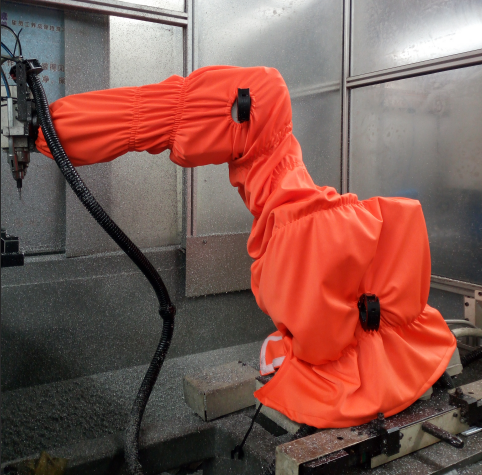
Robot Dust Protection Covers
First, let's look at dust protection covers. These covers are primarily used for robots working in dusty environments. Dust protection covers are usually made of special materials that can effectively prevent dust from entering the robot's interior, thus ensuring its normal operation.
The value of robot protective covers in cleanrooms is mainly reflected in the following aspects:
1. Improved product quality: Cleanrooms have very high requirements for product cleanliness; any tiny dust or contaminants can seriously affect product quality. Robot protective covers can effectively block the intrusion of external dust, particles, and chemical substances, ensuring that the robot does not become a source of pollution during operation, thereby maintaining the cleanliness standards of the workshop and improving product quality.
2. Extended equipment lifespan: Robots working in cleanrooms for extended periods come into contact with various materials and equipment, which can easily lead to surface coating wear and component damage. Robot protective covers can comprehensively cover the robot's key parts, reducing direct contact with hard objects, reducing wear speed, and thus extending the robot's maintenance cycle and overall lifespan.
3. Reduced maintenance costs: Dust contamination and static electricity accumulation are common causes of equipment failure. Robot protective covers can effectively prevent these phenomena, reducing downtime and maintenance costs caused by failures.
4. Ensured production safety: The use of protective covers can also, to a certain extent, prevent safety hazards caused by accidental collisions or wear of the robot, providing a guarantee for the smooth progress of the production process.
Robot protective covers mainly provide the following protective functions in cleanrooms:
1. Dust and pollution prevention: This is one of the most basic and important functions of robot protective covers. Protective covers made of high-quality dustproof materials can effectively isolate airborne particles, dust, and other pollutants, ensuring the stable operation of the robot in a cleanroom. 2. Anti-static: Static electricity is one of the common disruptive factors in cleanrooms and can seriously affect the normal operation of robots. Robot protective suits typically feature an anti-static design, using special materials to prevent the accumulation of electrical charges on the robot in static environments, thereby reducing the impact of static electricity on the robot. This function not only helps protect the robot from static damage but also improves overall production efficiency and product quality.
3. Wear-resistant: Robot protective suits are made of high-strength, wear-resistant materials that can withstand various challenges, ensuring good performance even after long-term use. This durability helps reduce downtime and maintenance costs, extending the overall lifespan of the robot.
4. Easy to clean and maintain: Cleanrooms have high requirements for equipment cleanliness. Robot protective suits are designed to be simple and easy to install, and easy to clean and maintain during use. This helps maintain the cleanliness of the cleanroom, reduces downtime due to cleaning, and improves production efficiency and product quality.
High-Temperature Resistant Protective Suits for Robots
Secondly, there are high-temperature resistant protective suits. These suits are designed for robots working in high-temperature environments. They can withstand extremely high temperatures while also preventing direct heat contact with the robot, protecting it from heat damage.
High-temperature and splash-proof robot protective suits are made of high-temperature resistant materials, possessing characteristics such as high-temperature resistance, flame retardancy, and heat insulation. They can effectively protect robots in high-temperature environments. This material typically has a high melting point and good thermal stability, maintaining good stability at high temperatures. The protective suit also has excellent heat insulation properties, reducing damage to the robot from external heat and thus extending its service life.
High-temperature and splash-proof robot protective suits also have excellent splash protection capabilities. The protective suit can effectively prevent damage to the robot from splashes of high-temperature liquids, sparks, and other debris. In industrial production, splashes of high-temperature substances often occur, posing a great threat to robots. High-temperature and splash-proof robot protective suits can effectively protect the critical parts of the robot's body, reducing damage from high-temperature substances.
Design and Structure
High-temperature and splash-proof robot protective suits adopt a design structure that conforms to mechanical movement, using high-temperature resistant materials to effectively resist the intrusion of high-temperature substances and provide heat insulation, ensuring the normal operation of the robot in high-temperature environments. The protective suit usually adopts a modular design for easy disassembly and cleaning. The structure of the protective suit is adapted to the structure of the robot, ensuring that the protective suit fits the robot closely and that the robot's freedom of movement is not restricted.
Application Areas
High-temperature and splash-proof robot protective suits are widely used in various high-temperature and harsh environments, such as automated production lines in the steel, metallurgy, ceramics, and glass industries. In these industries, robots need to work in high-temperature environments for extended periods, and high-temperature and splash-proof robot protective suits can provide comprehensive protection, ensuring their normal operation and extending their service life.
Furthermore, impact-resistant protective suits are also a common type. These suits are designed for robots working in environments where physical impacts may occur, such as assembly lines or places where heavy objects are handled. By absorbing and dispersing impact forces, these protective suits can reduce damage to the robot itself.
Robot Anti-Static Protective Clothing
Finally, let's look at anti-static protective clothing. This type of protective clothing is designed for robots working in environments prone to static electricity. Anti-static protective clothing can effectively dissipate static electricity, preventing static electricity from interfering with and damaging the robot's internal electronic equipment.
The dangers of static electricity should not be underestimated. When robots operate at high speeds, mechanical friction generates a large amount of static charge. When these static charges accumulate to a certain level, electrostatic discharge occurs. For precision integrated circuits and microelectronic components, electrostatic discharge can cause internal damage to components, leading to reduced product performance, shortened lifespan, or even complete product failure.
In addition to damaging products, static electricity also poses a serious threat to the production process. Electrically charged robot arms can attract tiny dust and particles from the air like a magnet, severely polluting the cleanroom environment and leading to a decrease in product yield. In environments with flammable and explosive gases or dust, such as in the petroleum, chemical, and painting industries, static sparks generated by robot movements can become an ignition source, causing serious fires or even explosions, directly threatening the safety of the entire factory facility and personnel. Furthermore, strong electrostatic discharge can interfere with the robot's own precision sensors and control systems, leading to malfunctions, inaccurate positioning, and affecting production efficiency and stability.
Faced with these serious challenges, the emergence of anti-static robot protective clothing has become a key line of defense in ensuring safe industrial production. This "protective armor," specially tailored for industrial robots, is made of special anti-static materials, including composite conductive fibers. These materials have appropriate conductivity, allowing them to quickly and smoothly dissipate the static charge generated by friction on the robot's surface to the ground, preventing charge accumulation and high potential, thus fundamentally eliminating the risk of electrostatic discharge.
In production applications, the protective clothing effectively prevents dust accumulation by eliminating static electricity, providing environmental protection for high-yield production. In addition to its core anti-static function, the protective clothing also offers protection against wear and tear, oil stains, acid and alkali corrosion, and metal splashing. It protects the robot's body, cables, and joints from daily physical damage and chemical corrosion, thereby reducing failure rates, extending equipment lifespan, and reducing maintenance costs. In general, choosing the appropriate protective clothing for industrial robots is crucial, depending on their different application environments and task requirements. Each type of protective clothing has its specific functions and advantages, effectively protecting the robot, extending its service life, and improving production efficiency. At the same time, the correct choice of protective clothing can also help companies save costs and reduce the frequency of equipment maintenance and replacement. Therefore, we need to rationally select and use industrial robot protective clothing based on the specific operating environment and task requirements.
Previous: What is Skein Length Tester?
N e x t : FAQs About Light Fastness Tester
