





Anti Synthetic blood penetration tester,ISO 22609:2004
2026/01/16
Share:

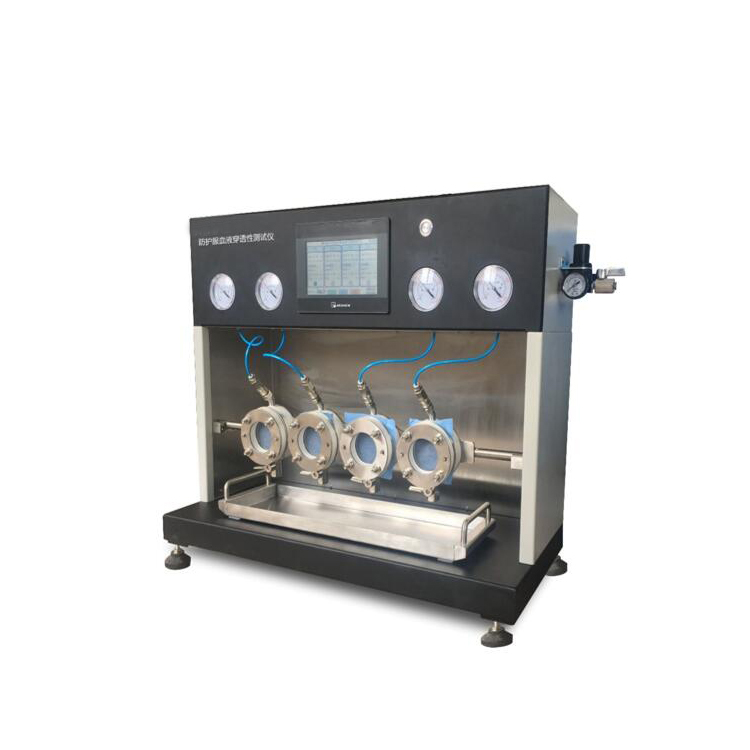
What is a Synthetic Blood Penetration Tester?
A synthetic blood penetration tester is a laboratory testing device designed to simulate the impact of human blood splashes on protective materials, thereby evaluating their resistance to synthetic blood penetration. During testing, a predetermined pressure is used to project a fixed volume of synthetic blood at high speed onto the test specimen. The material’s performance is then determined based on whether penetration occurs. This test is widely used in quality control and compliance assessment of medical protective products and is a key step in product development and certification processes.
Testing Principles
1. Simulation of Blood Splash Behavior
The core concept of synthetic blood penetration testing is to replicate real-world blood splashing conditions. In the test setup, the specimen is securely mounted on a fixture, and the spraying distance is typically set between 300 and 305 mm. A fixed volume of synthetic blood—commonly 2 mL—is then horizontally projected onto the material at a controlled velocity. The back surface of the sample is examined to determine whether penetration has occurred. Precise control of velocity and pressure is essential to ensure test repeatability and consistency.
2. Typical Test Parameters
Common testing parameters include:
Spraying distance: Approximately 300–305 mm, adjustable according to relevant standards.
Nozzle diameter: Typically 0.84 mm, which helps regulate fluid flow characteristics.
Spray velocity: Often set at three levels—450 cm/s, 550 cm/s, and 635 cm/s—corresponding to different pressure conditions.
Spray pressure: Simulates different blood pressure scenarios, commonly 10.6 kPa (≈80 mmHg), 16 kPa (120 mmHg), and 21.3 kPa (160 mmHg).
These parameters cover a range of impact conditions to evaluate material performance across different protection levels.
3. Evaluation Method
After testing, visual inspection is typically used to determine whether synthetic blood has penetrated the material. If any penetration is observed, the sample is considered to have failed. In recent years, some advanced systems have integrated image analysis technologies to assist in more objective and accurate evaluation.
Relevant Standards
To ensure international consistency and comparability of test results, synthetic blood penetration testing follows recognized standards:
1. ASTM F1862
This standard outlines a test method for evaluating the resistance of medical face masks to synthetic blood penetration under controlled horizontal projection at a known velocity. It is one of the most widely used standards in medical mask testing.
2. ISO 22609
This international standard specifies test methods for assessing the resistance of medical face masks to synthetic blood penetration, aligning closely with ASTM F1862 but within the ISO framework to support global harmonization.
3. Chinese Standards
In China, standards such as GB 19083-2010 (technical requirements for medical protective masks) and YY/T 0691-2008 (test methods for resistance to synthetic blood penetration in protective equipment) are commonly applied to ensure compliance with national regulations.
Main Components of the Equipment
A typical synthetic blood penetration tester consists of several key parts:
1. Sample Fixation System
This component securely holds the test specimen in a shape that mimics real usage conditions. Some fixtures are designed with a convex surface to better simulate material stress during actual wear.
2. Pressure-Controlled Spraying System
Using compressed air and a precision nozzle, this system delivers a controlled volume of synthetic blood in a short time frame. High-precision pressure and timing controls enhance test accuracy and repeatability.
3. Observation and Data Recording System
While traditional evaluation relies on visual inspection, modern testers often include digital displays, touchscreens, and software systems that record and analyze test results, improving efficiency and traceability.
4. Target Plate and Spray Path Control
Many systems incorporate a target plate to stabilize the spray stream and ensure accurate impact at the center of the sample, thereby reducing variability.
Practical Applications
The synthetic blood penetration tester is widely used in multiple areas:
1. Medical Mask Performance Testing
Blood splash resistance is a critical requirement for medical masks, especially in surgical and high-risk environments. This tester provides a reliable means to assess protective performance under simulated conditions.
2. Protective Clothing and Isolation Gowns
Beyond masks, protective suits, gowns, and eyewear materials are also evaluated using similar testing methods to ensure adequate barrier performance against body fluids.
3. New Material Development
With advances in nanotechnology and composite materials, many innovative protective fabrics are being developed. Synthetic blood penetration testing helps researchers compare material performance and optimize designs.
4. Product Certification and Compliance
Many regulatory bodies require proof of performance through standardized testing. Results from synthetic blood penetration tests are essential for product approval and market access.
Technological Advances and Future Trends
As testing technology evolves, several key trends are emerging:
1. Increased Automation
Modern systems feature automated controls, digital interfaces, and integrated data management, making testing more standardized and reliable.
2. Multi-Station and High-Throughput Testing
Some advanced testers allow multiple samples to be evaluated simultaneously, significantly improving efficiency for large-scale quality control.
3. Intelligent Image Analysis
Future systems may incorporate AI-based image recognition to automatically detect penetration, reducing human subjectivity and improving accuracy.
The synthetic blood penetration tester is an indispensable tool in the evaluation of medical protective equipment. By accurately simulating real-world blood splash scenarios and adhering to international standards, it provides essential data for product development, quality assurance, and regulatory compliance. As testing technology continues to advance, this equipment will play an even greater role in enhancing the safety and effectiveness of protective materials, ultimately contributing to global public health and occupational safety.
Previous: What is a Mask Air Tightness Tester?
N e x t : Fabric Friction Charging Charge Tester,JIS L-1094
