





How to Operate the Impact Abrasion Resistance Tester?
2026/03/20
Share:

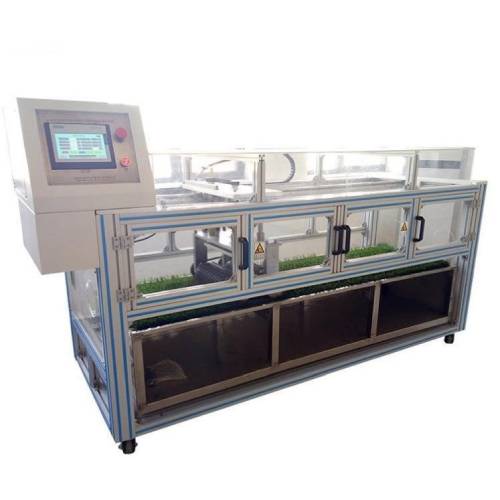
Background of Development
The development of the Impact Abrasion Resistance Tester is fundamentally driven by the growing demand in modern industry for precise evaluation of material performance under complex dynamic mechanical environments. As application scenarios become increasingly extreme and diversified, traditional single-property tests (such as standalone abrasion or impact testing) are no longer sufficient to reflect real service conditions.
1. Comprehensive Enhancement of Safety and Reliability Standards
In key industries such as automotive manufacturing, electronics, personal protective equipment (PPE), and specialized footwear and apparel, materials such as plastics, composites, engineered leather, and functional coatings are widely used. In real-world applications, these materials are often exposed to combined impact and friction forces (e.g., motorcycle riding suits experiencing both collision and ground abrasion during a fall, or industrial gloves subjected to impact and scratching during operation).
To ensure product safety and reliability, there is an urgent need for testing methods and equipment capable of simulating and evaluating such combined stress conditions.
2. Establishment and Promotion of International and Industry Standards
To standardize the evaluation of material performance under combined wear conditions, organizations such as ISO, ASTM, and GB have progressively established and released testing standards for combined or sequential impact–abrasion behavior. These standards have directly driven the development, commercialization, and technological advancement of specialized equipment such as the Impact Abrasion Resistance Tester.
3. Evaluation Challenges from Advanced Materials
With the emergence of advanced materials such as polymer composites, superhydrophobic coatings, and nano-reinforced materials, unique failure mechanisms may occur under combined high-speed impact and continuous friction, including coating delamination, substrate cracking, and interfacial debonding.
To better understand these behaviors and optimize material formulations and processes, researchers require advanced testing equipment capable of accurately simulating real impact–abrasion scenarios and providing quantitative data.
4. Rigid Demand for PPE Performance Verification
In occupational safety and health, the performance of personal protective equipment is directly related to user safety. Products such as cut-resistant gloves, puncture-resistant fabrics, and anti-slip safety footwear must be tested under realistic scenarios involving falls, impacts, and continuous friction.
The Impact Abrasion Resistance Tester provides critical and reliable data support for product certification and performance grading.
5. Trend Toward Intelligent and Automated Testing
Modern testing instruments increasingly integrate microprocessor control, digital sensors, and automated data acquisition and analysis technologies. Advanced Impact Abrasion Resistance Testers typically feature digital displays, automatic energy calibration and compensation, parameter presetting, automatic result calculation and output, and data storage and traceability.
These capabilities significantly improve testing accuracy, repeatability, and efficiency, while meeting the needs of modern laboratories and quality control departments for high-throughput and highly reliable data.
Operating Procedure
Whether the Impact Abrasion Resistance Tester is easy to operate largely depends on the specific model, manufacturer design philosophy, and level of integrated technology. From the current state of development, most modern combined impact–abrasion testing systems offer significantly improved usability compared to earlier models, especially those featuring digital control and automation.
Ease-of-Operation Analysis
High Level of Intelligence
Many modern devices utilize advanced microprocessor control technology to automatically monitor and correct energy losses caused by friction and air resistance. Key results such as force, energy, and wear are displayed directly on high-resolution screens, greatly simplifying data reading and processing.
User-Friendly Human-Machine Interface
Some advanced abrasion or composite testers are equipped with color touchscreen control systems, offering multilingual interfaces (e.g., English and Chinese) and jog functions that allow precise manual adjustments, making setup and sample alignment more convenient and accurate.
High Automation and Integration
Modern equipment supports presetting and storage of testing parameters (such as impact energy, friction speed, load, and cycle count), as well as automatic counting, auto-stop, report printing, and large-capacity data storage/export. These features reduce manual intervention, minimize operator-related errors, and improve repeatability and efficiency.
Requirement for Professional Training
Despite simplified operation due to automation, operators must still receive basic training to ensure results comply with ASTM, ISO, GB, and other standards. This includes understanding test principles, proper sample preparation and mounting, equipment calibration, and correct parameter settings. Therefore, completely inexperienced personnel are not recommended to operate the equipment independently.
Typical Operating Steps
1. Pre-Test Preparation and Sample Conditioning
Strictly follow relevant testing standards (e.g., ASTM)
Power on the equipment and inspect all moving components
Calibrate key parameters such as impact energy and friction load if necessary
Prepare samples according to standard specifications (size, shape), clean surfaces, and condition under standard temperature and humidity
2. Parameter Setting and Sample Mounting
Input test parameters via control panel or software, including impact energy, angle, friction speed or frequency, applied load, and total test cycles
Securely and accurately mount the sample in the fixture, ensuring proper alignment with the impact head or friction wheel
Confirm the test sequence (impact first, abrasion first, or alternating)
3. Test Execution
Start the test program after confirming all settings
The equipment automatically performs impact, abrasion, or combined actions
During testing, key data such as impact force, absorbed energy, friction coefficient, wear depth, or mass loss are recorded and displayed in real time
4. Test Completion and Result Analysis
The equipment stops automatically after reaching the preset cycle
Carefully remove the sample and observe damage (cracks, perforation, wear marks)
Retrieve and export complete test data from the display or connected software
Evaluate material performance according to standards (e.g., mass loss rate, thickness reduction, or cycles to failure)
Equipment Precautions
Clean the working area and fixtures after each test
Prepare samples according to standards such as ASTM D256. ISO 179. and GB/T 1043
Equipment Calibration
Before testing, comprehensive calibration is required:
Zero-point adjustment
Accurate calibration of impact energy
Selection of appropriate abrasion wheels or media
Parameter Setting
Operators set parameters via touchscreen or physical buttons:
Impact energy and pendulum release angle
Load, wheel speed, and total test cycles
Test Execution
Impact test: pendulum strikes the fixed sample
Abrasion test: friction wheel or head runs continuously on the sample surface
Result Reading
After testing, the system automatically calculates and displays:
Impact strength
Sample mass loss
Wear amount
Some advanced models support direct report printing.
Cleaning and Maintenance
Remove debris and residues after each test
Inspect key components such as wheels and fixtures
Perform regular calibration and maintenance to ensure long-term accuracy
Technical Advantages and Industry Value
Technical Advantages
High-Precision Measurement: Equipped with high-sensitivity digital sensors, precision encoders, and high-speed data acquisition systems
Multi-Standard Compatibility: Supports ASTM, ISO, DIN, and GB standards (e.g., ASTM D4060. ASTM D4966. ISO 12947)
Realistic Simulation: Simultaneously simulates combined impact and abrasion conditions
Automation and Intelligence: Touchscreen control, automatic compensation, and data management
Multi-Function Integration: Some models support additional tests such as tear resistance, puncture resistance, and friction coefficient
Robust Structure: High-strength cast iron or steel frame ensures long-term stability and repeatability
Industry Value
Ensures Product Reliability: Provides scientific data for durability prediction and quality validation
Accelerates R&D Cycles: Replaces long-term field testing with accelerated laboratory testing
Meets Compliance Requirements: Helps products comply with international standards and enhances market competitiveness
The Impact Abrasion Resistance Test plays a crucial role in materials science and industrial quality control. It acts as a rigorous evaluator by applying precisely controlled combined impact and abrasion forces to assess material durability and service life under harsh conditions.Whether for developing advanced high-strength materials, optimizing composite formulations, or ensuring the long-term reliability of critical components in mining machinery, engineering structures, and transportation infrastructure, this test provides indispensable quantitative data and scientific support.It is no exaggeration to say that the Impact Abrasion Resistance Tester is an essential tool for ensuring product quality, advancing material technology, and enhancing industrial durability—a solid backbone for modern engineering innovation.
Previous: What is the dry rate test for fabric?
N e x t : What is a building material smoke density testing machine?
