





What is environmental stress cracking resistance?
2026/09/15
Share:

How to Understand the Working Principle of an Environmental Stress Cracking Tester
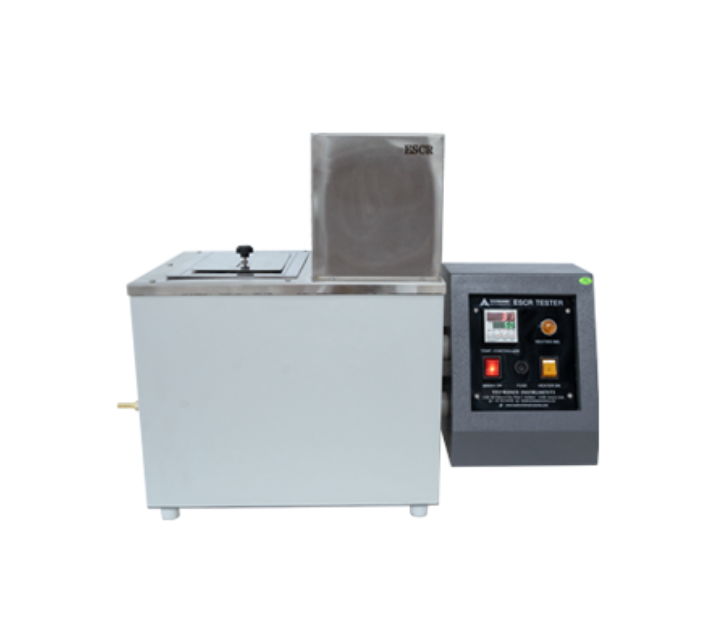
To understand the working principle of this equipment, it is necessary to begin with the interaction between “environment” and “stress.” The tester does not simply immerse the specimen in a liquid or apply tensile force alone. Instead, its design is based on creating a controlled and repeatable “chemical-mechanical” coupled environment.
The tester applies a constant tensile strain or load to standardized plastic specimens through precision fixtures. This stress level is typically lower than the yield strength of the material measured in air. At the same time, the specimen is continuously exposed to a specific chemical environment. These chemical agents may include detergents, oils, acids, alkalis, or other industrial chemicals.
The key function of the instrument is to maintain a stable and consistent stress level and uniform environmental conditions, ensuring that any subsequent changes in material performance can be objectively attributed to the combined effects of mechanical stress and environmental exposure, rather than fluctuations in the test conditions.
Application Scenarios of the Environmental Stress Cracking Tester
In the research and development of new polymeric materials, researchers can use the IPT Environmental Stress Cracking Tester to evaluate the environmental stress cracking resistance of materials during the formulation optimization of polyolefins, modified engineering plastics, high-performance elastomers, and other advanced materials. By testing different formulations and processing conditions, researchers can quantitatively compare the performance of different solutions, providing data-based support for formulation adjustment and process optimization while shortening the development cycle.
In industrial production and quality control, the equipment can be used for batch performance sampling during the production of plastic raw materials and the processing of modified plastic products. For example, manufacturers of water-supply pipes and gas transmission pipes can conduct environmental stress cracking resistance tests on polyolefin raw materials from each production batch before processing. Materials can be put into production after their performance has been confirmed to meet the required specifications, helping prevent premature failure of finished products during service.
In third-party testing and compliance evaluation, the IPT Environmental Stress Cracking Tester, as a dedicated testing instrument designed to meet applicable standard requirements, can provide standardized test data. Third-party testing organizations can use the equipment to provide downstream manufacturers with reliability and compliance testing services for polymer materials, helping meet the performance verification requirements for products entering the market.
In service-life verification under demanding operating conditions, the tester can be used to simulate actual service environments and conduct accelerated tests on end products that are exposed to corrosive media for extended periods while subjected to constant mechanical stress. Typical applications include plastic pipes used for oil and gas gathering systems, corrosion-resistant linings for chemical containers, and packaging containers for household and personal-care products. Researchers can use the test results to evaluate the expected service life of materials and provide a technical basis for selecting suitable engineering materials.
Overall, the IPT Environmental Stress Cracking Tester, with its stable control accuracy and ability to accommodate various testing conditions, can support the entire process from material research and development to production quality control and final product verification. It is a commonly used dedicated testing instrument for reliability research and performance evaluation of polymeric materials.
Importance of the Environmental Stress Cracking Tester
The importance of the Environmental Stress Cracking Tester lies primarily in its ability to identify potential brittle cracking risks at an early stage, even when the material is subjected to stress well below its yield strength, thereby helping prevent premature product failure during service. This type of failure is one of the most common failure modes of plastic products and can result in significant safety hazards and economic losses.
Simply put, the value of the tester is that it helps “identify potential problems in advance” before a material enters production:
Ensuring Long-Term Reliability:
By simulating actual service conditions involving stress, chemical media, and temperature, the tester can quantitatively evaluate a material's resistance to environmental stress cracking and help predict its service life. This can help prevent sudden cracking of products such as pipes, containers, and cables during service.
Supporting Research, Development, and Quality Control:
During the optimization of new material formulations, the tester enables quantitative comparisons of different formulations and processing conditions, helping shorten development cycles. In industrial production, it can be used for sampling and testing raw material batches to ensure that materials meet the required specifications before processing, thereby reducing the risk of batch-related failures.
Meeting Compliance Requirements:
As a dedicated testing instrument designed to comply with various international standards, the tester provides test data that can serve as an important basis for product performance verification, market access, third-party testing, and certification.
Covering Critical Application Areas:
From water-supply and drainage pipes and gas transmission pipes to oil and gas gathering pipelines, chemical-container linings, and impermeable geomembrane layers, many critical engineering applications rely on environmental stress cracking testing to help ensure material reliability and operational safety.
Overall, the Environmental Stress Cracking Tester plays an important and often indispensable role in material research and product quality evaluation across multiple industries by simulating different environmental conditions and applying various types of mechanical stress. It provides strong technical support for ensuring product quality, improving material reliability, and advancing the development of polymer materials science.
Previous: What is a spring torsion testing machine?
N e x t : the last page
