




Search keywords:
product name, product type, model number,
test method, manufacturer, technique, application
-
Cone Calorimeter
The import of American VTEC, cone calorimeter ultra high cost performance
more
-
Digital Elmendorf Tearing Tester
Pendulum method test material tear strength, operating more simple, more accurate data
more
-
ZwickiLine Materials testing machines
Top of the world's leading universal material testing machine
more
Battery combustion tester
BACK

Standards:
Applications:
Product Information:
The Battery Combustion Tester is designed for safety evaluation of lithium-ion batteries by simulating direct exposure to flame jet combustion under extreme conditions.
The equipment verifies battery behavior when subjected to sustained flame impingement, including risks of ignition, explosion, rupture, or excessive temperature rise.
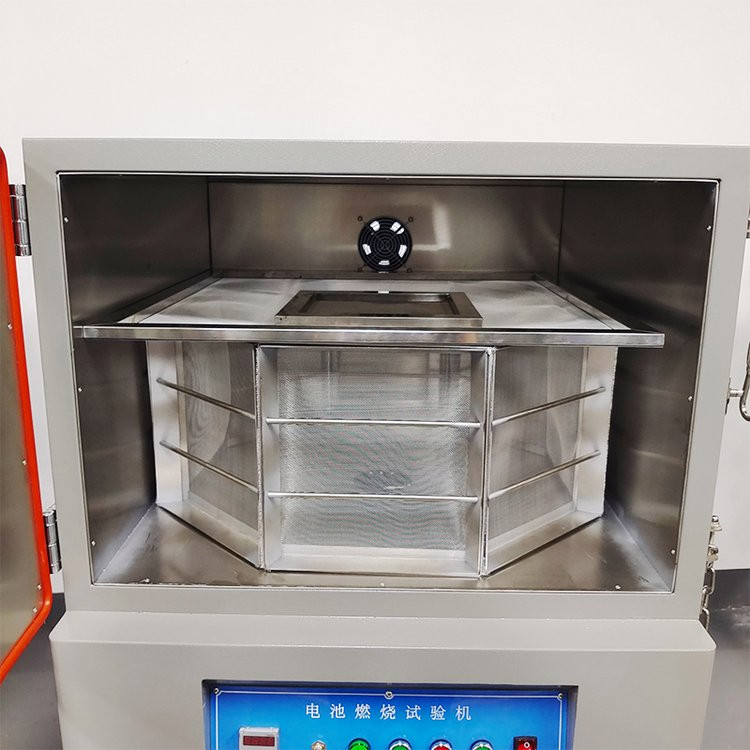
The system adopts liquefied petroleum gas (LPG) as fuel with a Bunsen burner configuration and integrates a reinforced explosion-proof test chamber, gas leakage protection, and automatic flame control, making it suitable for laboratory certification testing and safety compliance evaluation.
Application
(1) Cylindrical lithium-ion cells (e.g. 18650, 21700)
(2) Prismatic lithium-ion batteries
(3) Pouch (polymer) lithium batteries
(4) Button and coin cells
(5) Lithium-ion battery packs for consumer electronics
(6) Power batteries for electric vehicles
(7) Energy storage battery modules
Standards
(1) UN 38.3 – Lithium Batteries Transport Testing
(2) UL 1642:2012 – Lithium Batteries Safety Standard
(3) UL 2054:2012 – Household and Commercial Batteries
(4) IEC 62281:2004 – Safety of Primary and Secondary Lithium Cells and Batteries
(5) GB 31241-2014 – Safety Requirements for Lithium-Ion Cells and Batteries
(6) SJ/T 11170-1998 – Lithium-Ion Battery Safety Test Methods
Features
(1) Designed for battery flame jet combustion testing in accordance with GB 31241 and related standards
(2) Uses high-purity liquefied petroleum gas as fuel with Bunsen burner structure
(3) Automatic ignition system with adjustable flame application time
(4) Continuously adjustable flame height to meet different standard requirements
(5) Strictly designed test steel mesh and aluminum mesh in accordance with standard specifications
(6) Precisely defined burner position and test platform geometry
(7) Double-layer reinforced test chamber with explosion-proof pressure relief port
(8) Built-in lighting system for clear observation during testing
(9) Dual gas leakage alarm system with automatic gas shut-off function
(10) High-quality electrical components ensuring stable and reliable operation
(11) Supports switching between local and remote control operation
(12) Optional fire extinguishing module and video monitoring system
Technical Parameters
| Parameter | Specification |
|---|---|
| Test Item | Flame Jet Combustion Test |
| Test Objects | Button, cylindrical, pouch, prismatic lithium batteries |
| Combustion Gas | High-purity liquefied petroleum gas (LPG) |
| Burner Type | Bunsen burner |
| Burner Tube Inner Diameter | 9.5 mm |
| Burner Tube Length | 100 mm |
| Flame Control | Automatic ignition; flame application time and combustion duration 0–999 s, continuously adjustable |
| Flame Height | 10–75 ±2 mm |
| Test Steel Mesh | Wire diameter 0.45 mm, 20 mesh |
| Test Aluminum Mesh | Wire diameter 0.25 mm, 16 mesh |
| Power Supply | Single-phase 220 VAC ±10% (110 VAC optional), 50/60 Hz |
| Rated Power | 0.5 kW |
| Operating Temperature | 25 ± 3 ℃ (recommended) |
| Operating Humidity | 30–90 %RH |
| Explosion Protection | Pressure relief port, reinforced enclosure |
| Auxiliary Functions | Built-in lighting, optional fire extinguisher, optional video monitoring* |
| Installation Dimensions | W1020 × D980 × H1865 mm |
| Equipment Weight | Approx. 357 kg |
* Video monitoring requires customer-provided PoE switch compliant with IEEE 802.3af/at.
Accessories
(1) Bunsen burner assembly
(2) Steel test mesh
(3) Aluminum protection mesh
(4) Gas leakage detection system
(5) Explosion-proof observation structure
(6) Built-in illumination system
(7) Optional fire extinguishing module
(8) Optional video monitoring system
Test Procedures
(1) Place the battery sample on the test platform above the specified steel mesh
(2) Select the applicable test standard and flame parameters
(3) Adjust flame height and flame application time
(4) Close and secure the explosion-proof test chamber
(5) Ignite the burner automatically and apply the flame to the sample
(6) Observe battery behavior through the observation window
(7) Record test results and inspect the sample after completion
Maintenance Information
(1) Regularly inspect gas pipelines, burner, and leakage alarm devices
(2) Check steel mesh and aluminum mesh for deformation or damage
(3) Verify flame height calibration periodically
(4) Keep electrical and gas components clean and dry
(5) Perform routine maintenance according to usage frequency
