




Search keywords:
product name, product type, model number,
test method, manufacturer, technique, application
-
Cone Calorimeter
The import of American VTEC, cone calorimeter ultra high cost performance
more
-
Digital Elmendorf Tearing Tester
Pendulum method test material tear strength, operating more simple, more accurate data
more
-
ZwickiLine Materials testing machines
Top of the world's leading universal material testing machine
more
Contact Heat Transmission Tester
BACK

Standards:
ISO 11092:2014:Textiles — Physiological effects — Measurement of thermal and water-vapour resistance under steady-state conditions (sweating guarded-hotplate test) ASTM D1518-17:Standard Test Method for Thermal Resistance of Batting Systems Using a Hot Plate ASTM F1868:Standard Test Method for Thermal Resistance, Evaporative Resistance, and Total Heat Loss Measurements of Clothing Materials Using a Sweating Hot Plate ISO 5085-1:Textiles — Determination of thermal resistance — Part 1: Low thermal resistance ISO 9920:2007:Ergonomics of the thermal environment — Estimation of thermal insulation and water vapour resistance of a clothing ensemble
Applications:
In the medical field, it helps develop and screen more comfortable medical protective clothing to prevent heat accumulation and discomfort caused by long-term wearing for medical staff, and reduce the risk of heat stroke; in the industrial and fire protection fields, it can evaluate the thermal insulation effect of high-temperature protective clothing to ensure the safety of workers in high-temperature environments and prevent heat injuries.
Product Information:
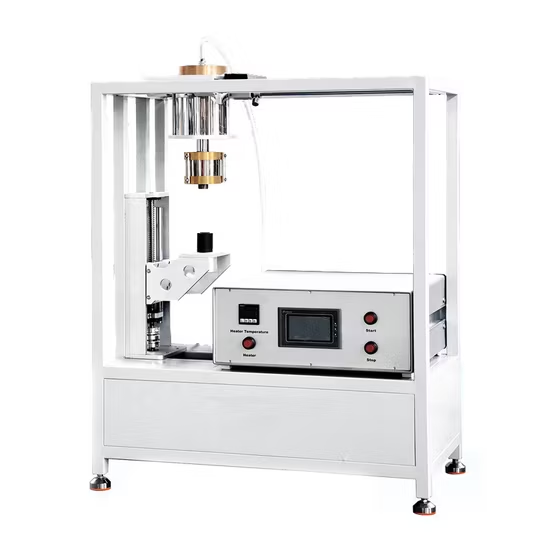
The Protective Clothing Thermal Conductivity Tester is a specialized device used to evaluate the thermal conductivity performance of thermal insulation clothing when it comes into contact with a heat source. By simulating a high-temperature contact environment, it quantifies the material's resistance to heat conduction, providing a scientific basis for the design, production, and use of thermal insulation clothing.
Applications
In the medical field, it helps develop and screen more comfortable medical protective clothing to prevent heat accumulation and discomfort caused by long-term wearing for medical staff, and reduce the risk of heat stroke; in the industrial and fire protection fields, it can evaluate the thermal insulation effect of high-temperature protective clothing to ensure the safety of workers in high-temperature environments and prevent heat injuries.
Standards
ISO 11092:2014:Textiles — Physiological effects — Measurement of thermal and water-vapour resistance under steady-state conditions (sweating guarded-hotplate test)
ASTM D1518-17:Standard Test Method for Thermal Resistance of Batting Systems Using a Hot Plate
ASTM F1868:Standard Test Method for Thermal Resistance, Evaporative Resistance, and Total Heat Loss Measurements of Clothing Materials Using a Sweating Hot Plate
ISO 5085-1:Textiles — Determination of thermal resistance — Part 1: Low thermal resistance
ISO 9920:2007:Ergonomics of the thermal environment — Estimation of thermal insulation and water vapour resistance of a clothing ensemble
Features
Quantitative Performance Data: Provides objective, numerical data on the thermal insulation properties of protective clothing materials.
Ensures Wearer Safety and Comfort: Supports the development and selection of materials that provide appropriate thermal protection against heat or cold.
Standard Compliance: Enables testing in accordance with relevant international and national standards, essential for product certification and market acceptance.
Versatile Material Testing: Applicable to a wide range of textile structures, from single fabrics to multi-layer protective ensembles.
Supports Research and Development: Facilitates the study of thermal behavior in textiles and the development of innovative protective materials.
Quality Control Tool: Allows manufacturers to verify the consistency of the thermal properties of their materials during production.
Technical Parameters
| Parameter | Specification |
|---|---|
| Sample | Textile |
| Testing standards | DIN EN 702. ISO 1217-1 |
| Sensor | Calorimeter |
| Power supply | 230 VAC / 350 VA |
| Gas source | Oxygen / Acetylene gas |
| Equipment dimensions (W x D x H) | 600 x 250 x 650 mm |
Test Procedures
Before the experiment, the heating cylinder was heated to the set temperature, and the sample was mounted onto the calorimeter. The calorimeter was moved towards the heating cylinder at a speed of 5 mm/s, and a load of 45 N was applied upon contact. The temperature rise time threshold of 10°C was measured using the calorimeter. The temperature of the heating cylinder could be adjusted from room temperature to 500°C.
Maintenance Method
Regularly check the operating status of the heating cylinder to ensure that the temperature adjustment range and heating stability meet the testing requirements.
Keep the calorimeter surface clean to prevent residue from affecting the accuracy of temperature measurements.
Regularly check the sample mounting area and loading mechanism to ensure consistent contact pressure.
Check that the gas source connection (oxygen/acetylene) is properly sealed to ensure safe use.
When the equipment is not in use, turn off the power and keep the equipment in a dry, well-ventilated environment.
Accessories
Accessories (Based on Technical Parameters and Test Procedures)
Heating Cylinder Assembly (Temperature Adjustable, Up to 500°C)
Calorimeter Sensor
Sample Fixing Device
Loading Mechanism (45 N Contact Load)
Gas Source Interface Assembly (Oxygen/Acetylene)
Power System (230 VAC / 350 VA)
FAQs
1. What is the purpose of the Contact Heat Transmission Tester?
The Contact Heat Transmission Tester is designed to evaluate the thermal conductivity performance of thermal insulation clothing when it comes into direct contact with a heat source. By simulating a high-temperature contact environment, the tester measures how quickly heat is transmitted through textile materials. The test results provide quantitative data that support the design, production, and selection of protective clothing intended to reduce heat transfer and protect the wearer from heat-related injuries.
2. How does the tester simulate contact heat transmission during testing?
During testing, the heating cylinder is first heated to a preset temperature, which can be adjusted from room temperature up to 500°C. The textile sample is mounted onto the calorimeter, which serves as the temperature sensor. The calorimeter is then moved toward the heating cylinder at a controlled speed of 5 mm/s. Upon contact, a load of 45 N is applied to ensure consistent pressure between the sample and the heat source. The tester measures the time required for the temperature on the calorimeter side to rise by 10°C, allowing quantitative evaluation of heat transmission performance.
3. What types of applications is this tester suitable for?
The tester is suitable for medical, industrial, and fire protection applications. In the medical field, it supports the development of protective clothing that reduces heat accumulation and discomfort during long-term wear. In industrial and fire protection environments, it is used to evaluate the thermal insulation effectiveness of high-temperature protective clothing, helping to ensure worker safety and prevent heat injuries in high-temperature conditions.
4. Which standards can be supported by this tester?
The Contact Heat Transmission Tester supports testing in accordance with multiple international standards related to thermal resistance and heat transfer in textiles. These include ISO 11092:2014. ASTM D1518-17. ASTM F1868. ISO 5085-1. and ISO 9920:2007. By enabling testing aligned with these standards, the instrument provides reliable and comparable data for research, product development, certification, and quality control. Compliance with recognized standards is essential for market acceptance of protective clothing materials in regulated industries.
