




Search keywords:
product name, product type, model number,
test method, manufacturer, technique, application
-
Cone Calorimeter
The import of American VTEC, cone calorimeter ultra high cost performance
more
-
Digital Elmendorf Tearing Tester
Pendulum method test material tear strength, operating more simple, more accurate data
more
-
ZwickiLine Materials testing machines
Top of the world's leading universal material testing machine
more
Manual Wire Bending Tester
BACK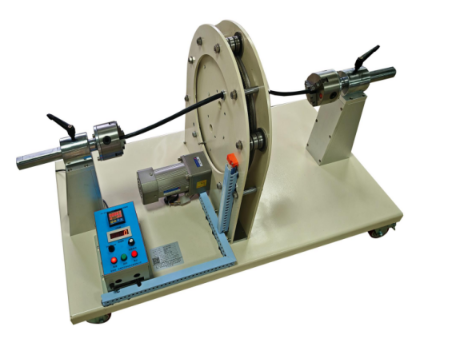


Standards:
JIS C 3005 – Testing method for flexible cords
Applications:
(1) Automotive wire harness testing – evaluate conductor integrity under repeated bending.
(2) Power cord quality control – ensure mechanical reliability of household and industrial cords.
(3) USB and data cable durability – simulate repetitive bending during normal use.
(4) Electrical appliance wiring – check wire insulation and conductor performance.
(5) Laboratory R&D – test new wire materials for bending fatigue resistance.
Product Information:
The Manual Wire Bending Tester is designed to evaluate the mechanical durability of electrical wires according to the JIS-C3005 standard. By bending wire samples repeatedly through preset holes, the tester assesses damage, cracking, surface cracks, and conductor strand breakage. The instrument features simple operation, bidirectional rotation, and automatic stop after reaching the preset number of cycles.
Parameters
| Parameter | Specification |
|---|---|
| Clamp Type | Manual |
| Clamp Spacing | 0–500 mm adjustable |
| Total Cycles | 0–999.999 cycles (manual setting) |
| Test Speed | 20 cycles/min |
| Off-Center Distance | 50. 75. 100. 150 mm |
| Sample Parallel Section Diameters | φ4 mm, φ6 mm, φ8 mm, φ10 mm, φ12 mm, φ15 mm, φ18 mm, φ20 mm |
Features
(1) Manual operation with adjustable clamp spacing.
(2) Supports a wide range of wire diameters (4–20 mm).
(3) Bidirectional rotation ensures uniform stress application.
(4) Cycle count can be set manually up to 999.999 cycles.
(5) Simple, reliable mechanical design for consistent test results.
Accessories
(1) Set of clamps for various wire diameters.
(2) Calibration manual.
(3) Instruction and operation manual.
(4) Adjustable off-center distance accessories.
(5) Optional data recording sheet.
Test Procedures
(1) Insert the wire sample through the specified circular hole of the clamp.
(2) Secure the wire in the fixture at the preset spacing.
(3) Set the total number of bending cycles.
(4) Start the test; the wheel rotates the wire sample in the selected direction.
(5) Upon completion or wire failure, stop the test.
(6) Inspect the wire for cracking, surface damage, or strand breakage.
(7) Record the test results for quality assessment.
Maintenance Information
(1) Clean clamps and rotating components regularly to prevent debris accumulation.
(2) Lubricate moving parts periodically for smooth operation.
(3) Check cycle counter and manual settings for accuracy.
(4) Inspect mechanical parts for wear or misalignment.
(5) Store in a dry environment to avoid corrosion.
Conclusion
The Manual Wire Bending Tester provides a simple yet reliable method for assessing wire durability under repeated bending stress. It is widely used in automotive, electronics, power cord manufacturing, and R&D laboratories to ensure wire quality, compliance, and mechanical integrity.
FAQ
(1) What is this product?
It is a manual tester for evaluating the bending durability of electrical wires.
(2) What is this product used for?
It tests wires for cracking, strand breakage, and insulation damage under repeated bending conditions.
(3) What is the working principle of this product?
Wire samples are manually clamped and repeatedly bent through circular holes, simulating real-world bending stress.
(4) Why is this product important?
It ensures wire mechanical reliability, prevents premature failure, and supports quality control.
(5) What industries is this product suitable for?
Automotive wiring, power cord manufacturing, USB and data cable production, electrical appliance wiring, and R&D laboratories.
