




Search keywords:
product name, product type, model number,
test method, manufacturer, technique, application
-
Cone Calorimeter
The import of American VTEC, cone calorimeter ultra high cost performance
more
-
Digital Elmendorf Tearing Tester
Pendulum method test material tear strength, operating more simple, more accurate data
more
-
ZwickiLine Materials testing machines
Top of the world's leading universal material testing machine
more
Helmet Projection and Surface Friction tester
BACK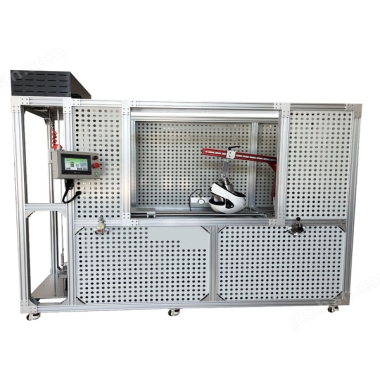


Standards:
Applications:
Produced according to helmet related standards, it is mainly used to test the shear force and friction performance of the surface raised structure of motorcycle helmets and electric vehicle helmets. Widely used in various helmets related production, scientific research, quality supervision and testing units.
Product Information:
The helmet projection and surface friction tester is a device used to test the frictional force between the helmet surface and other objects. Its main purpose is to ensure that the helmet has sufficient friction during use to prevent slipping or detachment, thereby improving safety.
Standards
(1)GB811: Helmets for motorcycle and electric bicycle users
(2)ECE R22.05: ECE R22.05 Motorcycle Helmet Standard
Features
(1) PLC touch screen control.
(2) Horizontally oriented carrier with exchangeable installation of sandpaper and cutter.
(3)Head type can be rotated 360.
(4)Equipped with professional speed measuring tooling.
Accessoriess
(1)Abrasive sandpaper
(2)Steel cutting blade
(3)Weights
(4)Weight dropping device
(5)Preloading device
(6)Sensor
(7)Head form
(8)Specimen holder
Parameters
| Technical Parameter | Description |
|---|---|
| Friction sandpaper | Length: 300mm - 303mm; Grade 80 aluminum oxide coated sandpaper |
| Steel cutter | Height: 6mm; Width: 25mm; The top edge is chamfered with a radius of 1mm |
| Impact weight | 15kg - 15.5kg |
| Weight fall height | 0 - 1000mm |
| Pre-loaded weight | 400N - 410N |
| Sensor range | 0 - 120mm |
| Instrument power supply | 220V 50Hz |
Test Procedures
Mount the helmet onto the head form.
The support frame is rotated by a telescopic cylinder, and the support frame drives the sliding frame, rotating frame, and head form to move.
The head form moves the helmet, and by adjusting the position of the sliding frame and the angle of the head form, the part to be tested is connected to the loading platform.
During the shear force test, a steel cutter with a height of 6mm and a width of 25mm is installed on the loading platform. The surface of the cutter is subjected to carburizing and hardening treatment to a depth of 0.5mm.
The lifting component drives the loading platform to move, allowing the loading platform to move towards the helmet.
The lifting component drives the loading platform to move, causing the loading platform to slide relative to the helmet for the shear force test.
During the friction force test, a piece of aluminum oxide coated sandpaper with a length of 300mm and a grade of 80 is installed on the loading platform.
Adjust the position of the helmet so that the part of the helmet to be tested can slide and rub against the sandpaper.
Repeat steps 5-8 to perform the friction force test.
FAQ
1. What is a Helmet Projection and Surface Friction Tester?
This device evaluates the surface friction and impact behavior of helmets to ensure they can resist sliding and provide effective protection during collisions or impacts.
2. How does the helmet projection and friction test work?
The helmet is placed on a test rig and subjected to controlled impact or sliding simulations. Sensors measure surface friction, sliding distance, and impact response to assess helmet performance.
3. What types of helmets can be tested?
It can test industrial safety helmets, construction helmets, bicycle helmets, motorcycle helmets, and other protective headgear designed to resist sliding and impact forces.
4. What parameters are measured during testing?
The tester measures surface friction coefficient, sliding distance, impact resistance, and energy absorption. Data is used to evaluate helmet safety and compliance with standards.
5. Why is helmet projection and surface friction testing important?
Testing ensures helmets remain stable during impacts or falls, reducing rotational or sliding injuries, and ensures compliance with safety standards such as EN 397. ANSI Z89.1. or ISO.
