




Search keywords:
product name, product type, model number,
test method, manufacturer, technique, application
-
Cone Calorimeter
The import of American VTEC, cone calorimeter ultra high cost performance
more
-
Digital Elmendorf Tearing Tester
Pendulum method test material tear strength, operating more simple, more accurate data
more
-
ZwickiLine Materials testing machines
Top of the world's leading universal material testing machine
more
Safety Helmet Flammability Tester
BACK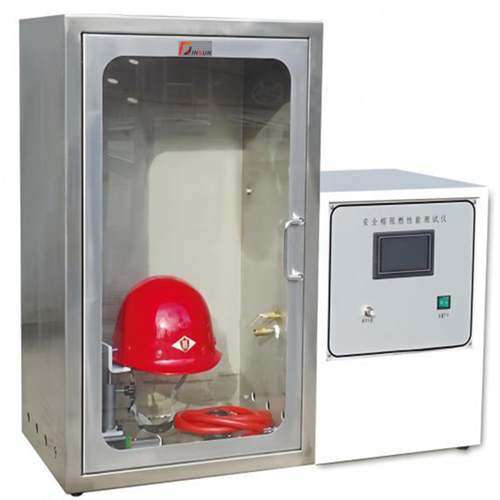


Standards:
Applications:
The tester is suitable for flame retardancy assessment of head protection products exposed to fire or high-temperature environments. Typical application scenarios and tested products include:
(1) Industrial Safety Helmets – construction helmets, mining helmets, oil and gas industry helmets.
(2) Electrical Safety Helmets – insulating helmets used for power distribution, substations, and electrical maintenance.
(3) Rescue and Emergency Helmets – firefighting helmets, emergency rescue helmets, disaster response helmets.
(4) Special Protective Helmets – metallurgical helmets, chemical industry helmets, welding and thermal operation helmets.
(5) Helmet Materials and Components – helmet shells, brim materials, suspension systems, and flame-retardant coatings.
(6) Quality Control and Certification Testing – routine factory inspection, third-party certification, and type testing for compliance verification.
Product Information:
The Safety Helmet Flammability Tester is designed to evaluate the flame-retardant performance of safety helmets when exposed to a standardized open flame. The instrument provides a controlled and repeatable test environment to determine afterflame time and afterglow time, ensuring that helmets meet fire safety requirements under relevant national and international standards. With a high degree of automation and precise timing control, it is widely used by helmet manufacturers, quality inspection institutions, and construction engineering testing laboratories.
Standards
The Safety Helmet Flammability Tester complies with and supports testing according to the following standards:
(1) GB/T 2811-2007 – Safety helmets (China)
(2) GB/T 2812-2006 – Safety helmet test methods (China)
(3) GB/T 38305-2019 – Head protection – Rescue helmets (China)
(4) EN 397 – Industrial safety helmets (Europe)
(5) EN 443 – Helmets for fire fighting in buildings and other structures (Europe)
(6) ANSI/ISEA Z89.1 – Industrial head protection (USA)
(7) CSA Z94.1 – Industrial protective headwear (Canada)
(8) ISO 11612 – Protective clothing against heat and flame (related material reference)
(9) ISO 17025 – General requirements for the competence of testing laboratories
(10) CE Conformity – Machinery and safety compliance
(11) ISO 9001 – Quality management systems
Features
(1) High-automation test process ensuring consistent and repeatable flame exposure.
(2) Precise measurement of afterflame time and afterglow time.
(3) Standard Bunsen burner flame source with controlled flame dimensions.
(4) Adjustable flame application time suitable for different standards.
(5) Compatible with multiple standard test gases including methane, propane, butane, and LPG.
(6) Stable fixture system for accurate positioning of helmets or test specimens.
(7) Clear timing display with high resolution for objective result evaluation.
(8) Reliable safety design suitable for routine laboratory and factory testing.
Accessories
(1) Standard Bunsen burner assembly – 1 set
(2) Flame length measuring scale – 1 piece
(3) Helmet holding fixture – 1 set
(4) Power cable – 1 piece
(5) User operation manual – 1 copy
Technical Parameters
| Parameter | Specification |
|---|---|
| Bunsen Burner Inner Diameter | 10 mm |
| Ignition Timing Range | 0 – 999.9 s (typical standard setting: 10 s) |
| Afterflame / Afterglow Timer Range | 0 – 999.9 s |
| Timer Accuracy | ±0.01 s |
| Flame Length Measuring Scale | 50 mm |
| Applicable Gas Types | Methane, Propane, Butane, LPG |
| Power Supply | AC 220 V, 50 Hz |
| Rated Power | 50 W |
Test Procedures
(1) Install the safety helmet or prepared test specimen on the designated fixture.
(2) Adjust the Bunsen burner position according to the applicable standard.
(3) Set the flame length using the flame measuring scale.
(4) Select the required flame application time on the igniter timer.
(5) Ignite the burner and apply the flame to the specified test position.
(6) After flame removal, automatically record afterflame and afterglow times.
(7) Evaluate test results according to the selected standard requirements.
Maintenance Information
(1) Regularly inspect and clean the Bunsen burner to ensure stable flame characteristics.
(2) Verify timer accuracy periodically to maintain measurement reliability.
(3) Check gas connections for leakage before operation.
(4) Keep the test chamber and fixtures clean to avoid contamination.
(5) Store the instrument in a dry, well-ventilated environment when not in use.
FAQ
1. What is a Safety Helmet Flammability Tester?
This device evaluates the flame resistance and ignition behavior of helmets, ensuring they provide protection against fire hazards in high-risk environments.
2. How does the flammability test work?
The helmet or sample material is exposed to a controlled flame or heat source for a specified time. Observations are made on ignition, flame spread, burning duration, and self-extinguishing properties.
3. What types of helmets can be tested?
It can test industrial safety helmets, construction helmets, firefighting helmets, and other protective headgear made from plastics, composites, or thermoset materials.
4. What parameters are measured during testing?
The tester measures ignition occurrence, flame spread rate, burning duration, charring, melting, and structural degradation. Data is used for quality control and safety compliance.
5. Why is flammability testing important?
Testing ensures helmets resist catching fire and limit flame spread, protecting the wearer from burns and injuries. It helps manufacturers comply with safety standards such as EN 397. ASTM F2178. or ISO fire-resistance regulations.
