




Search keywords:
product name, product type, model number,
test method, manufacturer, technique, application
-
Cone Calorimeter
The import of American VTEC, cone calorimeter ultra high cost performance
more
-
Digital Elmendorf Tearing Tester
Pendulum method test material tear strength, operating more simple, more accurate data
more
-
ZwickiLine Materials testing machines
Top of the world's leading universal material testing machine
more
Comprehensive Test Bench for Car Door Locks and Hinges
BACK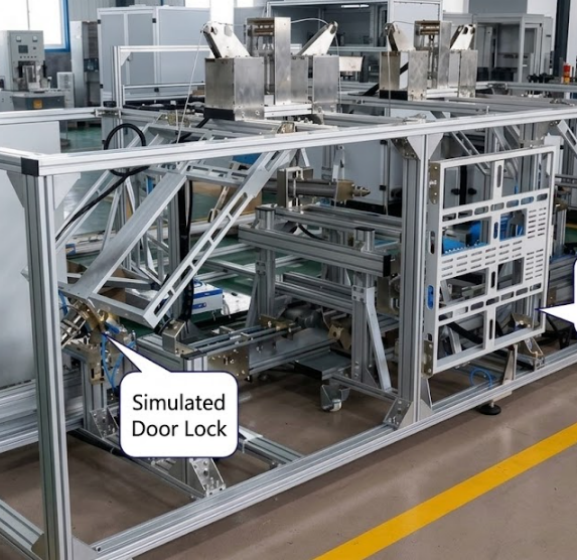


Standards:
Applications:
Product Information:
This test bench is mainly used to perform simulated durability tests on car door hinges and door locks of passenger cars, SUVs, and MPVs under normal temperature conditions. The tests are designed to inspect the functional quality of vehicle side door locks and hinges.The test bench primarily consists of two parts, including the door lock and hinge durability simulation mechanism. It is capable of simulating the durability of a single car door.For customer convenience, the bench is equipped with two sets of door durability mechanisms, allowing tests to be conducted on either one door or two doors simultaneously.
Standards
QC/T 323-2007 – "Automotive Door Locks and Door Retainers"
GB 15086-2006 – "Performance Requirements and Test Methods for Automotive Door Locks and Door Retainers"
QC/T 627-1999 – "Automotive Power Door Lock Systems"
The technical specifications of this test bench comply with the relevant testing requirements outlined in the above standards.
Technical Specifications of the Test Bench
1. Mechanical Performance
Test frequency: 1–8 cycles/min, adjustable by modifying test steps and pause times.
Side door opening angle: 0–80°, adjustable according to different vehicle models.
Test actions include: Unlocking (mechanical or pneumatic) → Door opening → Door closing.
Durability test cycle range: 1–999.999 cycles.
2. Operating Conditions
Ambient temperature: 0℃ to 40℃
Relative humidity: 20%–85% RH
Power supply: AC 220V ±10%, 50Hz ±2%
Air supply pressure: 0.6–0.8 MPa
Control System
Computer Control Section
1. Hardware Configuration
Computer System
Yanzhuang Industrial Control Computer: P4 3.0GHz / 1GB RAM / 160GB HDD
19-inch LCD Monitor
Motion Detection Board
Data Acquisition Board
Drawer-type Keyboard Tray
2. Pneumatic System
Pneumatic Control Cabinet,A separate pneumatic control cabinet independently controls and drives the motion of each door-opening mechanism.
The pneumatic layout is well-organized, standardized, and clearly labeled.
Pneumatic pipelines inside the test bench, as well as those connecting the test bench to the control system, are protected by metal cable trays, ensuring both equipment reliability and an aesthetically clean appearance.
3.Electrical Control Cabinet
A separate electrical control cabinet is provided.
All electrical system control and signal wiring is reasonably arranged, standardized, and clearly labeled.
All connection ports are easily detachable, facilitating maintenance and repair.
4.Control and Data Processing Software
The test bench software is developed on the Windows XP operating platform, offering user-friendly operation.
The software allows setting of working time, test cycle count, and low-pressure alarms.
1) Model Management Module
Users can add or delete a product model for a specific vehicle type.
The test management program has two access levels:
Operator: Can only perform test-related operations.
Administrator: Can modify and confirm product models, product parameters, durability cycle counts, and other relevant settings.
2) Test Action Module
Allows editing of product test actions, including parameters such as door opening, closing, and pause times.
Users can combine different actions to create various test sequences suitable for different vehicle types’ durability tests.
For door durability tests, actions such as unlocking, opening, and closing can be edited and input.
3) Test Parameter Module
Enables setting of test cycle counts, door opening/closing failure counts, and other test parameters.
Allows configuration of action pause times and detection parameters for front hood or door closure position.
4) System Function Module
Includes system management, print functions, and the ability to modify related test report content and print test reports.
Test data is automatically saved, and can be exported to Excel.
A database is provided to store measured data for easy querying and retrieval.
5) Fault Alarm Module
The test bench is equipped with self-diagnosis and alarm functions.
If a system fault occurs, the system will trigger an alarm and automatically stop the test.
During testing, if any cylinder fails to perform its intended action within the set time, an alarm signal is issued, and the system indicates the location of the fault.
