




Search keywords:
product name, product type, model number,
test method, manufacturer, technique, application
-
Cone Calorimeter
The import of American VTEC, cone calorimeter ultra high cost performance
more
-
Digital Elmendorf Tearing Tester
Pendulum method test material tear strength, operating more simple, more accurate data
more
-
ZwickiLine Materials testing machines
Top of the world's leading universal material testing machine
more
Electrochemical Workstation
BACK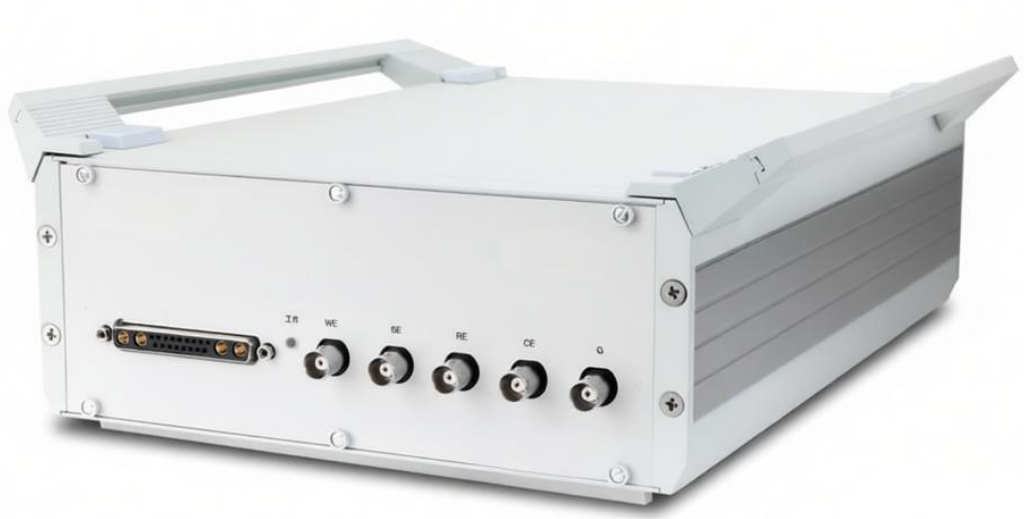


Standards:
Applications:
The electrochemical workstation is widely used in electrode process research, chemical power sources, electroplating, electrolysis, electroanalytical chemistry, metal corrosion studies, and the determination of electrochemical protection parameters, among other fields.
Product Information:
The electrochemical testing system consists of an Electrochemical Workstation (including potentiostat/ galvanostat and electrochemical impedance spectroscopy modules) and control and data analysis software.The electrochemical workstation includes four main functional modules: electroanalysis, corrosion, electrochemical impedance spectroscopy (EIS), and energy modules, enabling the implementation of all major electrochemical measurement techniques.
Product Features
The hardware of the electrochemical workstation is built with high-quality integrated circuits, featuring high control precision, fast response speed, stable performance, compact structure, and a high degree of automation. The system incorporates a high-speed control unit and a high-precision 18-bit dual-channel A/D converter, enabling high-resolution data acquisition. Communication with the PC is achieved via Ethernet.
The electrochemical workstation adopts a high-speed data processor, providing fast and high-precision electrochemical measurements. Installation and configuration are simple, with Ethernet connectivity (supporting plug-and-play functionality) and low startup cost. A high-speed digital-to-analog conversion board enables the generation of instantaneous current and voltage pulses, producing various complex electrochemical test waveforms and supporting fully synchronized voltage and current measurements.The system supports a four-electrode configuration, allowing flexible testing of both high- and low-impedance electrochemical cells. It uses precise single-sine technology to ensure that the amplitude applied to the electrochemical cell remains consistent with the set value, maximizing measurement resolution under both linear and stable conditions.
The electrochemical workstation software is powerful and user-friendly, with simple experimental setup. It supports automated batch testing for potentiostatic, galvanostatic, and impedance experiments.The software provides functions such as information prompts and external system
integration, as well as data copy/paste and export capabilities, allowing easy data processing and transfer to external analytical software beyond the workstation platform.
Multiple graphs and datasets can be displayed in a single window. The built-in data analysis module supports comprehensive data processing and curve fitting functions, including linear fitting, peak analysis, polarization resistance (Rp) fitting, Tafel fitting, and electrochemical impedance spectroscopy (EIS) fitting.
Technical Parameters
|
Item |
Parameters |
|
Applied potential range |
±10 V |
|
Maximum current |
±1 A continuous, ±1 A peak |
|
Cell voltage (compliance voltage) |
±21 V |
|
Potentiostat rise time |
≤ 500 ns |
|
Potentiostat bandwidth (-3 dB) |
2 MHz |
|
Applied potential ranges |
±100 mV, ±1 V, ±10 V |
|
Potential resolution |
0.0015% of full scale |
|
Potential accuracy |
±0.1% of full scale ±1 mV |
|
Potential noise |
< 1.5 mV RMS |
|
Current measurement range |
±1 nA to ±1 A (10 auto-ranging steps) |
|
Current resolution |
0.00038% of range (8 fA at 1 nA range) |
|
Current measurement accuracy |
±0.1% of full-scale reading ±1 pA |
|
Input bias current |
≤ 1 pA |
|
Positive feedback or dynamic iR compensation |
|
|
Current measurement offset |
Full scale, 18-bit resolution, 0.00038% accuracy |
|
Potential measurement offset |
Full scale, 18-bit resolution, 0.00038% accuracy |
|
Potential filter cutoff frequencies |
50 kHz, 10 kHz, 5 kHz, 1 kHz, 500 Hz, 100 Hz, 50 Hz, 10 Hz |
|
Signal filter cutoff frequencies |
50 kHz, 10 kHz, 5 kHz, 1 kHz, 500 Hz, 100 Hz, 50 Hz, 10 Hz |
|
Ethernet data communication, USB adapter supported |
|
|
Maximum data length |
0–2.000.000 points (expandable beyond 2 million points) |
|
Galvanostat (Constant Current Instrument) |
|
|
Constant current range |
±1 A |
|
Applied current accuracy |
±0.1% of full-scale reading ±1 pA |
|
Applied current resolution |
0.0015% of current range |
|
Measured potential range |
±100 mV, ±1 V, ±10 V (auto-ranging) |
|
Potential resolution |
0.00038% of measurement range |
|
Potential accuracy |
±0.1% of full scale ±1 mV |
|
Potentiometer |
|
|
Reference electrode input impedance |
≥ 10¹² Ω |
|
Reference electrode input bandwidth |
≥ 10 MHz |
|
Reference electrode input bias current |
≤ 1 pA @ 25°C |
|
Experimental Parameters |
|
|
CV & LSV scan rate |
0.000001 V/s to 10.000 V/s |
|
Potential increment during scan |
0.3 mV |
|
CA & CC pulse width |
0.000002 s to 1000 s |
|
Minimum sampling interval (CA) |
2 μs |
|
Minimum sampling interval (CC) |
2 μs |
|
DPV & NPV pulse width |
0.0002 s to 500 s |
|
SWV frequency |
0.001 to 20 kHz |
|
Minimum sampling interval (i–t) |
2 μs |
|
ACV frequency range |
0.1 Hz to 10 kHz |
|
SHACV frequency range |
0.1 Hz to 10 kHz |
|
FTACV frequency range |
0.1 Hz to 10 kHz (simultaneous acquisition of fundamental wave, 2nd, 3rd, 4th, 5th, and 6th harmonics ACV data) |
|
Electrochemical impedance spectroscopy (EIS) frequency range |
10 μHz to 1 MHz |
|
EIS amplitude |
0.1 mV to 1 V RMS |
Test Methods
|
Electroanalysis Methods |
Open Circuit Potential (OCP) |
|
|
Linear Sweep Voltammetry (LSV) |
|
|
Cyclic Voltammetry (Single CV) |
|
|
Cyclic Voltammetry (Multiple CV) |
|
|
Staircase Linear Sweep Voltammetry (SLSV) |
|
|
Staircase Cyclic Voltammetry (Single) |
|
|
Staircase Cyclic Voltammetry (Multiple) |
|
|
Chronoamperometry (CA) |
|
|
Chronopotentiometry (CP) |
|
|
Chronocoulometry (CC) |
|
|
Fast Potential Pulse |
|
|
Fast Current Pulse |
|
|
Square Wave Voltammetry (SWV) |
|
|
Differential Pulse Voltammetry (DPV) |
|
|
Normal Pulse Voltammetry (NPV) |
|
|
AC Voltammetry |
|
|
Second Harmonic AC Voltammetry |
|
|
Sixth Harmonic AC Voltammetry |
|
Corrosion Methods |
Linear Polarization Method |
|
|
Tafel Polarization |
|
|
Potentiodynamic Polarization |
|
|
Cyclic Polarization |
|
|
Potentiostatic Method |
|
|
Galvanic Corrosion |
|
|
Galvanostatic Method |
|
|
Potentiodynamic Method |
|
|
Zero Resistance Ammeter (ZRA) |
|
|
Electrochemical Noise (EN) |
|
|
Split-type LPR (Linear Polarization Resistance) |
|
Impedance Techniques
|
Potentiostatic Electrochemical Impedance Spectroscopy (EIS) |
|
|
Galvanostatic Electrochemical Impedance Spectroscopy (EIS) |
|
|
Mott-Schottky Analysis |
|
Energy Technologies
|
Potentiostatic Control |
|
|
Galvanostatic Control |
|
|
Galvanostatic Intermittent Titration Technique (GITT) |
|
|
Constant Power Mode |
|
|
Constant Resistance Mode |
|
|
Current CCDPL |
|
|
Power CCD |
|
|
Resistance CCD |
|
|
Custom Charge-Discharge Methods |
