




Search keywords:
product name, product type, model number,
test method, manufacturer, technique, application
-
Cone Calorimeter
The import of American VTEC, cone calorimeter ultra high cost performance
more
-
Digital Elmendorf Tearing Tester
Pendulum method test material tear strength, operating more simple, more accurate data
more
-
ZwickiLine Materials testing machines
Top of the world's leading universal material testing machine
more
Biodegradability Testing System
BACK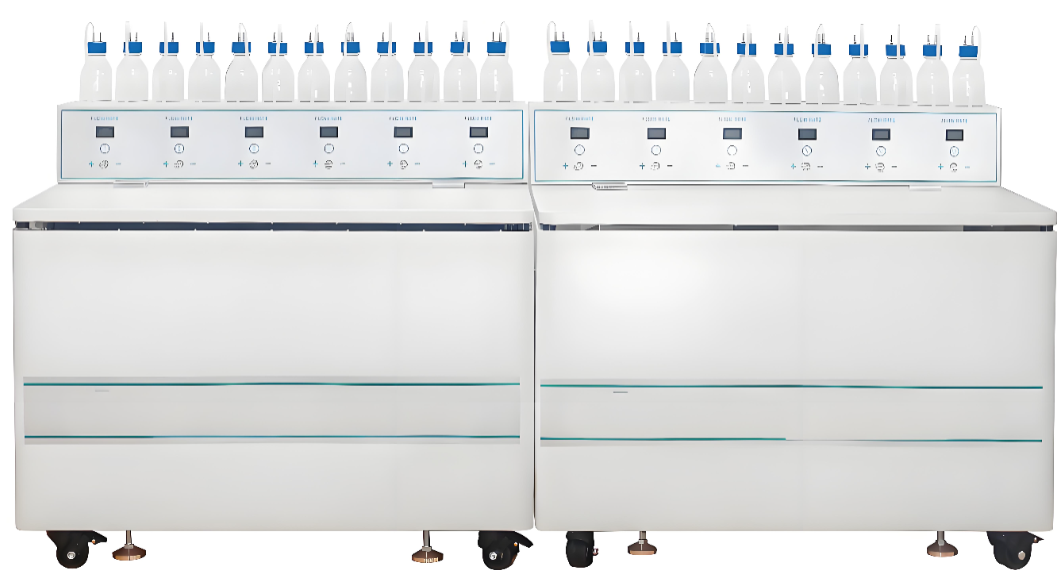


Standards:
Applications:
The system simulates intensive aerobic composting conditions to determine the ultimate aerobic biodegradation capacity and disintegration degree of test materials. It is also compatible with testing material degradation performance under both microbial composting conditions and simulated natural environmental conditions.
Product Information:
The system consists of 12 reaction vessels that can operate simultaneously or independently for testing. It is equipped with a highly stable constant-temperature circulation control system, an automatic humidification system, a high-precision electronic flow measurement system, and an infrared automatic carbon dioxide detection system. These features ensure stable operation of each reactor under any set temperature condition, significantly improving screening efficiency for test conditions and optimizing reaction parameters.Each of the 12 reaction vessels independently measures carbon dioxide concentration and can optionally be equipped with additional sensors such as O₂ and CH₄ to support extended standard applications. The system is controlled by an independent PLC system, which enables real-time data acquisition and analysis. Experimental data can be uploaded to a computer for full-process monitoring of biodegradation.In addition, the system adopts a medical-grade three-level security permission system with full data traceability, ensuring data authenticity, integrity, and reliability.
Reference Standards
|
Standard No. |
Standard Title |
|
GB/T 19277.1-2011 |
Determination of the ultimate aerobic biodegradability of materials under controlled composting conditions — Method by measuring the released carbon dioxide — Part 1: General method |
|
GB/T 38082-2019 |
Biodegradable plastic shopping bags |
|
GB/T 35795-2017 |
Fully biodegradable agricultural mulch films |
|
GB/T 38727-2020 |
Fully biodegradable plastic films and bags for logistics, express transport and delivery packaging |
|
GB/T 32366-2015 |
Biodegradable plastics — Poly(butylene adipate-co-terephthalate) (PBAT) |
|
GB/T 18006.1-2009 |
General technical requirements for disposable plastic tableware |
|
GB/T 18006.2 |
General quality requirements for disposable biodegradable tableware (draft for approval) |
|
GB/T 29646-2013 |
Modified polyester biodegradable plastics for blown films |
|
GB/T 16716.7-2012 |
Packaging and packaging waste |
|
GB/T 38082-2019 |
Biodegradable plastic shopping bags |
|
GB/T 35795-2017 |
Fully biodegradable agricultural mulch films |
Test Principle
The testing system simulates intensive aerobic composting conditions to determine the ultimate aerobic biodegradation capability of test materials.
The test material is mixed with inoculum and introduced into a static composting vessel. Within the vessel, the mixture is maintained under controlled conditions of temperature, moisture, and mineral inorganic salts. Under these conditions, the test material is expected to undergo biodegradation, ultimately producing carbon dioxide, water, mineral inorganic salts, and new biomass as final degradation products.
During the test, the carbon dioxide generated from both the test vessel and the blank vessel is continuously monitored and periodically measured. The cumulative amount of carbon dioxide produced is recorded.
The biodegradation percentage is calculated as the ratio of the actual amount of carbon dioxide produced by the test material to the theoretical amount of carbon dioxide that can be produced by the material.
The theoretical CO₂release is calculated based on the measured total organic carbon (TOC) content of the test material.
It should be noted that the biodegradation percentage does not include the carbon converted into new microbial biomass, as this carbon is not metabolized into carbon dioxide within the test period.
Product Specifications
|
Item |
Specification |
|
Test Channels |
12 channels (independent, expandable) |
|
Chamber Size |
≥ 2.0 × 0.5 × 0.5 m (constant temperature chamber) |
|
Temperature Control Range |
Room temperature to 70 °C |
|
Temperature Accuracy |
±1 °C |
|
Infrared CO₂ Monitoring Range |
0 – 50.000 ppm (accuracy: 3%) |
|
Flow Rate Range |
0 – 0.5 L/min (accuracy: 1.5%) |
|
Solid Sample Vessel Volume |
3 L |
Features
12-channel independent testing with professional computer-based monitoring (test channels are expandable)
Automatic temperature control (room temperature to 70 °C; other temperature ranges can be customized)
Continuous airflow aerobic system equipped with electronic gas flow measurement for higher accuracy; minimum flow unit displayed in liters
Airtight sealed reactors with leak-tightness verification system
Inlet gas humidification system to ensure proper moisture content of solid reaction materials
Automatic opening/closing temperature control system and semi-automatic stirring system, significantly reducing operator workload and operational difficulty
CO₂ exhaust gas extraction and detection system
Data acquisition system with user-defined sampling intervals and continuous parameter recording capability
ISP online control, upgrade, and remote service functionality
Three-level user permission system with data audit trail and secure experimental data storage
Remote monitoring of testing process and experimental data via PC and mobile devices
Product Configuration
|
Category |
Configuration Details |
|
Standard Configuration |
Biodegradable material testing system including mass flow controllers , infrared CO₂sensors, corrosion-resistant valves, connectors and sealing components, stirring device, data acquisition system (DAQ), process control software, user manual, Windows operating software, silent air pump, and air storage tank (oil-free air pump suitable for 12-channel operation) |
