




Search keywords:
product name, product type, model number,
test method, manufacturer, technique, application
-
Cone Calorimeter
The import of American VTEC, cone calorimeter ultra high cost performance
more
-
Digital Elmendorf Tearing Tester
Pendulum method test material tear strength, operating more simple, more accurate data
more
-

ZwickiLine Materials testing machines
Top of the world's leading universal material testing machine
more
F543 Double Plate Thermal Conductivity Meter
BACK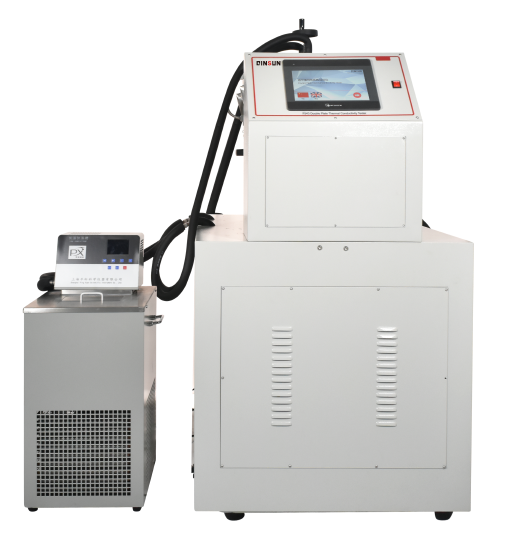


Standards:
Applications:
The F543 Dual-Plate Thermal Conductivity Tester is widely used for homogeneous plate materials such as rubber, glass, fiberboard, phenolic boards, extruded polystyrene (XPS) boards, foamed concrete, hollow glass, wooden boards, and various thermal insulation materials. It can also measure the thermal conductivity of granular materials, bulk materials, and soft materials.
The instrument is suitable for performance verification in new product development, quality control in production departments, third-party testing organizations, laboratory product performance validation, and material property testing by quality and technical supervision authorities.
Product Information:
The F543 Dual-Plate Thermal Conductivity Tester is equipped with an integrated constant-temperature water bath system, and all measurement and control functions are fully computer-controlled. It is mainly used for testing homogeneous plate materials such as plastics, rubber, glass, fiberboard, phenolic boards, extruded polystyrene (XPS) boards, foamed concrete, hollow glass, wooden boards, and various thermal insulation materials. It can also measure the thermal conductivity of granular materials, bulk materials, and soft materials. The instrument is widely applied in heat-resistant and thermal insulation material manufacturing enterprises, quality inspection institutions, universities, and research institutes.
Main structure
The instrument adopts a dual-plate thermal conductivity measurement method based on steady-state testing. Accurate results can only be obtained when the cold plate, hot plate, and guard plate reach thermal equilibrium under steady-state conditions. According to the one-dimensional steady-state heat transfer equation, the heat generated by the hot plate heater is transferred through the specimen to the cold plate, and then removed from the system by a circulating fluid or other working medium in the cold plate, forming a complete thermal cycle.
The instrument consists of two nearly identical specimens with a heating unit sandwiched between them. The heating unit is composed of a central circular or square heater and two metal face plates. The heat flow generated by the heating unit is conducted through the specimens on both sides and transferred to the respective cooling units (circular or square isothermal plate assemblies) on both ends.
Standards
GB/T 10294-2008 “Determination of steady-state thermal resistance and related properties of thermal insulation materials”
GB/T 3399-1982 “Test method for thermal conductivity of plastics — Guarded hot plate method”
GB/T 10801.1-2002 “Expanded polystyrene (EPS) thermal insulation products for building applications
GB/T 10801.2-2002 “Extruded polystyrene (XPS) thermal insulation products for building applications”
GB/T 3139-2005 “Test method for thermal conductivity of fiber-reinforced plastics”
GB/T 17794-2008 “Flexible cellular rubber insulation products”
Features
Intelligent touchscreen control panel:
PLC control system with higher efficiency and reliability, featuring programmability. It is equipped with a 7-inch color LCD touchscreen, enabling control, monitoring, calculation, and data display functions.
Dual-station testing
The instrument is equipped with two stations, allowing simultaneous testing. It is easy to operate, offers reliable performance, and significantly improves working efficiency.
Multi-directional protection design
The instrument features high safety performance and adopts an independent design of the electrical circuit and refrigeration circulation system, ensuring that data acquisition in the electrical system is not affected by the water circuit, thereby improving overall stability.
Reasonable structural design with high flexibility
The chassis is aesthetically pleasing and well-designed. The outer shell of the test chamber is treated with a powder coating process, providing high mechanical strength and excellent corrosion resistance. The equipment is compact in size, and the unique caster design further enhances the mobility and flexibility of the thermal conductivity tester.
Closed-loop temperature monitoring with automatic regulation.
The instrument features excellent temperature stability. Its unique guard plate design forms a one-dimensional protective effect, minimizing heat loss and ensuring no temperature dissipation.
Parameter
|
Operation mode |
Automatic |
|
Sample size |
300 mm × 300 mm × H (5–40) mm |
|
Specimen flatness |
0.1 mm |
|
Thermal conductivity measurement range |
0.001–2.000 W/(m·K) |
|
Thermal conductivity measurement accuracy |
±3% |
|
Measurement data repeatability |
±1% |
|
Temperature resolution |
0.01°C |
|
Temperature control accuracy |
0.05°C |
|
Sample thickness |
Standard 25 mm, range (5–40) mm |
|
Specimen thermal resistance requirement |
Thermal resistance of the specimen shall not be less than 0.1 (m²·K)/W, and the thickness shall meet the standard requirement; if the thermal resistance lower limit is as low as 0.02 (m²·K)/W, the measurement accuracy may not fully meet the requirement |
|
Clamping force |
≤ 2.5 kPa |
|
Power supply |
220 V ±10%, 2.5 kW, 50 Hz |
|
Weight |
260 kg |
|
Dimensions |
1100 mm × 1500 mm × 1500 mm |
