Search keywords:
product name, product type, model number,
test method, manufacturer, technique, application
-
Cone Calorimeter
The import of American VTEC, cone calorimeter ultra high cost performance
more
-
Digital Elmendorf Tearing Tester
Pendulum method test material tear strength, operating more simple, more accurate data
more
-
ZwickiLine Materials testing machines
Top of the world's leading universal material testing machine
more
Gelbo Flex flexing chamber
BACK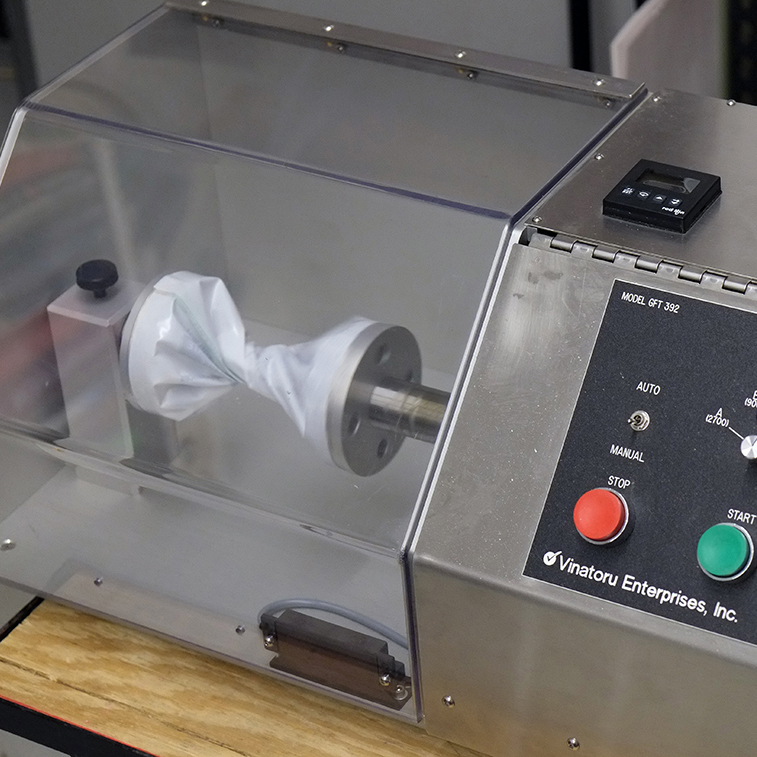


Standards:
Applications:
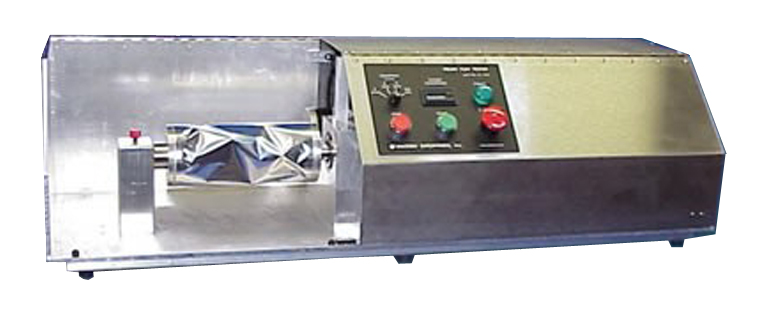
Gelbo Flex flexing chamber is designed to measure the amount of fiber debris of non-woven fabrics in the dry state in accordance with ISO9073-10. It can be used to test dry lint fall performance of non-woven raw material and other textile materials.The instrument is used for dry lint test of non-woven fabric in the dry state, and mainly suitable for assessing the lint performance of nonwoven fabrics and other textile materials which are used as medical protective materials (surgical drapes, gowns and clean air suits). During the test, the sample in the chamber undergoes a comprehensive force of torsion and compression. Meanwhile, the air is drawn from the chamber for air-born particles counting and classifying by a laser dust particle counter so as to assess the test results.
Product Information:
Gelbo Flex flexing chamber is designed to measure the amount of fiber debris of non-woven fabrics in the dry state in accordance with ISO9073-10. It can be used to test dry lint fall performance of non-woven raw material and other textile materials.
Test principle:
The sample in the test chamber experiences a comprehensive effect of torsion and compression. During the process of torsion, the air is drawn from the chamber and the particles in the air are counted and classified using a laser dust particle counter.
Standards:
YY/T 5056.6 Surgical drapes, gowns and clean air suits, used as medical devices for patients, clinical staff and equipment - Part 4: Dry lint test methods.
ISO 9073.10 Textiles. Test methods for nonwovens. Part 10_Lint and other particles generation in the dry state.
EN 13795-2-2004 Surgical drapes, gowns and clean air suits, used as medical devices for patients, clinical staff and equipment - Part 2 Test methods.
Principle:
The sample is subjected to a combined effect of torsion and compression in the test chamber. During this twist, air is drawn from the chamber and the particles in the air are counted and classified by using a laser dust particle counter.
Product parameters:
| Item | Specification |
|---|---|
| Torsion Room | Sealed torsion room and air manual machine |
| Twist Speed | 60 times/min |
| Twist Angle / Stroke | 180° / 120 mm |
| Sample Fixture | 82.8 mm |
| Laser Particle Counter Test Range | Collection of 0.3–25.0 μm samples |
| Laser Particle Counter Flow Rate | 28.3 L/min, ±5% |
| Sample Test Data Storage | 3000 data sets |
| Timer | 1–9999 times |
| Test Environment | Class 5 clean room (equivalent to Class 100 clean environment) |
Basic Structure:
1. Dry lint generator
1) Torsion device: to exert comprehensive force of torsion, compression and recovery
2) Torsion chamber (electrostatic resistance) : an organic glass body with electrostatic resistance which covers the torsion device
3) Air sampler: fixed on a specific location in the torsion chamber. The sample port has a certain shape.
2. Laser dust particle counter
Count and classify the particles in the sampled air.