




Search keywords:
product name, product type, model number,
test method, manufacturer, technique, application
-
Cone Calorimeter
The import of American VTEC, cone calorimeter ultra high cost performance
more
-

Digital Elmendorf Tearing Tester
Pendulum method test material tear strength, operating more simple, more accurate data
more
-

ZwickiLine Materials testing machines
Top of the world's leading universal material testing machine
more
MST Medical Compression Stocking Tester
BACK

Standards:
(1) ISO 13994 – Medical Compression Garments Standard (2) AATCC 139 – Textile Elasticity Test Standard (3) YY/T 0561 – Chinese Medical Hosiery Standard (4) ISO 17025 – Calibration of Testing and Measuring Equipment (5) ASTM D 3100 – Standard Test Methods for Stretch and Recovery of Textile Fabrics (6) EN 13795 – Performance Requirements for Surgical Clothing and Drapes (7) IEC 60601-1 – Safety Requirements for Medical Electrical Equipment
Applications:
The instrument is widely used for quality control of medical compression stockings, research and development of pressure-mapping hosiery, clinical validation of therapeutic compression levels, and forensic evaluation of garment failures.
Product Information:
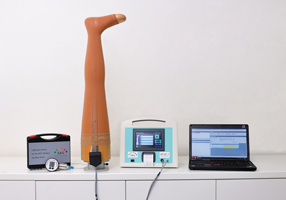
The MST Medical Compression Stocking Tester is a professional instrument designed to evaluate the compression performance, elasticity, and durability of medical-grade compression stockings. It ensures compliance with international and domestic healthcare and textile standards by measuring pressure distribution, hysteresis loss, and fabric resilience under repeated stress cycles. The compact design makes it suitable for laboratory and clinical environments.
Features
(1) Dual testing modes: static mode to measure initial compression pressure and dynamic mode simulating walking at 5–120 steps per minute
(2) Pressure gradient mapping from ankle to knee
(3) Hysteresis loss calculation and real-time fabric strain visualization
(4) WiFi data export to HIPAA-compliant platforms
(5) ±0.5–1 mmHg measurement accuracy
(6) 100-cycle fatigue testing capability
(7) Medical-grade silicone clamps (latex-free)
(8) Automated zero-drift compensation
(9) CE and IECEx certified for medical environments
Parameters
| Parameter | Specification |
|---|---|
| Pressure Measurement | Capacitive sensor array, 0.1 mmHg resolution |
| Pressure Range | 15–50 mmHg, adjustable |
| Test Modes | Static pressure (1-minute hold) / Dynamic cyclic loading (10–100 cycles) |
| Elastic Recovery Rate | ≥95% |
| Sample Size | 30×300 mm (calf segment simulation) |
| Sample Clamping | Adjustable vacuum chuck (5–50 N grip force) |
| Data Output | Pressure-time curve and CSV export |
| Power Supply | 220V/50Hz, 0.8 kW |
| Dimensions (L×W×H) | 600×400×800 mm |
Accessories
(1) Medical-grade silicone clamps (latex-free)
(2) ISO 17025-calibrated pressure sensors
(3) Five-year sensor calibration service
(4) Control and data acquisition software
Test Procedures
(1) Prepare samples by cutting 30×300 mm specimens from stockings
(2) Clamp each specimen using a vacuum chuck with approximately 20 N of force
(3) Select the test mode (static or dynamic) and set the number of cycles
(4) Run the test with real-time monitoring of pressure
(5) Generate pressure distribution heatmaps and hysteresis loss reports
Conclusion
The MST Medical Compression Stocking Tester offers a precise and reliable solution for evaluating compression performance, elasticity, and durability of medical compression stockings. With advanced pressure sensing, static and dynamic testing modes, and accurate pressure gradient mapping, it ensures compliance with key medical and textile standards. Its automated operation, high measurement accuracy, and comprehensive data output make it ideal for quality control, product development, and clinical validation. Overall, the MST tester supports consistent therapeutic performance and enhances the safety and effectiveness of medical compression garments.
FAQ
1. Why is "Hysteresis Loss" a critical measurement for compression stockings?
Hysteresis loss measures the energy lost when the fabric is stretched and then relaxed. In medical stockings, low hysteresis loss is vital because it indicates the fabric can maintain consistent therapeutic pressure throughout the day without sagging or losing its "snap."
2. How does the "Dynamic Mode" differ from standard textile stretch tests?
Standard tests often only measure how far a fabric stretches. The MST Tester’s Dynamic Mode simulates the actual muscle pump action of a human calf while walking, allowing you to see how the pressure fluctuations (systolic and diastolic pressures of the garment) change over 100 or more "steps."
3. Why are the clamps made of medical-grade silicone?
Medical stockings often contain delicate elastane or specialized coatings. Silicone clamps provide a high-friction grip that prevents slippage during a 50 N pull while being soft enough to avoid tearing the knit structure or causing "runs" in the material.
4. Can this instrument test arm sleeves or other compression garments?
Yes. While optimized for calf segments, as long as the specimen can be cut to the 30 × 300 mm size or the clamps can accommodate the garment's geometry, you can evaluate the pressure profiles of arm sleeves, waist binders, or athletic compression wear.
5. What is the significance of the "Ankle-to-Knee" pressure gradient?
Medical stockings must be "graduated," meaning the pressure is highest at the ankle and decreases as it moves up the leg. The MST Tester allows you to verify this gradient numerically to ensure the garment effectively assists venous return rather than restricting it.
