




Search keywords:
product name, product type, model number,
test method, manufacturer, technique, application
-
Cone Calorimeter
The import of American VTEC, cone calorimeter ultra high cost performance
more
-
Digital Elmendorf Tearing Tester
Pendulum method test material tear strength, operating more simple, more accurate data
more
-

ZwickiLine Materials testing machines
Top of the world's leading universal material testing machine
more
Retro-Reflective Coefficient Tester
BACK

Standards:
The system supports compliance with the following standards: GB/T 28468-2012 – Method for Measuring Retro-Reflective Coefficient of School Safety Uniforms (Appendix A) GB 20653-2020 – Method for Measuring Retro-Reflective Coefficient of High-Visibility Protective Clothing (Appendix C) GB/T 18833-2012 – Road Traffic Reflective Film GB/T 26377-2010 – Retro-Reflective Measurement Instruments JT/T 612-2004 – Retro-Reflective Measurement Instruments ASTM E808 – Standard Guide for Description of Retro-Reflective Materials ASTM E809 – Standard Test Method for Measurement of Retro-Reflector Optical Performance ASTM E810 – Standard Test Method for Retro-Reflective Coefficient of Sheeting Materials DIN 67520 – Minimum Luminance Requirements for Traffic Safety Reflective Materials
Applications:
The tester is suitable for a wide range of applications:
Traffic Safety Materials: Assessing reflective signs, markings, and school uniforms for visibility compliance.
Occupational Safety Garments: Evaluating high-visibility protective clothing used in construction, transportation, and industrial environments.
Vehicle Inspection: Measuring reflective markings on trucks and other vehicles.
Quality Control: Testing reflective materials, license plates, vests, and garments for standardized retro-reflection performance.
Product Information:
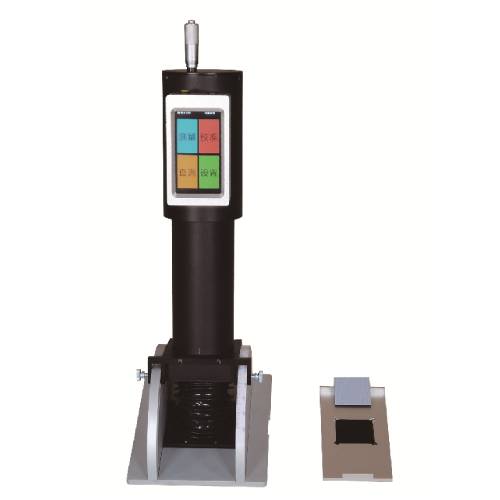
The Retro-Reflective Coefficient Tester is a precision instrument designed to evaluate the retro-reflective performance of high-visibility safety materials, including professional occupational warning garments and reflective school uniforms for children. By accurately measuring the retro-reflection coefficient, the system provides objective and reproducible data for quality assessment, ensuring compliance with national and international safety standards.
Parameters
| Parameter | Specification |
|---|---|
| Measurement Range | 0–3000 cd/(lx·m²) |
| Measurement Accuracy | ±0.1 cd/(lx·m²) using microphotometric acquisition system |
| Observation Angle | 0°–2°, adjustable, ±0.002° |
| Incidence Angle | -45° to 45°, adjustable, ±1° |
| Light Source | Standard illuminant A, color temperature 2856 K, uniform vertical illuminance |
| Detector | Silicon photodiode with CIE-corrected spectral filter, V(λ) compliance |
| Sample Reference Center | Aperture subtended angle 12′, vertical illuminance uniformity ≤5% |
| Detector Movement | Vertically adjustable, observation angle 12′–120′ |
| Calibration Angles | Up to 12 angle pairs can be calibrated at once |
| Data Storage | Up to 10.000 test records |
| Screen | 4.5" touchscreen, 854 × 480 resolution |
| Storage Method | TF card |
| Sample Fixture | Quick-change structure for easy mounting |
| Calibration Plates | One black and one white calibration plate included |
| Power Supply | AC 220 V, 50 Hz, 500 W |
| Weight | Approx. 10 kg |
Features
High-precision retro-reflection measurement with microphotometric acquisition system
Adjustable observation and incidence angles for versatile testing conditions
Standardized illuminant and calibrated detector for accurate, repeatable results
Quick-change sample fixture allows efficient testing of multiple materials
Touchscreen interface for easy operation and data visualization
Built-in storage for up to 10.000 test records
Automatic calibration using included black and white plates
Accessories
Main unit with control box and sample platform
Calibration plates (black and white, one each)
Product certificate
User manual
Test Procedures
Sample Preparation
Mount the reflective material or garment on the sample platform using the quick-change fixture.
Ensure the sample area corresponds to the testing aperture and standard requirements.
Calibration
Perform calibration using the included black and white plates to ensure measurement accuracy.
Measurement
Adjust the observation and incidence angles according to the testing standard.
Illuminate the sample with standard illuminant A and record the retro-reflective coefficient via the detector.
Repeat measurements for multiple points or samples as required.
Data Recording
Store test results on the TF card or view on the touchscreen interface.
Generate reports summarizing retro-reflection performance for quality assessment.
Maintenance Information
Regularly clean the detector and light source to maintain measurement accuracy
Inspect and tighten the sample fixture to prevent misalignment during tests
Calibrate the instrument periodically using the included plates
Ensure the touchscreen and data storage system function correctly
Store the instrument in a dry, dust-free environment to prevent sensor degradation
Conclusion
The Retro-Reflective Coefficient Tester provides reliable and accurate evaluation of retro-reflective performance for safety-related materials and garments. With standardized optical conditions, flexible angle adjustment, and precise data acquisition, it supports consistent quality control and compliance verification. The instrument is well suited for laboratory testing, production inspection, and certification work across traffic safety, occupational protection, and vehicle marking applications.
FAQs
1. What is the purpose of the Retro-Reflective Coefficient Tester?
The Retro-Reflective Coefficient Tester is designed to evaluate the retro-reflective performance of high-visibility safety materials, including occupational safety garments, school uniforms, reflective vests, and vehicle markings. By accurately measuring the retro-reflection coefficient, it provides objective, reproducible data for quality assessment. The system ensures that reflective materials meet national and international safety standards, improving visibility in low-light conditions and enhancing the safety of workers, students, and road users.
2. How does the tester perform measurements?
The system uses a microphotometric acquisition detector with a CIE-corrected silicon photodiode and a standardized light source (illuminant A, 2856 K). Samples are mounted on a quick-change fixture, and observation and incidence angles are adjusted according to the testing standard. The detector measures retro-reflected light intensity at multiple angles, storing up to 10.000 test records. Automatic calibration with included black and white plates ensures accuracy. The touchscreen interface allows operators to visualize data, record results, and generate reports efficiently, providing repeatable, standardized measurements across multiple samples.
3. Which materials and applications are suitable for testing?
This tester is suitable for reflective materials used in traffic safety signs, occupational safety garments, school uniforms, reflective vests, license plates, and vehicle markings. It supports R&D, quality control, and compliance verification in industries such as textiles, automotive, and transportation. By assessing the retro-reflection coefficient, the system helps ensure that materials provide adequate visibility and meet standards including GB 20653-2020. ASTM E810. and DIN 67520. It can evaluate both raw materials and finished products for consistent safety performance.
4. What are the main features of the tester?
Key features include high-precision retro-reflection measurement, adjustable observation and incidence angles, standardized illuminant and calibrated detector for repeatable results, and a quick-change sample fixture for efficient testing of multiple materials. The built-in touchscreen interface enables easy operation, data visualization, and record storage. Automatic calibration using included black and white plates maintains measurement accuracy. The system can store up to 10.000 test records and supports versatile testing conditions for both finished garments and raw reflective materials.
