




Search keywords:
product name, product type, model number,
test method, manufacturer, technique, application
-
Cone Calorimeter
The import of American VTEC, cone calorimeter ultra high cost performance
more
-
Digital Elmendorf Tearing Tester
Pendulum method test material tear strength, operating more simple, more accurate data
more
-
ZwickiLine Materials testing machines
Top of the world's leading universal material testing machine
more
Textile water evaporation rate tester
BACK

Standards:
The design and operation comply with both national and international standards, including: (1) AATCC Test Method 201 – Drying rate of fabrics (2) AATCC Test Method 199 – Water vapor transmission of textiles (3) AATCC Test Method 200 – Moisture management testing (4) ASTM E96 – Standard test methods for water vapor transmission of materials (5) ISO 11092 – Measurement of thermal and water-vapor resistance of textiles (6) GB/T 23457 – Testing of textile drying and moisture evaporation performance
Applications:
The tester is suitable for:
(1) Apparel and sportswear R&D: assessing quick-drying fabrics for activewear, swimwear, and performance clothing.
(2) Textile manufacturing: quality control of woven, knitted, and non-woven fabrics to ensure moisture management standards.
(3) Home textiles: evaluating moisture evaporation for towels, bedding, and functional fabrics.
(4) Industrial textiles: testing filtration materials, protective clothing, and medical fabrics for water-handling performance.
(5) Textile testing laboratories: providing standardized data for product certification and comparative studies.
(6) Educational institutions: training students on moisture transport and drying behavior of fabrics.
Product Information:
The Textile Water Evaporation Rate Tester is a precision instrument designed to evaluate the moisture evaporation and quick-drying performance of textiles. By measuring the rate of water evaporation from fabric samples under controlled conditions, it provides quantitative, repeatable, and objective data on textile moisture management properties. This instrument is widely used in textile R&D, quality control, and performance verification labs.
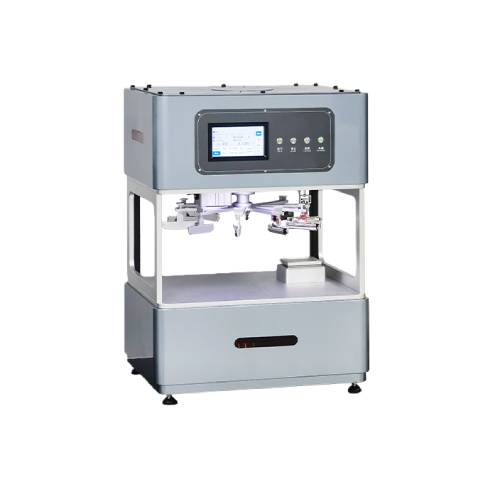
Product Features
(1) High-precision measurement: uses imported balances with 0.001g accuracy for reliable, repeatable results.
(2) Multi-station testing: 6 independent workstations with individually controlled motors for high throughput.
(3) Computer-controlled operation: software-based upper computer control for experiment setup, monitoring, and data acquisition.
(4) Safety design: institutional self-locking prevents accidents during sudden power failure.
(5) Optimized structure: precise sample positioning and smooth motor operation with minimal noise.
(6) Flexible measurement: adjustable weighing interval and automatic test termination based on evaporation rate stability.
(7) Data analysis: real-time curve generation and automatic evaporation rate calculation for accurate reporting.
Technical Parameters
| Parameter | Specification |
|---|---|
| Sensor Accuracy | 0.001 g |
| Sample Weight | < 100 g |
| Sample Weighing Interval | ≥1 min (adjustable) |
| Applicable Sample Size | 100 mm × 100 mm |
| Number of Workstations | 6 (independently controlled) |
| Control Mode | Computer upper software control |
| Power Supply & Power | AC 220V ±10%, 50Hz, 200W |
| Dimensions (L×W×H) | 500 × 450 × 665 mm |
| Instrument Weight | 40 kg |
| Test Termination Condition | Evaporation rate change <1% |
Accessories
(1) Standard sample holders (6 pcs)
(2) Imported high-precision balance (built-in)
(3) Drive motors for each workstation
(4) Software package for data acquisition and analysis
(5) Calibration tools
(6) User manual
Test Procedures / Maintenance
(1) Prepare textile samples of 100×100 mm and place them in the sample holders.
(2) Set the weighing interval, number of workstations, and test conditions via the software.
(3) Start the test: the system monitors and records the evaporation weight in real time.
(4) Observe the generated drying curves and calculate the evaporation rate.
(5) Test terminates automatically when the evaporation rate change is <1%.
(6) After testing, clean sample holders, balance pan, and surrounding areas to prevent residue accumulation.
(7) Periodically check and calibrate balance accuracy, motor performance, and software settings for consistent results.
Conclusion
The Textile Water Evaporation Rate Tester offers a reliable and objective solution for evaluating moisture evaporation and quick-drying performance of textile materials. Through high-precision weighing, multi-station testing, and computer-controlled data acquisition, it delivers accurate and repeatable evaporation rate results. Compliant with recognized international and national standards, the system supports textile R&D, quality control, and certification testing across a wide range of applications. Its efficient operation, flexible testing parameters, and clear data analysis capabilities make it an essential tool for improving moisture management performance and ensuring consistent textile quality.
FAQ
1. How does the "6-station independent control" benefit the testing process?
It allows you to run different types of fabrics or different test parameters on each station at the same time. You can start or stop any of the six tests without interfering with the others, which significantly increases laboratory efficiency compared to single-station units.
2. Why is a resolution of 0.001g necessary for this test?
Quick-dry fabrics often evaporate moisture in very small increments. To calculate an accurate "rate," the sensor must be sensitive enough to detect minute changes in mass over short intervals (e.g., 1 minute), which is impossible with standard 0.01g balances.
3. What environmental factors can affect the test results?
Evaporation is highly sensitive to ambient temperature and humidity. For standardized results, you should operate the tester in a climate-controlled room. Even minor fluctuations in air speed can alter the drying rate.
4. Can this machine test fabrics with very high water absorption, like heavy towels?
Yes, as long as the total sample weight (fabric + absorbed water) does not exceed 100g. For exceptionally heavy materials, you may need to adjust the amount of water applied to remain within the sensor's measurement range.
5. How is the "Evaporation Rate" actually calculated by the software?
The software performs a linear regression or differential calculation of the weight loss over time ($\Delta \text{Mass} / \Delta \text{Time}$). It identifies the constant-rate drying period to provide the most accurate assessment of the fabric's functional performance.
