




Search keywords:
product name, product type, model number,
test method, manufacturer, technique, application
-
Cone Calorimeter
The import of American VTEC, cone calorimeter ultra high cost performance
more
-
Digital Elmendorf Tearing Tester
Pendulum method test material tear strength, operating more simple, more accurate data
more
-
ZwickiLine Materials testing machines
Top of the world's leading universal material testing machine
more
Textile far infrared emissivity tester
BACK

Standards:
GB/T 30127.4-2013: Determination of Far-Infrared Emissivity of Textile Materials (China) ISO 18562-3:2017: Test methods for far-infrared properties of textiles ASTM E1933: Standard Test Method for Measuring the Far-Infrared Emissivity of Materials EN 14505: Clothing for protection against heat and flame — Measurement of thermal properties ISO 11092: Textiles — Physiological effects — Measurement of thermal and water-vapour resistance
Applications:
Quality control and performance evaluation of natural fibers such as cotton and wool.
Assessment of synthetic fibers, including polyester, nylon, and blended yarns.
Measurement of far-infrared emissivity of woven, knitted, and nonwoven fabrics.
Evaluation of finished garments and functional textiles (heat-retaining, moisture-wicking).
R&D support for new fiber blends and smart textile development.
Compliance testing for international markets requiring thermal performance data.
Process optimization for textile manufacturing based on far-infrared performance.
Product Information:
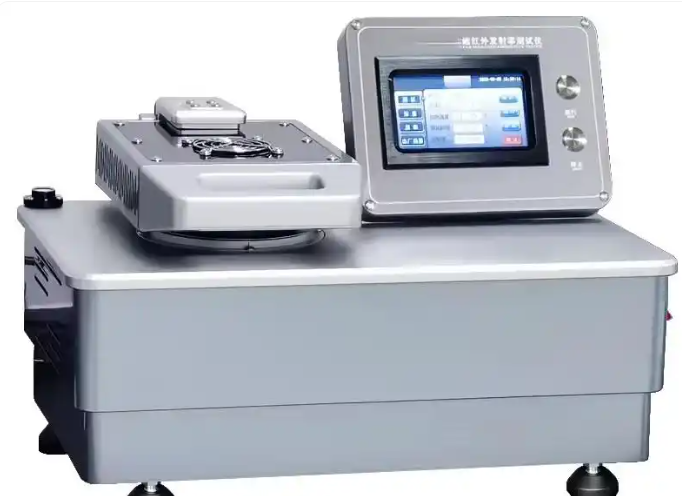
The Textile Far-Infrared Emissivity Tester is a precision instrument designed to evaluate the far-infrared radiation properties of textile materials. It can measure fibers, yarns, fabrics, nonwovens, and finished textile products, providing critical data for product design, quality control, and performance optimization. This tester ensures accurate and reproducible measurements of far-infrared emissivity for both natural and synthetic fibers.
Features
(1) Sequential blackbody and sample measurement for accurate emissivity evaluation.
(2) Far-infrared spectral range 5–14 μm for comprehensive textile analysis.
(3) High-precision heating plate with temperature control ±0.5°C.
(4) Non-destructive testing method preserving sample integrity.
(5) Touchscreen interface with intuitive menu-based operation.
(6) Lock-in and microelectronic signal processing for detecting weak far-infrared radiation.
(7) USB and network interface for data export and software integration.
(8) Compact, lightweight design suitable for laboratory and R&D environments.
(9) Supports both natural and synthetic fibers, woven and nonwoven fabrics, and finished textile products.
Technical Parameters
| Item | Detail |
|---|---|
| Measuring range | 0.01–1.00 |
| Wavelength | 5–14 μm |
| Test temperature | 34°C |
| Thermal plate diameter | Φ60 mm |
| Temperature control accuracy | ±0.5°C |
| Power supply | 220 V, 50–60 Hz |
| Dimensions | 160 × 180 × 350 mm (6.30 × 7.07 × 13.78 inch) |
| Net weight | 15 kg (33.07 lb) |
Accessories
Certified standard blackbody reference panel
Thermal measurement plate
Far-infrared radiation measurement system
USB/network cable for data transfer
User manual and software for data acquisition
Optional calibration kit for verification of measurement accuracy
Test Procedures
Place the standard blackbody panel on the heating plate and set the desired temperature.
Sequentially place the textile sample on the heating plate after blackbody measurement.
Allow the sample to reach thermal equilibrium.
Measure the far-infrared radiation intensity of both the blackbody and sample.
Calculate the far-infrared emissivity as the ratio of sample radiation to the blackbody radiation.
Record and analyze results using the software interface.
Repeat measurements as necessary for different sample types or temperatures.
Maintenance Information
Clean blackbody and thermal plates regularly to maintain measurement accuracy.
Periodically calibrate the far-infrared measurement system using certified reference materials.
Inspect the heating plate, sensors, and electronics for wear or damage.
Keep the instrument in a dry, dust-free environment to prevent interference or damage.
Ensure software and firmware are updated for optimal performance.
Avoid mechanical shocks to maintain sensor precision.
Conclusion
The Textile Far-Infrared Emissivity Tester provides an accurate, non-destructive, and standardized method for evaluating the far-infrared radiation performance of textile materials. With precise temperature control, sensitive signal processing, and a comprehensive spectral range, it delivers reliable emissivity data for fibers, fabrics, and finished products. Compliant with multiple international and national standards, the system supports textile R&D, quality control, and functional performance verification. Its compact design, intuitive operation, and stable measurement capability make it an essential tool for optimizing thermal performance and supporting innovation in functional and smart textiles.
FAQ
1. Why is the test temperature set specifically at 34°C?
34°C represents the average surface temperature of human skin. Since many far-infrared textiles are designed for "passive heating" by reflecting body heat back to the wearer, testing at this temperature provides the most realistic simulation of actual use.
2. Can this tester distinguish between different types of far-infrared additives?
While the tester measures the total emissivity of the material, it does not identify the chemical composition. However, you can use it to compare the effectiveness of different concentrations of ceramic or mineral additives in your fiber blends.
3. Does the color of the fabric affect the emissivity measurement?
In the visible spectrum, color matters; however, in the far-infrared spectrum (5–14 μm), the physical structure and material composition are the dominant factors. You may find that two fabrics of different colors but identical composition have very similar emissivity values.
4. How does "emissivity" relate to "heat retention"?
High emissivity in the far-infrared range generally indicates that the material is efficient at absorbing and re-radiating thermal energy. For textiles, this usually translates to better thermal regulation and perceived warmth for the wearer.
5. Is there a minimum sample size required for an accurate test?
The heating plate is Φ60 mm. Your sample should be large enough to completely cover this plate (at least 70 x 70 mm) to ensure that the sensor only detects radiation from the textile and not the surrounding air or equipment.
