




Search keywords:
product name, product type, model number,
test method, manufacturer, technique, application
-
Cone Calorimeter
The import of American VTEC, cone calorimeter ultra high cost performance
more
-
Digital Elmendorf Tearing Tester
Pendulum method test material tear strength, operating more simple, more accurate data
more
-
ZwickiLine Materials testing machines
Top of the world's leading universal material testing machine
more
Taber Abrasion Resistance Tester
BACK

Standards:
ISO Standards: ISO 9352. ISO 5470. ISO 7784 ASTM Standards: ASTM D1044. ASTM D3884. ASTM D4060 Chinese Standards: GB/T 5137.1. QB/T 2726 German Standard: DIN 53109 ASTM D3884. ASTM D1175. ASTM D1044. ASTM D4060. ASTM D4685. TAPPI T476. ISO 9352. ISO 5470-1. JIS K7204. JIS A1453. JIS K6902. JIS L1096. JIS K6964. DIN 52347. DIN 53109. DIN 53754. DIN 53799. SATRA TM163
Applications:
The Taber abrasion tester has a wide range of applications, covering multiple industries and fields. Its main application areas include:
1. Coatings Industry: Used to test the abrasion resistance of coatings to evaluate their durability and service life in practical use.
2. Plastics Industry: Used to test the abrasion resistance of plastic products to evaluate their service life under mechanical friction, chemical corrosion, and other environments.
3. Rubber Industry: Used to test the abrasion resistance of rubber products to evaluate their service life and performance under friction, extrusion, and other environments.
4. Paper Industry: Used to test the abrasion resistance of paper to evaluate its durability and quality during printing, writing, and other processes.
5. Textile Industry: Used to test the abrasion resistance of textiles to evaluate their durability and quality during wearing, washing, and other processes.
6. Flooring Industry: Used to test the abrasion resistance of flooring materials to evaluate their service life and performance under foot traffic, friction, and other environments.
In addition, the Taber abrasion tester is widely used in the automotive, electronics, and construction industries, providing strong support for material quality control and performance evaluation.
Product Information:
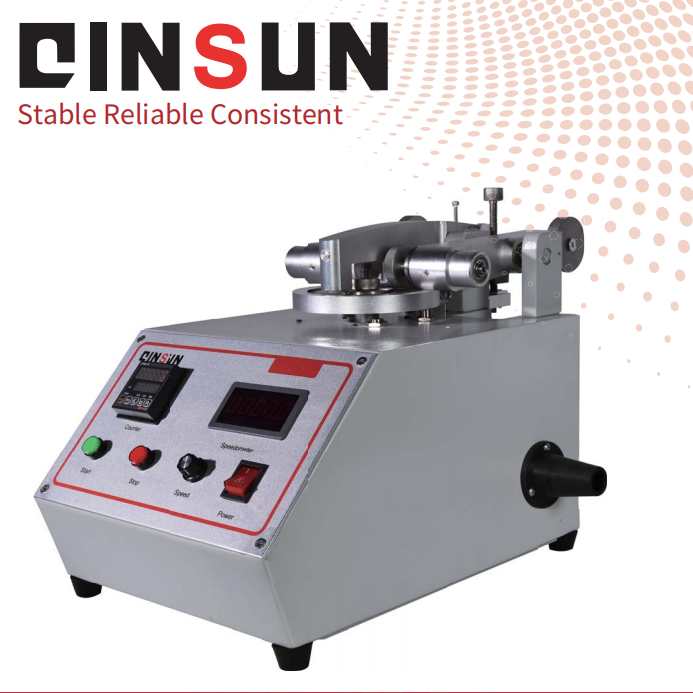
Taber Abrasion Tester is also referred to as Taber abraser or Taber abrader, which is used to evaluate the wear resistance of materials or finished products.
The machine features a rotary platform, allowing two abrading wheels to slide against the test piece at a constant speed.
This single platform Taber Abrasion Tester owns an elaborate design and adopts a precise drive system and a transmission device to ensure it runs smoothly, reliably and with low noise during use, providing a reliable and comfortable testing experience.
It is widely applicable to the determination of abrasion resistance of the leather, fabrics, textiles, coatings, paint, glass, ceramics, paper, high-pressure decorative laminates, natural rubbers, plastics, etc.
Features
Digital Control Interface: LCD screen displays real-time speed (30–75 RPM adjustable) and allows manual or programmed cycle settings.
Advanced Balance System: Rear arm equipped with interchangeable counterweights (250g, 500g, 750g, 1000g) for precise pressure control, including 125g ASTM compliance.
Adjustable Vacuum System: Height-adjustable suction port adapts to materials of varying thicknesses, efficiently removing debris during testing.
Modular Abrasion Wheels: Replaceable wheels (e.g., CS-10. H-18) and sandpaper discs (S-11) cater to diverse material testing needs.
Sample Preparation Kit: Includes sample stickers (S-36) and a diamond wheel polisher for pre-test surface conditioning.
Parameters
| Parameter | Specification |
|---|---|
| Rotational Speed | Adjustable: 30–75 RPM (digital control) |
| Sample Diameter | 100 mm |
| Test Platform Diameter | 113 mm |
| Cycle Range | 1–999.999 revolutions (presettable) |
| Air Pressure | 250g (standard) |
| Weight Options | 250g, 500g, 750g, 1000g (included); 125g (optional) |
| Wheel Pressure Range | 125g, 250g, 500g, 750g, 1000g, 1250g |
| Vacuum Arm Adjustment | Height-adjustable |
| Power Supply | 220V, 50Hz |
| Dimensions | 220 (W) × 380 (D) × 300 (H) mm |
| Net Weight |
20 kg |
Accessoriess
Standard accessories:Grinding wheel system,Worktable.Control system,Counter,Load unit.
Test Procedures
The typical test procedure for the Taber abrasion tester includes:
1. Preparing the accessories and test sample.
2. Mounting and securing the prepared sample on the test platform.
3. Mounting the friction wheel onto the clamp and applying the balance weights to both sides.
4. Adjusting the vacuum pump's suction height and removing debris from the sample.
5. Mounting the sample at the other station of the instrument in the same manner.
6. Turning on the instrument and setting the bearing drive count on the timer.
7. Starting the instrument; the friction wheel will circulate and rub the sample at a set speed.
8. The test will automatically stop after reaching the set value. Remove the friction wheel and weights, loosen the clamp, and remove the sample.
9. The test is complete. Turn off the instrument, remove the sample for analysis and comparison to evaluate the material's abrasion resistance.
FAQ
1.What is this product?
The TABER Abrasion Resistance Testing Machine is a precision instrument designed to evaluate the wear resistance and abrasion properties of flat materials under controlled load and speed conditions.
2.What is this product used for?
It is used to measure material characteristics such as mass loss, thickness reduction, and changes in light transmittance caused by abrasion, simulating real-life wear conditions.
3.Why is this product important?
This equipment provides accurate and reproducible data on material durability, helping manufacturers ensure product quality, predict service life, and meet international standards.
4.What industries is this product suitable for?
It is suitable for a wide range of industries, including furniture, automotive interiors, textiles, coatings, plastics, flooring, electronics, and decorative materials.
5.What types of this product are available?
The tester can be equipped with different sample holders (small or large), dual-arm weights for varying pressures, and adjustable vacuum arms to meet different test standards and material requirements.
