




Search keywords:
product name, product type, model number,
test method, manufacturer, technique, application
-
Cone Calorimeter
The import of American VTEC, cone calorimeter ultra high cost performance
more
-
Digital Elmendorf Tearing Tester
Pendulum method test material tear strength, operating more simple, more accurate data
more
-
ZwickiLine Materials testing machines
Top of the world's leading universal material testing machine
more
Toyota Specialized Abrasion Tester
BACK

Standards:
JIS L 0849 (Japanese Industrial Standard for Abrasion Resistance of Textiles) ISO 5470-2 (Rubber- or Plastics-Coated Fabrics — Abrasion Resistance) ASTM D4060 (Standard Test Method for Abrasion Resistance of Organic Coatings)
Applications:
Automotive OEMs (paint, coating, and trim durability)
Aerospace manufacturers (composite panel testing)
Medical device makers (biocompatible polymer wear)
Research universities (advanced material innovation)
Evaluate automotive interior materials such as leather, fabric, vinyl, and plastic trim for wear and colorfastness.
Test textiles for apparel, home furnishings, and decorative fabrics.
Assess natural and synthetic leather, as well as composite materials.
Perform durability testing on plastic sheets, thin films, and coated surfaces.
Evaluate carpets, pile fabrics, and decorative textiles.
Support materials R&D, incoming inspection, and mass-production quality control.
Product Information:
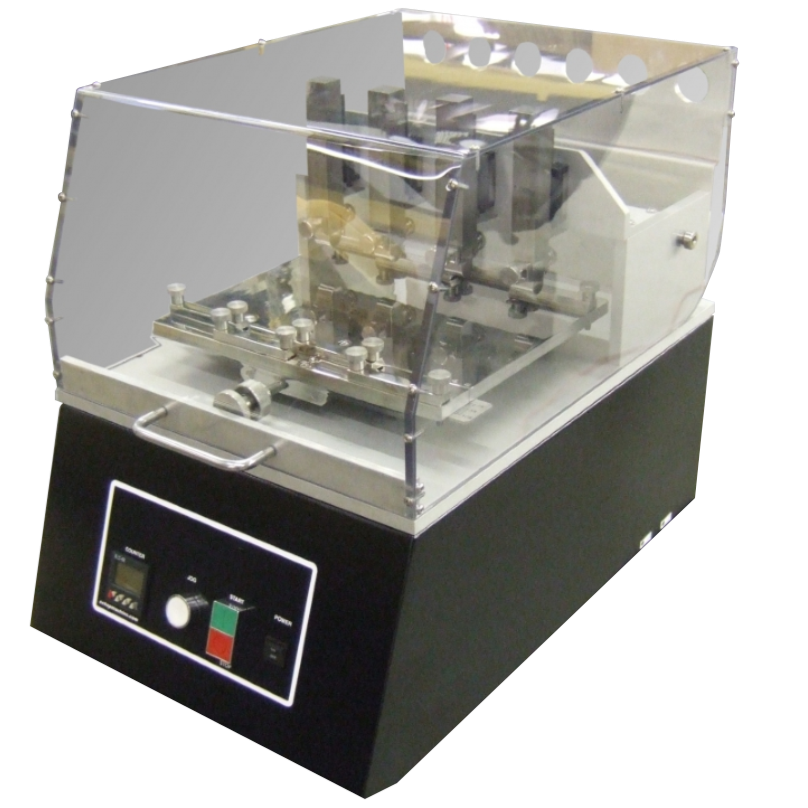
The Toyota Specialized Abrasion Tester is designed to evaluate the abrasion resistance, color transfer, and surface durability of textiles, leather, plastics, and coatings. By applying controlled load, speed, and friction media, it simulates real-world wear caused by repeated rubbing, contact, or dragging. This tester supports material R&D, quality control, and batch inspection, ensuring durability and appearance retention in automotive, textile, and coated materials.
Product Advantages
Unmatched Precision
Proprietary load cell technology (±0.005 N accuracy) captures subtle wear patterns, critical for coated materials and thin films.
Extreme Durability
Aircraft-grade aluminum frame and corrosion-resistant components withstand 24/7 industrial use.
Smart Automation
AI-driven test protocols adjust speed, pressure, and cycles in real time based on material feedback.
Universal Testing Capability
Handles substrates from ultra-thin polymers (10 µm) to reinforced composites (10 mm thickness).
Global Compliance
Pre-loaded JIS, ISO, and ASTM test modes with automatic report generation in 8 languages.
Product Features
Testing Modes
Rotary Abrasion: 1–200 RPM for flat surfaces (e.g., coatings, films).
Reciprocating Abrasion: 10–50 mm stroke for seams, edges, and 3D geometries.
Custom Waveforms: Programmable motion profiles for simulated real-world wear (e.g., gear teeth, bearing surfaces).
Real-Time Analytics
4K camera system (120 FPS) with AI-powered fuzz/pill detection and surface roughness mapping.
Data Ecosystem
Cloud-connected software stores 100.000+ test results, predicts wear life, and integrates with ERP/MES systems.
Safety & Sustainability
Low-energy mode (50% power reduction), self-cleaning chamber, and CE/UL/RoHS certification.
Technical Parameters
| Parameter | Specification |
|---|---|
| Load Cell Capacity | 0–100 N (±0.005 N accuracy) |
| Speed Range | 1–200 RPM (rotary) / 10–50 mm/s (reciprocating) |
| Stroke Length | 10–50 mm (±0.01 mm resolution) |
| Test Stations | 1 (expandable to 3 with optional kit) |
| Dimensions (L×W×H) | 900×700×1.600 mm |
| Weight | 350 kg |
| Operating Environment | 5–40°C, ≤85% RH (non-condensing) |
| Power Supply | 220V/110V AC, 50/60Hz, 3.2kW |
Accessories
Abrasive Kits
5× precision-ground steel wheels (for TABER®-equivalent testing).
10× sandpaper discs (P80–P2500 grit).
Calibration Tools
JIS/ISO-certified reference block, load cell verifier, and traceable certificate.
Sample Fixtures
Pneumatic clamps for flat/curved specimens, vacuum chuck for thin films.
Software Suite
AI analytics platform with wear simulation, ERP integration, and 8-language report generator.
Safety Bundle
Emergency stop, acoustic enclosure, and fume extraction port.
Test Procedures
Cut specimens according to standard requirements and perform any necessary pre-treatment.
Mount specimens in the clamps and apply prescribed elongation.
Install the appropriate friction head and friction media according to the standard.
Set the number of cycles and operating speed.
Start the test and monitor operation until completion.
Remove specimens after testing.
Evaluate the wear, color transfer, and surface changes under specified lighting conditions.
Record results and generate test reports.
FAQ
1.What is this product?
It is an abrasion tester for evaluating the wear resistance and colorfastness of textiles, leather, plastics, and coatings.
2.What is this product used for?
You use it to simulate real-world rubbing, friction, and wear, assessing durability and appearance retention of materials.
3.How does this product work?
The device applies controlled load and motion via friction heads and media, performing repeated rubbing cycles on specimens, then evaluates surface wear, color transfer, and damage.
4.Why is this product important?
It ensures materials meet quality and durability requirements, supporting automotive, textile, and coating industries in R&D and production control.
5.Which industries is this product suitable for?
Automotive OEMs, textile and leather manufacturers, coatings and plastic suppliers, R&D laboratories, and quality assurance centers.
