




Search keywords:
product name, product type, model number,
test method, manufacturer, technique, application
-
Cone Calorimeter
The import of American VTEC, cone calorimeter ultra high cost performance
more
-
Digital Elmendorf Tearing Tester
Pendulum method test material tear strength, operating more simple, more accurate data
more
-
ZwickiLine Materials testing machines
Top of the world's leading universal material testing machine
more
Wire-to-Wire Vibration Abrasion Tester
BACK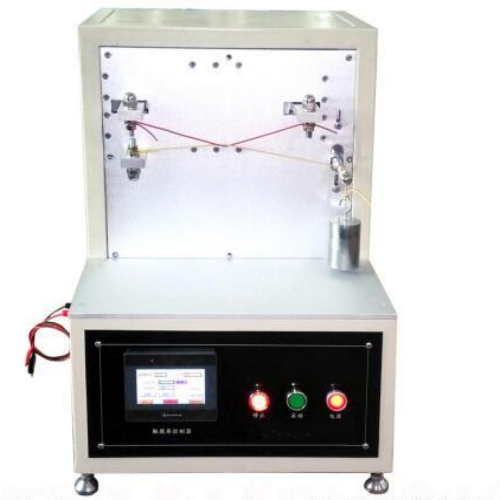


Standards:
Applications:
(1) Automotive wiring harness manufacturers – assess wire insulation abrasion resistance.
(2) Electrical component quality control – verify compliance with wire wear standards.
(3) Research and development – test new wire insulation materials.
(4) Automotive electronics testing labs – evaluate vibration-induced wear on wiring systems.
(5) Certification bodies – perform standardized abrasion testing of low-voltage wires.
Product Information:
The Wire-to-Wire Vibration Abrasion Tester is designed to evaluate the abrasion resistance of automotive wires with cross-sectional areas below 6 mm² under controlled vibration conditions. The instrument tests the insulation surface of wires under repetitive contact, providing an accurate assessment of automotive wire durability and wear performance.
Standards
(1) VW60306:2000-11 – Automotive wire abrasion testing standard
(2) GS95007-1:2007-08 – Wire insulation wear test requirements
Parameters
| Parameter | Specification |
|---|---|
| Vibration Frequency | 10 Hz |
| Vibration Amplitude | 6.35 ± 0.25 mm |
| Vibration Direction | Horizontal |
| Fixed Wire Support Distance | 280 mm |
| Movable Wire Support | One point on fixed platform, other passes through guide >14× wire diameter |
| Distance Between Vibration and Fixed Table | 45 mm |
| Friction Point | Midpoint of sample (10% position) |
| Applied Mass | 10 N, 12.5 N, 15 N, 20 N |
| Abrasion Count Setting | 1–9999 cycles adjustable |
| Automatic Stop | When wire insulation is breached and conduction occurs |
Features
(1) Simulates real-world vibration conditions to evaluate wire-to-wire insulation wear.
(2) Adjustable load weights allow testing under different pressure conditions.
(3) Horizontal vibration table ensures uniform abrasion across the wire surface.
(4) Automatic shutdown prevents damage once insulation failure or short circuit occurs.
(5) Supports a wide range of cycle settings for long-term durability evaluation.
Accessories
(1) Fixed wire clamps for secure positioning.
(2) Movable wire guide supports.
(3) Set of standard weights (10 N, 12.5 N, 15 N, 20 N).
(4) Vibration control panel.
(5) Instruction manual and testing guide.
Test Procedures
(1) Install the test wires on the fixed and movable supports according to wire diameter and sample length.
(2) Set the vibration frequency, amplitude, and horizontal direction on the control panel.
(3) Select the desired load weight to apply to the wire contact point.
(4) Configure the number of abrasion cycles.
(5) Start the test; the instrument will apply horizontal vibration to the wires.
(6) Monitor the test; the machine will automatically stop if wire insulation breaks and electrical conduction occurs.
(7) Record the abrasion cycles at which failure occurs and analyze insulation wear.
Maintenance Information
(1) Clean wire clamps and guide rods regularly to prevent residue buildup.
(2) Inspect vibration table bearings and sliding surfaces for wear.
(3) Calibrate vibration amplitude and frequency periodically to maintain accuracy.
(4) Lubricate movable components as per manufacturer guidelines.
(5) Store the instrument in a dry, vibration-free environment when not in use.
Conclusion
The Wire-to-Wire Vibration Abrasion Tester provides precise and reliable evaluation of automotive wire insulation wear under vibration. It is essential for manufacturers, R&D labs, and quality control centers to ensure wire durability and compliance with automotive industry standards.
FAQ
(1) What is this product?
It is a vibration abrasion tester for evaluating the insulation wear resistance of automotive wires.
(2) What is this product used for?
It tests wire insulation durability under vibration to determine abrasion resistance and predict service life.
(3) What is the working principle of this product?
Wires are subjected to controlled horizontal vibration while in contact, simulating repeated friction to measure insulation wear.
(4) Why is this product important?
It ensures automotive wires meet safety and durability standards, preventing potential electrical failures.
(5) What industries is this product suitable for?
Automotive manufacturing, electrical component production, R&D laboratories, quality control centers, and certification agencies.
