




Search keywords:
product name, product type, model number,
test method, manufacturer, technique, application
-
Cone Calorimeter
The import of American VTEC, cone calorimeter ultra high cost performance
more
-
Digital Elmendorf Tearing Tester
Pendulum method test material tear strength, operating more simple, more accurate data
more
-

ZwickiLine Materials testing machines
Top of the world's leading universal material testing machine
more
G280 Ozone Colorfastness Tester
BACK

Standards:
The tester complies with the following international and national test standards: GB/T 11039.3-2005 (Textiles — Color fastness tests — Color fastness to atmospheric pollutants — Part 3: Atmospheric ozone) ISO 105-G03:1993 (Textiles — Tests for colour fastness — Part G03: Colour fastness to atmospheric ozone) GB/T 7762-2014 (Vulcanized rubber or thermoplastic rubber — Resistance to ozone cracking — Static strain test) GB/T 13642-2015 (Vulcanized rubber or thermoplastic rubber — Resistance to ozone cracking — Dynamic strain test) AATCC 109-2016 (Colorfastness to ozone in the atmosphere under low humidity) AATCC TM129-2011 (2016)e (Colorfastness to ozone in the atmosphere under high humidity)
Applications:
The G280 Ozone Colorfastness Tester is widely used in quality control, product development, and compliance testing across multiple industries.
Typical application scenarios include:
Evaluation of ozone colorfastness of dyed and finished textiles
Assessment of ozone-induced discoloration in fabrics under low and high humidity conditions
Ozone aging and cracking resistance testing of vulcanized rubber and thermoplastic rubber
Comparative testing between test specimens and control reference samples
Applicable test products include:
Knitted fabrics, woven fabrics, and coated textiles
Rubber seals, hoses, belts, and elastomer components
Textile products used in outdoor, industrial, or polluted atmospheric environments
Product Information:
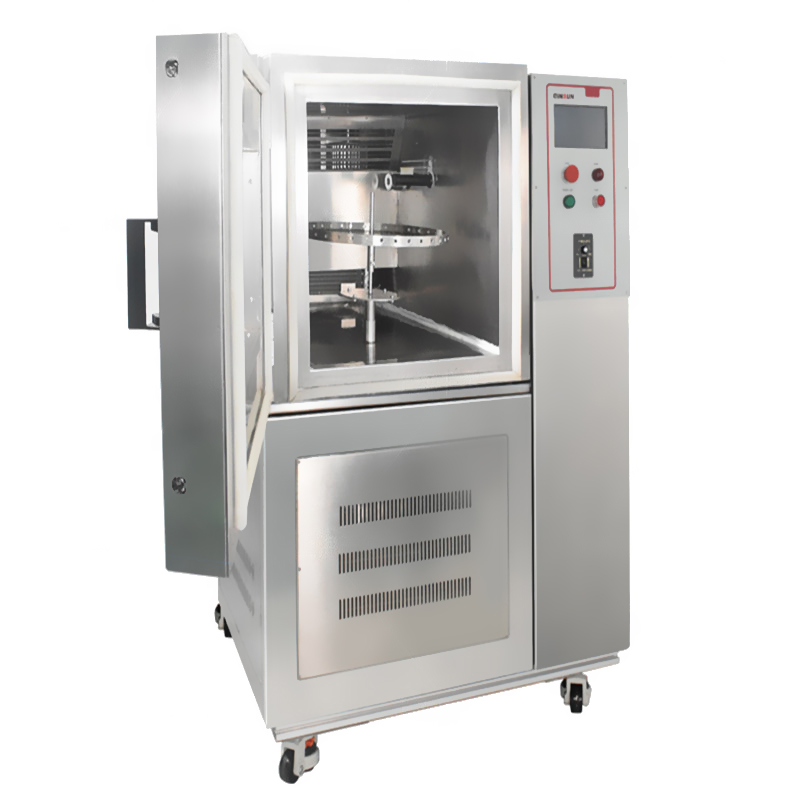
G280 Ozone Colorfastness Tester is designed to evaluate the colorfastness and aging performance of rubber, textiles, and fabrics when exposed to ozone environments. The tester simulates atmospheric ozone conditions to assess material resistance to ozone-induced discoloration, fading, and degradation. The system integrates an ozone generator, circulation fan, baffle system, rotating specimen rack, and sealed test chamber to ensure stable ozone exposure and reliable test repeatability. It is suitable for both textile colorfastness testing and rubber ozone aging evaluation under controlled laboratory conditions.
Parameters
| Parameter | Specification |
|---|---|
| Control Mode | Automatic |
| Ozone Concentration Range | 1–1000 pphm |
| Specimen Rack Rotation Speed | 1–10 RPM, adjustable |
| Specimen Clamp Material | Stainless steel |
| Main Body Material | Stainless steel |
| Weight | 155 kg |
| Power Supply | 220 V, 50 Hz |
| Overall Dimensions (L × W × H) | 1020 mm × 1000 mm × 1650 mm |
Features
Equipped with a high-efficiency ozone generator, precision controller, and closed-loop ozone concentration control system to ensure stable and accurate ozone exposure throughout the test
Rotating specimen rack accommodates up to 24 specimens simultaneously, improving test efficiency and consistency
Stainless steel specimen clamps mounted on metal wire slip rings allow secure fixation of samples with various sizes and shapes
User-friendly control interface displays preset parameters and real-time test conditions, enhancing operational clarity and result reliability
Robust stainless steel chamber construction ensures corrosion resistance and long-term durability under ozone exposure
Accessories
(1) Rotating specimen rack
(2) Stainless steel specimen clamps
(3) Built-in ozone generator
(4) Circulation fan and airflow baffle system
Test Procedures
Prepare test specimens and control reference samples according to the applicable standard.
Mount specimens and control samples securely on the rotating specimen rack using stainless steel clamps.
Set the required ozone concentration, rotation speed, temperature, and humidity conditions based on the selected test method.
Place both test specimens and control samples inside the ozone test chamber and start the test cycle.
Maintain chamber temperature within the specified range (64–82 °F) and relative humidity at approximately 67% during testing.
Continue the test until the control sample fades to match the specified fading standard, which defines one test cycle.
Repeat test cycles until the specimen reaches the required color change level or the predetermined number of cycles is completed.
Evaluate and record the color change of specimens to determine ozone colorfastness or aging performance.
Maintenance Information
Regularly inspect the ozone generator and airflow system to ensure stable ozone output and uniform circulation
Keep the specimen rack and clamps clean to prevent contamination affecting test results
Periodically verify ozone concentration accuracy as part of routine laboratory calibration practices
Ensure the chamber interior is dry and free of residue after testing, especially following high-humidity ozone tests
FAQ
1. What types of materials can be tested using the G280 Ozone Colorfastness Tester?
The G280 Ozone Colorfastness Tester is suitable for evaluating both textile materials and rubber products. It can assess the ozone-induced color fading of fabrics as well as the aging and cracking resistance of vulcanized and thermoplastic rubber. This dual applicability makes the instrument suitable for laboratories that handle textile colorfastness testing and rubber durability evaluation under ozone exposure conditions.
2. How is ozone concentration controlled during testing?
The tester uses a high-efficiency ozone generator combined with a closed-loop control system. Ozone is generated through grid discharge using a high-voltage transformer and injected into the test chamber before the low-pressure circulation fan. This configuration allows continuous monitoring and automatic adjustment of ozone concentration within the range of 1–1000 pphm, ensuring stable and repeatable test conditions throughout the entire test cycle.
3. Why are control reference samples used during ozone colorfastness testing?
Control reference samples are used to define a standardized test cycle. During testing, both the specimen and the control sample are exposed to the same ozone, temperature, and humidity conditions. When the control sample fades to match the specified fading standard, one test cycle is completed. This approach ensures objective comparison and improves the accuracy and consistency of colorfastness evaluation.
4. How many specimens can be tested at the same time?
The rotating specimen rack is designed to hold up to 24 specimens simultaneously. This allows multiple samples to be tested under identical conditions, improving testing efficiency and ensuring consistent exposure to ozone across all specimens.
