




Search keywords:
product name, product type, model number,
test method, manufacturer, technique, application
-
Cone Calorimeter
The import of American VTEC, cone calorimeter ultra high cost performance
more
-
Digital Elmendorf Tearing Tester
Pendulum method test material tear strength, operating more simple, more accurate data
more
-
ZwickiLine Materials testing machines
Top of the world's leading universal material testing machine
more
Carbon Arc Weathering Test Chamber
BACK

Standards:
ASTM G153-13 Standard Practice for Testing Nonmetallic Materials Using a Closed Carbon Arc Lamp ASTM D3980 Practice for Interlaboratory Testing of Paints and Related Materials ASTM G23 Testing Nonmetallic Materials Using Carbon Arc Exposure Apparatus (With and Without Water) ASTM G114 Terminology Related to Natural and Artificial Weathering Tests for Nonmetallic Materials ASTM G151 Laboratory Light Source Acceleration Test Apparatus for Nonmetallic Materials ASTM G152 Open Carbon Arc Exposure Method for Nonmetallic Materials ISO 4892-3 Plastics - Laboratory Light Source Test Methods ISO 4892-1 Plastics - Laboratory Light Source Test Methods, Part 1: General Guidelines ISO 4892-4 Plastics - Laboratory light source test methods - Part 4: Open carbon arc lamp JIS A1415 Test methods for accelerated exposure aging of plastic building materials JIS D0205 Test methods for weather resistance of automotive parts JIS L0842-2004 Test methods for lightfastness to staining under enclosed carbon arc lamp JIS L0891-2007 Test Methods for Accelerated Weathering Colorfastness Using Xenon Arc Lamp or Sunlight-Type Carbon Arc Lamp JIS K7102 Test Method for Colorfastness of Plastics to Carbon Arc Lamp Irradiation JIS B7751 Sunlight Carbon Arc Lamp Type Light Resistance Tester and Weathering Tester (Enclosed Carbon Arc Lamp) NES M0135 Weathering and Light Resistance Testing of Synthetic Resin Parts NES M0141 Test Methods for Coated Synthetic Resins
Applications:
Carbon Arc Weathering Test Chamber is a globally recognized instrument for accelerated sunlight colorfastness testing. It evaluates the light-induced aging of various materials and products, serving applications in textile fibers, building materials, notebooks, and common office supplies. The chamber complies with multiple sunlight colorfastness testing standards.
Product Information:
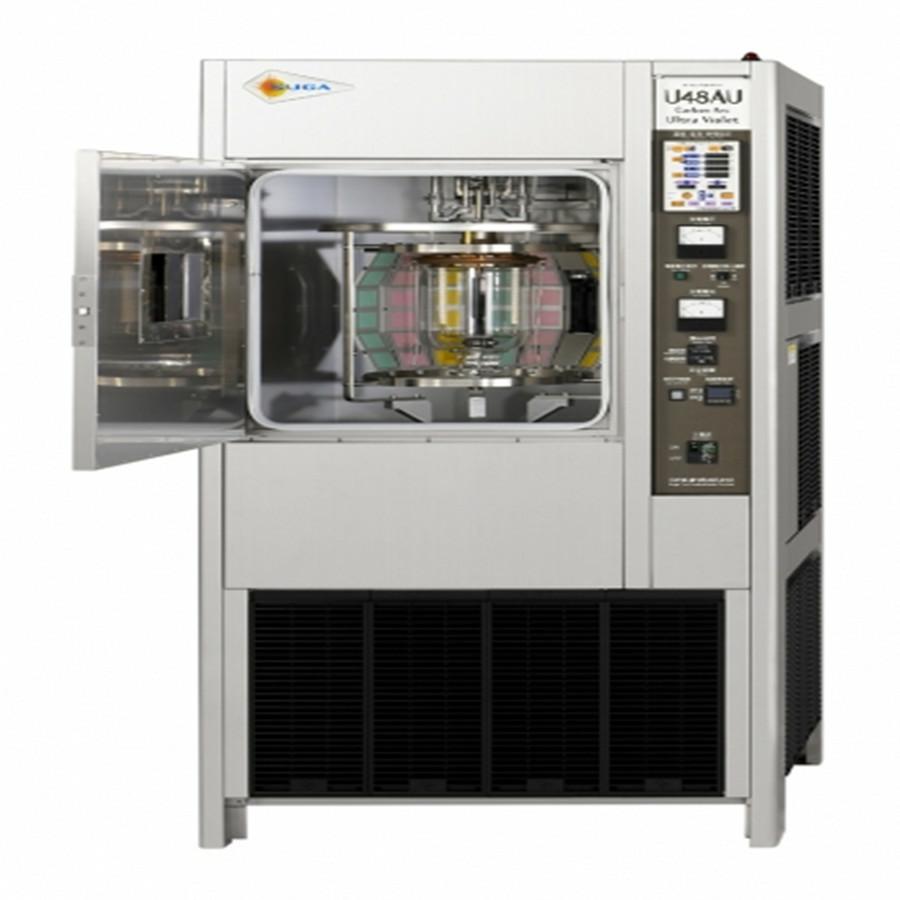
The Carbon Arc Weathering Test Chamber is a globally recognized instrument designed for high-precision accelerated lightfastness and weathering testing. By utilizing an enclosed carbon arc lamp as its primary light source, this chamber replicates the ultraviolet and visible spectrum of sunlight to evaluate how materials degrade over time. It allows you to simulate the effects of prolonged solar exposure on various products—ranging from textiles to electronics—ensuring that your materials meet international durability and colorfastness requirements before they reach the market.
Features
Light Source—Long-life ultraviolet carbon rod emitting UV light at 388nm wavelength, capable of continuous operation for 48 hours.
Control System—Equipped with a humidity generator and continuous airflow delivery for high-precision temperature and humidity control.
Automatic Air Control System—Regulates air circulation within the mixing chamber and environmental air.
SUGA U48 and U48AU models are available to meet diverse user requirements.
Parameters
| Item | Specifications |
|---|---|
| Light Source | Carbon Arc Lamp |
| Continuous Operation Time of Light Source | 48 hours |
| Discharge Voltage & Current | 135V±10V, 16A±2A |
| Temperature Range | 63°C±3°C |
| Humidity Range | 35% RH to 50% RH±5% RH |
| Humidity Control | Atomizer |
| Temperature Cycle | Air circulation regulated by air control valve |
| Test Samples | Maximum capacity: 108 piecesSample size: 65mm×55mm, 1mm thickness |
| Power Supply | Single-phase, 200V, 41A |
| Dimensions (L×W×H) | 104cm × 95cm × 205cm |
| Weight | 354kg |
Accessories
Ultraviolet Carbon Rods: Specialized electrodes designed for 48-hour continuous discharge.
Specimen Holders: Stainless steel clips designed for standard $65\text{mm} \times 55\text{mm}$ samples.
Black Panel Thermometer (BPT): For monitoring the surface temperature of the specimens.
Glass Filter Globes: High-transparency globes to protect the samples from combustion byproducts while transmitting the required UV spectrum.
Humidifier Wick/Atomizer: Components for the humidity generation system.
Test Procedures
1. Preparation of Samples
Measure and cut your test materials to the standard $65\text{mm} \times 55\text{mm}$ size. Mount them securely into the specimen holders, ensuring the side to be tested is facing inward toward the light source.
2. Rod and Filter Installation
Install a new set of carbon rods into the lamp assembly. Clean the glass globe to ensure maximum UV transmission and place it over the arc assembly. Check the gap between the rods to ensure reliable ignition.
3. Parameter Configuration
Access the control panel to set the Black Panel Temperature (BPT) to the standard $63^{\circ}\text{C}$ and configure the humidity levels. Set the timer for the required test duration (up to 48 hours for a single rod cycle).
4. Initiating the Test
Start the air circulation and humidity systems first, then ignite the carbon arc. The specimen rack will begin to rotate around the light source to ensure that every sample receives an identical dose of radiation.
5. Final Assessment
Once the test cycle is complete, remove the samples. Compare the exposed specimens against an unexposed control sample or a standard Gray Scale to evaluate the degree of color change, fading, or physical degradation.
FAQ
1.Why does the U48AU focus on the 388nm UV range?
The 388nm spectrum is highly effective at triggering the photochemical reactions responsible for fading in textiles and the degradation of polymers. By concentrating energy in this band, the U48AU can accelerate the solar aging process much faster than natural sunlight.
2.How does the enclosed carbon arc differ from an open-flame carbon arc?
An enclosed carbon arc operates within a glass globe, which creates a specific atmosphere that filters out certain short-wave UV rays and contains the byproducts of combustion. This provides a more stable spectrum for lightfastness testing compared to open-flame systems.
3. I run the chamber for longer than 48 hours without intervention?
The carbon rods are consumed during the discharge process. Therefore, you must stop the test and replace the rods after 48 hours. However, the system allows you to restart the test immediately to accumulate the thousands of hours often required by international standards.
4.What is the significance of the rotating specimen drum?
The drum rotates at a constant speed to eliminate any potential "hot spots" or variations in light intensity. This ensures that the 108 samples all experience the exact same environmental stress, making your test data statistically significant.
5.What water quality is required for the humidity system?
To prevent scale formation on the atomizer and specimens, you should use deionized or distilled water. Mineral-rich tap water can lead to white deposits on your samples, which may interfere with colorfastness assessments.
6.Is it possible to simulate rain or dew with this specific model?
The U48AU is primarily designed for lightfastness and humidity testing. For standards requiring significant water spray (rain simulation), a sunlight-type carbon arc weathering tester with a spray system (like the SUGA S80) is typically more appropr
