




Search keywords:
product name, product type, model number,
test method, manufacturer, technique, application
-
Cone Calorimeter
The import of American VTEC, cone calorimeter ultra high cost performance
more
-
Digital Elmendorf Tearing Tester
Pendulum method test material tear strength, operating more simple, more accurate data
more
-
ZwickiLine Materials testing machines
Top of the world's leading universal material testing machine
more
Photovoltaic Module Backsheet 90-Degree Peel Strength Tester
BACK

Standards:
The tester is designed to comply with international and national standards: (1) GB/T 9535 – Crystalline Silicon Terrestrial Photovoltaic (PV) Modules – Design Qualification and Type Approval (2) IEC 61730-2 – Photovoltaic (PV) Module Safety Qualification – Part 2: Requirements for Testing
Applications:
The tester is suitable for evaluating PV module backsheet adhesion performance in various scenarios:
Crystalline silicon PV module backsheet peel strength testing
Thin-film PV module backsheet adhesion evaluation
Design verification and type testing of PV modules
Research and development of PV module encapsulation materials
Production process quality control for PV module assembly
Reliability and safety testing of PV modules
Testing in third-party inspection agencies and certification laboratories
Academic and research institutions studying photovoltaic encapsulation materials
Product Information:
Photovoltaic Module Backsheet 90-Degree Peel Strength Tester
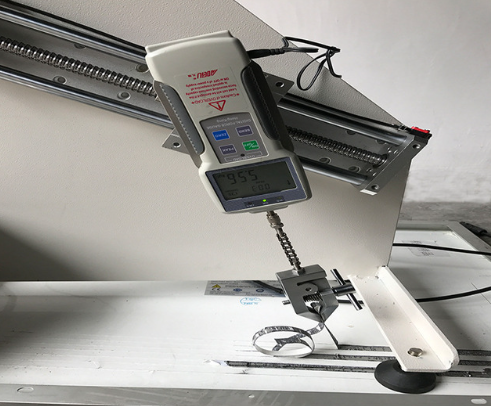
The Photovoltaic Module Backsheet 90-Degree Peel Strength Tester is a specialized mechanical testing system designed to measure the adhesion performance between PV module backsheet and encapsulant layers. By performing 90° or adjustable-angle peel tests at controlled speed, the system quantifies the force required during peeling, enabling evaluation of backsheet bonding strength and long-term reliability. This equipment is essential for assessing PV module material quality, design verification, type testing, and production quality control.
Parameters
| Item | Technical Specification |
|---|---|
| Rated Load | 500 N |
| Maximum Peel Force | ≥ 200 N |
| Travel | 210 mm |
| Test Speed Range | 50 – 500 mm/min (digital display) |
| Standard Peel Angle | 90° |
| Peel Angle Range | 0 – 180° (adjustable) |
| Glass Movement Speed | 50 ± 5 mm/min |
| Force Display | Digital display |
Features
Compliant with IEC 61730-2 requirements for PV module backsheet peel strength
Supports standard 90° peel testing and adjustable-angle tests for flexibility
Stable load control and high repeatability of force measurement
Digital speed setting for intuitive and precise operation
High structural rigidity suitable for glass-based PV module testing
Suitable for R&D, type testing, and production quality control
Accessories
(1) Main testing system with loading mechanism
(2) Peel fixture for backsheet clamping
(3) Glass fixation platform for module support
(4) Force sensor with 500 N rated load
(5) Digital display control system for force and speed
(6) Consumable peel clamping components (replace based on use frequency)
(7) Sample preparation tapes or auxiliary fixing materials
Test Procedures
Prepare PV module backsheet peel test samples according to standard size and peel length requirements.
Secure the module glass on the testing platform.
Clamp the backsheet end into the peel fixture.
Set the peel angle (typically 90°) and test speed.
Start the test to perform constant-speed peeling.
Record real-time peel force variations and maximum peel force.
Complete the test and analyze data to determine compliance with standard requirements.
Maintenance Information
Regularly inspect and calibrate force sensors to maintain measurement accuracy.
Check peel fixtures and clamps for wear or deformation and replace as needed.
Verify digital display and speed control system operation before testing.
Clean testing platform and clamps to avoid contamination affecting adhesion readings.
Periodically review test protocol and ensure alignment with current standard requirements.
Conclusion
The Photovoltaic Module Backsheet 90-Degree Peel Strength Tester provides a reliable, repeatable, and standardized method for evaluating backsheet adhesion in photovoltaic modules. By combining adjustable peel angles, precise speed control, and real-time force measurement, it ensures accurate assessment of module material quality and long-term reliability, making it indispensable for R&D, type testing, and production quality assurance.
FAQ
1. What is the main purpose of the PV Module Backsheet 90-Degree Peel Strength Tester?
The tester is designed to evaluate the adhesion performance between the backsheet and encapsulant layer of PV modules. By performing 90° or adjustable-angle peel tests at controlled speeds, it measures the force required to separate the backsheet, providing quantitative data on bonding strength. This information is critical for design verification, type testing, and production quality control, ensuring long-term reliability of PV modules.
2. Can the tester perform peel tests at angles other than 90°?
Yes, the tester supports adjustable peel angles from 0° to 180°, while 90° is the standard for IEC 61730-2 testing. This flexibility allows comparison of adhesion performance under different mechanical stress scenarios and is useful for research, development, and material evaluation of PV module backsheets.
3. Why is digital speed control important in peel testing?
Digital speed control ensures precise and repeatable peeling rates, which directly affects the measurement of peel force. Consistent speed eliminates variability caused by manual operation and allows for accurate comparison of backsheet adhesion between different modules or materials, improving test reliability and repeatability.
