




Search keywords:
product name, product type, model number,
test method, manufacturer, technique, application
-
Cone Calorimeter
The import of American VTEC, cone calorimeter ultra high cost performance
more
-

Digital Elmendorf Tearing Tester
Pendulum method test material tear strength, operating more simple, more accurate data
more
-

ZwickiLine Materials testing machines
Top of the world's leading universal material testing machine
more
Wet Leakage Current Tester
BACK

Standards:
IEC 61215 – Crystalline Silicon Photovoltaic Module Design Qualification and Type Approval
Applications:
The system is applicable to multiple testing scenarios for PV modules:
Humidity Resistance Testing: Assess insulation performance under wet conditions.
Environmental Simulation: Simulate rain, fog, dew, and melting snow to verify module safety.
Junction Box and Circuit Waterproofing: Evaluate internal circuit protection against moisture ingress.
PV Module Certification Testing: Compliant with IEC 61215.
Durability Assessment: Evaluate long-term performance under humid environments.
R&D Verification: Test insulation and anti-leakage designs in the development stage.
Power Safety Testing: Ensure module reliability in electrical applications.
Product Information:
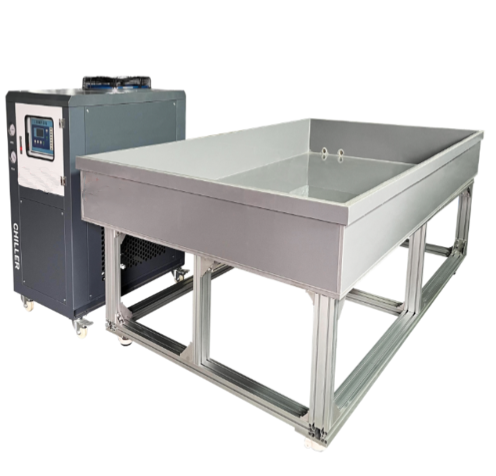
The Wet Leakage Current Test System is designed to evaluate the insulation performance of photovoltaic (PV) modules under humid conditions. By simulating rain, fog, dew, and melting snow, it accurately assesses the internal circuitry safety and reliability of PV modules. The system prevents moisture-induced corrosion, leakage, or other electrical hazards, ensuring modules maintain compliance with safety and quality standards.
Parameters
| Item | Technical Parameter |
|---|---|
| Test Tank Size | 2100 × 1000 × 250 mm (W×D×H), thickness 15 mm |
| Tank Material | Acrylic (Transparent) |
| Temperature Control | Self-developed constant temperature system, 22 ±3℃ |
| Liquid Resistivity | < 3500 Ω·cm |
| Spray System | 3 × UL laboratory spray nozzles, each with water pressure gauge and flow adjustment valve |
| Insulation Test Instrument Output Voltage | 0–5000 V adjustable |
| Maximum Leakage Current | 5 mA |
| Voltage Ramp Rate | 500 V/s |
| Insulation Resistance Measurement Range | 1 MΩ – 9999 MΩ |
| Leakage Current Measurement Range | 0.001 – 5.000 mA DC |
| Control Precision | High-precision conductivity meter and constant temperature control |
| Sample Capacity | Customizable according to fixture, supports multiple modules simultaneously |
Features
Fully simulates wet environmental conditions including rain, fog, dew, and melting snow.
Constant temperature water tank ensures a stable test environment with precise temperature control.
Multi-nozzle design enables full coverage of junction boxes and modules for comprehensive testing.
Insulation tester supports high voltage and low leakage current measurements.
High-transparency acrylic tank allows observation of testing process.
Conductivity meter monitors water resistivity in real-time, ensuring measurement accuracy.
Robust sample fixtures support multiple modules simultaneously.
Data logging, export, and historical tracking are supported for analysis and record-keeping.
Accessories
Insulation Test Instrument: Output 0–5000 V, leakage current measurement 0.001–5 mA.
Water Temperature Control Box: Maintains tank at 22 ±3℃.
Spray System Rack: Supports multi-angle spraying, includes 3 UL nozzles.
Insulation Tank: Acrylic, transparent for observation.
Conductivity Meter: Monitors liquid resistivity in real-time.
Sample Fixture: Can secure multiple modules for testing.
Test Procedures
Verify proper grounding of the system and confirm that the tank, spray system, and conductivity meter are operational.
Install the PV modules on the sample fixture and ensure secure mounting.
Set the constant temperature system to maintain the tank at 22 ±3℃.
Adjust spray system pressure and flow for full coverage of junction boxes and module surfaces.
Start the insulation tester, setting test voltage and leakage current range.
Monitor liquid resistivity, ensuring it remains below 3500 Ω·cm.
After testing, turn off spray and temperature control systems and save test data.
Periodically clean the tank and nozzles to maintain testing accuracy.
Maintenance Information
Ensure proper grounding and check system functionality before each test.
Inspect and clean spray nozzles and water tank regularly to prevent clogging.
Verify the conductivity meter calibration to maintain measurement precision.
Keep sample fixtures clean and stable to ensure repeatable results.
Check insulation tester for consistent voltage output and leakage current measurement accuracy.
Conclusion
The Wet Leakage Current Test System provides precise simulation of humid environmental conditions, enabling comprehensive evaluation of PV module insulation performance. By combining controlled temperature, multi-nozzle spraying, and high-voltage measurement, the system ensures modules are tested for moisture resistance, electrical safety, and reliability. It is an essential tool for PV module R&D, quality control, and certification labs.
FAQ
What environmental conditions can this system simulate?
The system can simulate rain, fog, dew, and melting snow conditions. Using a combination of constant-temperature water tanks and multi-nozzle spray systems, it reproduces the effects of humid environments on PV modules to verify insulation performance and electrical safety.
How does the system monitor insulation performance?
The insulation tester applies up to 5000 V and measures leakage currents from 0.001 to 5 mA. The system continuously monitors insulation resistance and leakage current in real time, ensuring that modules maintain proper circuit integrity during exposure to moisture.
Can multiple PV modules be tested simultaneously?
Yes. The sample fixture can be customized to accommodate multiple modules simultaneously. This allows efficient testing of several modules under identical wet conditions, providing consistent and repeatable results for research, quality control, and certification purposes.
What measures ensure test accuracy?
The system uses a high-precision conductivity meter to monitor water resistivity, ensuring it stays below 3500 Ω·cm. Temperature is maintained at 22 ±3℃ by the constant temperature system, and multi-angle spray nozzles ensure full coverage. This combination ensures highly accurate and reliable wet leakage current measurements.
