




Search keywords:
product name, product type, model number,
test method, manufacturer, technique, application
-
Cone Calorimeter
The import of American VTEC, cone calorimeter ultra high cost performance
more
-
Digital Elmendorf Tearing Tester
Pendulum method test material tear strength, operating more simple, more accurate data
more
-
ZwickiLine Materials testing machines
Top of the world's leading universal material testing machine
more
Conduit Bending Test Machine
BACK

Standards:
IEC 61730-2:2004 – Photovoltaic (PV) Module Electrical Safety Requirements
Applications:
The machine is widely used in:
Mechanical Performance Testing: Evaluate bending and torsion resistance of PV module conduits.
Safety Assessment: Verify conduit performance for PV module electrical safety.
R&D Durability Verification: Test conduit designs during development stages.
PV Module Certification: Compliant with IEC 61730-2 requirements.
Mechanical Stress Simulation: Assess conduit performance under installation and transportation forces.
Material and Structural Optimization: Verify the mechanical robustness of different conduit materials and designs.
Product Information:
The Conduit Bending Test Machine is designed to evaluate the bending and torsion resistance of photovoltaic (PV) module conduits. By applying specified weights to the conduit and rotating it at a controlled speed, the system simulates mechanical stresses that conduits may encounter during transportation, installation, and operational use. This allows accurate assessment of conduit reliability, durability, and structural integrity.
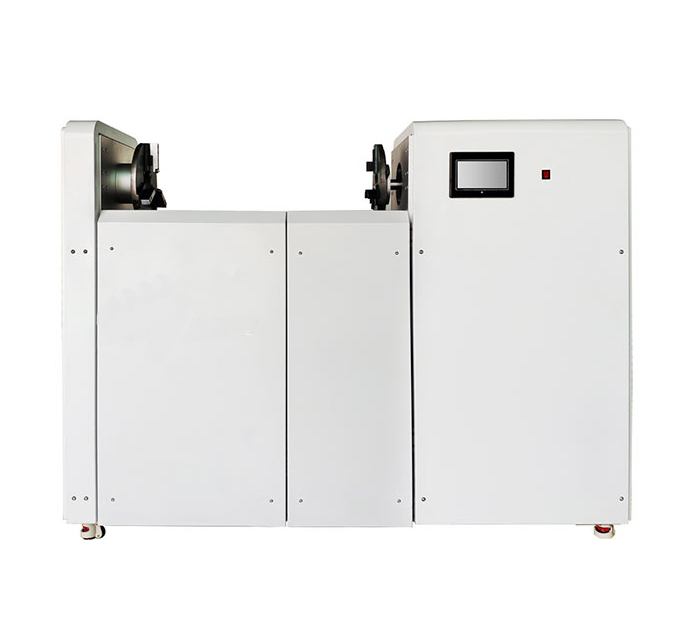
Parameters
| Item | Technical Parameter |
|---|---|
| Controller Frequency Range | 0–120 Hz |
| Spindle Rotational Speed | N rev./min = Frequency Hz / 60 (e.g., 60 Hz → 1 rev./min) |
| Timer Range | 1–9999 s |
| Power Supply | Single-phase AC 220 V, 100 W |
| Conduit Outer Diameter & Weight | 13–25 mm → 220 N; 26–50 mm → 330 N; 51–100 mm → 490 N |
Features
Adjustable frequency control enables precise rotational speed.
Wide timer range suitable for long-duration endurance tests.
Standardized weights accommodate various conduit diameters.
Simple operation with high repeatability and reliability.
Suitable for research, production, and certification laboratories.
Accessories
Controller: Frequency setting 0–120 Hz for spindle speed adjustment.
Spindle: Supports stable rotation of conduits.
Weights: Standardized weights corresponding to conduit diameters (220 N, 330 N, 490 N).
Sample Fixture: Securely holds conduit to ensure safe and stable testing.
Timer: Range 1–9999 seconds, supports automatic stop.
Test Procedures
Verify proper grounding and ensure the controller and power supply function normally.
Mount the conduit onto the sample fixture and ensure it is securely fixed.
Select the appropriate weight according to the conduit diameter.
Set spindle rotation frequency (0–120 Hz) and test duration.
Start the device and observe the conduit rotation and stress application.
Upon test completion, turn off the machine and record experimental results.
Periodically clean the spindle and fixture to maintain precision and safety.
Maintenance Information
Ensure grounding is secure and controller functionality is verified before each test.
Clean spindle and sample fixtures regularly to maintain rotation precision.
Inspect weights for integrity and correct placement.
Confirm timer and controller calibration periodically.
Store components in a clean, dry environment to prolong equipment life.
Conclusion
The Conduit Bending Test Machine provides precise simulation of mechanical stress on PV module conduits. By combining controlled rotational speed with standardized weights, it accurately reproduces bending and torsion forces encountered during module installation, transport, and use. This ensures reliable evaluation of conduit durability, mechanical performance, and compliance with IEC 61730-2 standards, supporting both R&D and certification laboratories.
FAQ
What is the purpose of the Conduit Bending Test Machine?
The machine evaluates the bending and torsion resistance of PV module conduits under controlled mechanical stress. By applying specified weights and rotating the conduit at adjustable speeds, it simulates real-world stresses encountered during installation, transportation, and operational use. This ensures the conduit’s durability, structural integrity, and safety compliance.
How are conduit diameters and weights matched for testing?
The system uses standardized weights corresponding to conduit diameters: 13–25 mm → 220 N, 26–50 mm → 330 N, 51–100 mm → 490 N. This ensures consistent force application and accurate testing of mechanical resistance for different conduit sizes, enabling reliable assessment of performance under repeated stress conditions.
Can the rotation speed be adjusted for different test scenarios?
Yes. The controller allows frequency adjustment from 0 to 120 Hz. The spindle rotational speed is calculated as N rev./min = Frequency Hz / 60. For example, setting 60 Hz results in a spindle rotation of 1 rev./min. This flexibility accommodates various endurance and fatigue testing requirements.
