





UL 2596 Grit Flame Jet Tester Installed in Hungary
2026/11/11
Share:

Customer Background
Over the past two years, Debrecen, a city in eastern Hungary, has become one of the busiest locations in Europe's power battery supply chain. Automakers and cell manufacturers have established operations in the region, attracting a growing number of upstream material suppliers. One of these suppliers is a small-to-medium-sized company specializing in battery enclosure and packaging materials. Its primary customers are local and regional battery cell manufacturers and module integrators. Its product portfolio includes composite battery pack bottom housings, thermal insulation layers for module end plates, and metal-plastic composite housings for prismatic cells.
The common selling points of these materials are heat resistance, flame retardancy, and high structural strength. The most direct evidence of these properties is a test report issued in accordance with UL 2596. Test Method for Thermal and Mechanical Performance of Battery Enclosure Materials.
Previously, the company outsourced all combustion-related testing to a third-party laboratory in Western Europe. The waiting time for a single material sample could easily reach six to eight weeks. As material development cycles became increasingly demanding, the company's management decided to establish its own combustion testing capabilities. Equipment selection began in the second half of 2025. and the company ultimately installed our UL 2596 Grit Flame Jet Test Equipment.
Problems and Pain Points
During the equipment selection process, the company's testing team identified four major challenges:
1. Long Outsourced Testing Cycles Delayed Material Development
A new enclosure material typically required more than ten rounds of thermal runaway simulation testing, from formulation adjustments to small-batch validation. Outsourcing every round, including transportation and laboratory scheduling, meant that it could take two months to obtain data for a single formulation. This made it difficult to keep up with customer sample approval meetings.
2. Existing Testing Services Could Not Meet Flat Material Sample Requirements
A key principle of UL 2596 is to evaluate battery enclosure materials using flat material specimens rather than burning entire battery assemblies. However, external laboratories primarily focused on full-assembly testing and lacked sufficient familiarity with specimen clamping, calibration positions, and grit flame conditions for flat specimens. This resulted in poor data comparability and reduced customer confidence in the test reports.
3. Flame Test Conditions Were Difficult to Control Consistently
The temperature and grit impact intensity of grit and jet flames could fluctuate with changes in gas flow rates. Manual adjustment of flowmeters introduced considerable variation between tests, and there had been instances where the same batch of material produced conflicting results in repeated tests.
4. Exhaust Gas Management and Safety Compliance Pressure
Material combustion generated substantial smoke and exhaust gases. The existing testing room had insufficient exhaust capacity and did not meet the requirements of the laboratory safety assessment.
Solution: UL 2596 Grit Flame Jet Test Equipment
To address these challenges, we recommended our Grit Flame Jet Test Equipment, designed in accordance with UL 2596 Ed. 2. and developed an installation solution tailored to the customer's laboratory conditions.
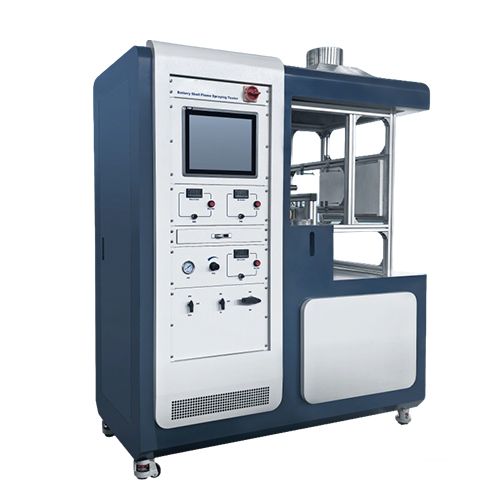
The equipment features an integrated steel structure and an open test platform, with overall dimensions of 1600 × 750 × 2100 mm and a total weight of 250 kg. The open platform helps reduce heat accumulation in the testing area while making specimen loading and unloading more convenient. A stainless steel exhaust hood is installed above the platform to collect smoke generated during specimen combustion. The exhaust airflow is adjustable, directly addressing the customer's exhaust management concerns.
The core component is an imported flame jet burner consistent with those used in UL laboratories. The burner outlet has an outer diameter of approximately 28.6 mm and incorporates 30 methane supply ports, 78 oxygen supply ports, and a grit supply port. It delivers a 3 kW jet flame and a grit flame with a grit delivery rate of 1.5 g/s. An electric spark igniter provides automatic ignition, while flame application and grit blasting are fully automated. The flame shield opens automatically during testing.
Gas control is a critical feature of this equipment. Three mass flow controllers independently regulate methane (0–10 L/min), oxygen (0–50 L/min), and air. All controllers offer an accuracy better than 2% F.S. and incorporate temperature and pressure compensation. This is precisely the key technology that addresses the challenge of maintaining consistent flame test conditions.
Temperature measurement is performed using four 30 AWG K-type thermocouples, designated for flame temperature calibration, specimen backside temperature measurement, temperature measurement at a point 25 mm behind the specimen, and backup use, respectively. The stainless steel specimen holder features separate calibration and test positions and is automatically inserted during testing, ensuring that every specimen occupies exactly the same geometric position as during calibration.
The software runs on the Windows platform and supports both manual and automatic operating modes. Its functions include flame temperature calibration, temperature-time curve generation, grit signal-time curve generation, and test report export and management. The data acquisition system records temperature and grit signals simultaneously, with a temperature resolution of 0.1°C and a time interval of 1 second.
Equipment Advantages and Application Results
Within one week of equipment arrival, installation and commissioning were completed. The customer's testing team completed flame temperature calibration and successfully ran its first automatic test program within two days.
After six months of operation, the actual benefits were reflected in three major areas:
Significantly Shortened Material Development Cycles
A single thermal runaway simulation test on flat material specimens, which previously required six to eight weeks through external laboratories, could now be completed internally with results available within one day. The complete validation cycle for a new enclosure formulation was reduced from two months to two weeks. This enabled the company to keep pace with customer sample approval schedules, directly benefiting two new project awards.
Improved Data Reliability
The combination of a burner consistent with those used in UL laboratories, mass flow controllers, and an automatically positioned specimen holder significantly reduced deviations in repeatability tests on the same batch of materials. Test reports were generated in accordance with the temperature measurement point arrangement and curve formats specified by UL 2596. eliminating the need for additional explanations during customer reviews.
Successful Laboratory Safety Assessment
The adjustable exhaust hood, automatic ignition, and automatic flame shield enabled the testing room to successfully pass the customer's on-site safety audit. This is also a mandatory requirement in many battery cell manufacturers' supplier laboratory audits.
Key Problems Solved
Looking back, this equipment helped the customer resolve four critical challenges:
From No In-House Testing Capability to Independent Testing: UL 2596 flat specimen testing capabilities were successfully established, eliminating dependence on external laboratory scheduling.
From Unstable Data to Controlled Test Conditions: Mass flow controllers with temperature and pressure compensation enabled consistent reproduction of the 3 kW jet flame and 1.5 g/s grit flame conditions, resolving repeatability issues.
From High-Risk Manual Operations to Fully Automated Procedures: Ignition, flame application, grit blasting, flame shield operation, and specimen insertion were all automated, keeping personnel away from the combustion zone during testing.
From Uncontrolled Smoke Emissions to Controlled Exhaust Collection: The stainless steel exhaust hood and adjustable exhaust system enabled controlled smoke collection and discharge, allowing the laboratory to pass its safety assessment on the first attempt.
Customer Feedback
The customer's laboratory manager provided a straightforward assessment:
"Previously, our biggest concern was when customers asked, 'Can you provide the test data this week?' Now, we can complete testing on Friday and send the report by Monday using our own equipment. The software's automatic mode and report export functions save us a tremendous amount of time on data organization. The temperature and grit curves are incorporated directly into the report, making the results immediately understandable to customers."
He particularly highlighted one detail: during installation, our engineers calibrated the flame temperature point by point in accordance with UL 2596 requirements and saved the calibration procedure in the software. The team's weekly routine calibration now requires only a single button click.
"For a supplier of our size, being able to make UL 2596 testing a routine daily operation rather than a major undertaking every six months is the greatest value this equipment delivers."
Previous: Improving Packaging Impact Testing with an Incline Impact Tester in Poland
N e x t : the last page
