





UV Weathering Test Chamber for Plastics, Coatings & Textiles
2025/11/25
Share:

Product Introduction & Functions
The UV Accelerated Weathering Tester (UVtest) is a state-of-the-art laboratory instrument designed to replicate the environmental effects of sunlight, temperature, and moisture on materials. By simulating these conditions in a controlled environment, it accelerates material aging, allowing manufacturers, researchers, and testing laboratories to predict long-term performance and durability without waiting for actual outdoor exposure.
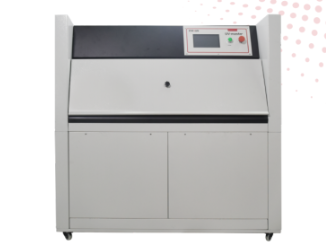
Core Functions:
Simulated Sunlight Exposure: Uses UVA and UVB fluorescent lamps to mimic the full spectrum of sunlight, including harmful UV radiation.
Temperature Control: Adjustable heating elements allow precise simulation of heat conditions that materials experience outdoors.
Condensation & Water Spray: Reproduces dew, rainfall, or high-humidity conditions to test material resistance to moisture.
Automated Data Logging: Monitors UV irradiance, temperature, humidity, and test cycles in real-time.
Material Degradation Assessment: Evaluates color fading, gloss reduction, cracking, chalking, embrittlement, and surface deterioration.
Customizable Test Cycles: Users can set UV intensity, cycle duration, condensation periods, and temperature ramps to meet diverse testing standards.
Why It Matters:
Materials such as plastics, coatings, rubber, and textiles often fail prematurely in outdoor applications if their UV resistance is inadequate. This tester ensures early detection of potential weaknesses, saving costs and enhancing product reliability.
Applications (Application Scenarios)
The UVtest is highly versatile and used in multiple industries for quality control, research, and certification:
A. Plastics & Polymers
PVC, PE, PP, ABS, PC, PMMA, and engineering plastics.
Evaluates discoloration, brittleness, and surface cracking under prolonged UV exposure.
B. Coatings & Paints
Automotive coatings, industrial coatings, architectural paints, powder coatings.
Tests gloss retention, chalk resistance, color stability, and film integrity.
C. Rubber & Elastomers
Seals, gaskets, hoses, and outdoor rubber components.
Evaluates UV degradation, cracking, and loss of elasticity.
D. Textiles & Leather
Outdoor fabrics, synthetic leather, dyed materials.
Assesses colorfastness and surface integrity after UV exposure.
E. Automotive & Aerospace Components
Exterior plastics, instrument panels, trim parts, and composite materials.
Ensures materials can withstand sunlight and environmental exposure during vehicle lifecycle.
F. Construction Materials
PVC boards, decorative panels, roofing membranes, and waterproof materials.
Evaluates long-term color stability, mechanical performance, and UV resistance.
G. Electronics & Optical Components
Transparent plastics, lenses, display covers.
Ensures clarity, dimensional stability, and surface durability under UV exposure.
Compliant Standards
The UVtest complies with a broad range of international and national standards, ensuring reliability and repeatability:
ASTM Standards
ASTM G154: Fluorescent UV Exposure of Non-Metallic Materials.
ASTM D4329: UV Exposure of Plastics.
ASTM D4587: Accelerated Weathering of Coatings.
ASTM D5208: UV Exposure of Plastic Films.
ISO Standards
ISO 4892-1 / ISO 4892-3: Plastics—Exposure to Laboratory Light Sources (UV fluorescent lamps).
ISO 11507: Coatings—UV Exposure Testing Methods.
Chinese Standards (GB/T)
GB/T 16422.1 / GB/T 16422.3: UV Weathering of Plastics.
GB/T 23987: UV Weathering of Plastic Materials.
GB/T 5170.9: Calibration of UV Weathering Testing Equipment.
Key Parameters Across Standards:
Lamp Type: UVA-340 (closest sunlight simulation) / UVB-313 (accelerated aging)
Irradiance: 0.35–1.2 W/m²/nm @ 340 nm
Temperature Range: 40–70°C
Condensation / Water Spray Cycles: To simulate dew, rainfall, or high humidity
Test Duration: 24–2,000+ hours depending on material and standard
Frequently Asked Questions (FAQ)
Q1: What is the difference between UVA and UVB lamps?
UVA-340: Best simulates natural sunlight for long-term durability testing.
UVB-313: Accelerates aging more aggressively, suitable for rapid QC tests.
Q2: How long should UV tests run?
Quick screening: 300–500 hours
Standard durability evaluation: 1,000 hours
Automotive-grade or outdoor products: 2,000+ hours
Q3: Why is condensation/water spray important?
Simulates real environmental conditions such as dew, rainfall, or high humidity.
Critical for coatings, plastics, and outdoor materials where moisture accelerates degradation.
Q4: Can UV testing replace outdoor exposure?
No. UV testing provides accelerated results, while outdoor testing validates real-world performance.
Combining both gives the most accurate durability assessment.
Q5: Can the tester be customized?
Yes. Test parameters like UV intensity, temperature, cycle duration, and condensation can be adjusted to meet specific material requirements or testing standards.
Q6: What materials can be tested?
Plastics, coatings, rubber, textiles, leather, composites, optical plastics, and construction materials.
<script src="chrome-extension://lmnganadkecefnhncokdlaohlkneihio/enable.js"> </script> <script src="chrome-extension://lmnganadkecefnhncokdlaohlkneihio/enable.js"> </script> <script src="chrome-extension://lmnganadkecefnhncokdlaohlkneihio/enable.js"> </script> <script src="chrome-extension://lmnganadkecefnhncokdlaohlkneihio/enable.js"> </script>
Previous: Cable Abrasion Resistance Tester for Quality Control and R&D
N e x t : How to test fire retardant fabric?
