





Cable Abrasion Resistance Tester for Quality Control and R&D
2025/11/25
Share:

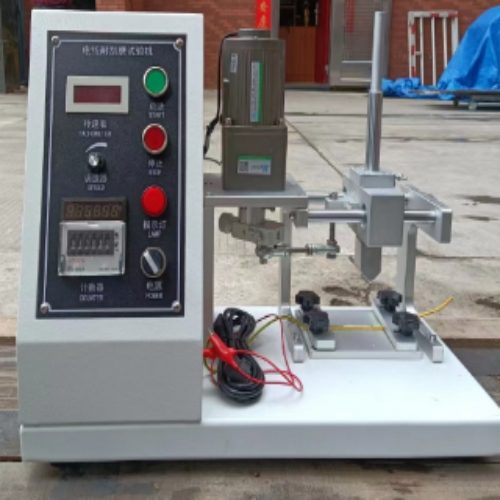
The Wire and Cable Scrape Abrasion Tester is a specialized instrument designed to assess the resistance of cable surfaces to scraping, cutting, and abrasion damage. By simulating real operational environments, it provides accurate, quantifiable data for quality control, R&D, and certification testing. This instrument is widely used in cable manufacturing plants, testing laboratories, research institutes, and inspection bodies.
Working Principle
The working principle of the Wire and Cable Scrape Abrasion Tester is based on mechanical loading and tribology (friction and wear) theory.
During testing:
A scraping head or abrasive device applies a controlled force to the cable surface.
The test system moves the scraper at a defined speed and frequency, simulating real-life friction, scraping, and wear conditions.
Sensors continuously collect key parameters such as:
Scraping force
Scraping speed
Number of scrape cycles
Wear depth or surface damage
The collected data is analyzed by the control system to calculate:
Abrasion index
Scrape resistance level
Wear performance evaluation
This ensures a precise, repeatable assessment of the cable’s surface durability under mechanical stress.
Applications (Application Scenarios)
The Wire and Cable Scrape Abrasion Tester is widely used in:
1. Cable Manufacturing Quality Control
Incoming material inspection
Production line sample testing
Finished product batch evaluation
Verification of insulation and sheath durability
2. Research & Development
Testing new polymer insulation materials
Evaluating flame-retardant, weather-resistant, or high-flexibility cables
Material formulation comparison experiments
3. Third-Party Testing Laboratories
Product certification
Conformity assessment
Compliance with national and international standards
4. Industries Using High-Durability Cables
Automotive wiring harness
Aerospace cables
Rail transit cables
Robotics and automation cables
Marine and offshore power cables
Compliant Standards
The Wire and Cable Scrape Abrasion Tester conforms to multiple national and international standards, including:
IEC 60811 – Common test methods for insulating and sheathing materials
IEC 60245 / IEC 60227 – Rubber and PVC insulated cables
UL 1581 – Reference standard for electrical wires, cables, and flexible cords
ASTM D2228 – Standard test method for abrasion resistance of cable insulation
GB/T 2951 – General test methods for cable insulating and sheathing materials
GB/T 5013 / GB/T 5023 – Rubber and PVC insulated cables test methods
(You can tell me your exact model number and I will match the precise standards.)
Frequently Asked Questions (FAQ)
Q1: What types of cables can be tested?
The tester is suitable for:
PVC-insulated cables
Rubber-insulated cables
XLPE cables
Automotive wires
Sheathed power cables
Special-purpose industrial cables
Q2: What are the key test parameters?
Typical adjustable parameters include:
Scraping force (N)
Scraping frequency and speed
Number of scraping cycles
Type of scraping head (needle, blade, abrasive wheel)
Q3: What is the purpose of scrape abrasion testing?
To evaluate the cable’s ability to withstand:
Mechanical wear
Repetitive bending friction
External scraping or rubbing
Installation and operational damage
Q4: How is test failure determined?
Common failure criteria include:
Exposure of conductor
Penetration through insulation
Surface cracking
Abrasion depth exceeding standard limits
Q5: Can the equipment be customized?
Yes. Scraping force, stroke length, test head type, sample fixtures, and automation functions can all be customized depending on customer requirements.
Previous: Xenon Arc Weathering Test Chamber for Material Aging Tests
N e x t : UV Weathering Test Chamber for Plastics, Coatings & Textiles
