





How to test the UV resistance of fabrics
2026/01/05
Share:

Testing Principles
The core of fabric UV resistance testing lies in quantifying its ability to block UV radiation. This process is achieved through two key parameters:
UV Protection Factor (UPF): This indicates the proportion of UV radiation that the fabric allows to pass through. For example, a UPF of 50 means that only 1/50 of UV radiation can penetrate the fabric, achieving a protection efficiency of 98%.
UV Transmittance: This directly reflects the proportion of UV radiation that the fabric allows to pass through; the lower the value, the better the protection.
The testing instrument measures the light transmittance of the fabric in the 280-400nm wavelength range by simulating the UV components of the solar spectrum, and then calculates the UPF value. For example, a dark-colored polyester fiber sample measured a UPF value of 50+ in a dry state, indicating that it meets the international "excellent protection" standard; however, the same sample's UPF value may drop to 30 in a wet state, revealing the impact of moisture on protective performance.
Standards System
Different countries and regions have established differentiated testing standards, but all use UPF (Ultraviolet Protection Factor) as the core evaluation indicator:
Chinese Standard (GB/T 18830-2009): Specifies that textiles with UPF > 40 and UVA transmittance < 5% can be labeled as "UV-protective products," applicable to clothing, parasols, and other daily necessities.
Australia/New Zealand Standard (AS/NZS 4399-2017): Subdivides protection levels into 15-29 (good), 30-49 (very good), and 50+ (excellent), requiring testing to simulate the stretching and wetting conditions of fabrics in actual use.
EU Standard (EN 13758-1/2): EN 13758-1 applies to textile fabrics, while EN 13758-2 applies to finished garments, emphasizing the control of temperature and humidity in the testing environment (e.g., 20℃±2℃, 65%±5%RH).
The American standard (AATCC 183-2014) uses spectrophotometry, requiring samples to be tested in both dry and wet conditions, and simulating performance degradation after 50 washes.
These standards collectively form a global framework for evaluating the UV protection performance of fabrics, providing consumers with reliable purchasing guidance.
Instrument Functions
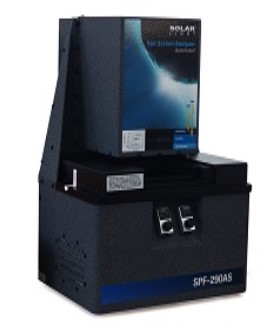
Professional fabric UV resistance testers typically include the following functional modules:
Dual-beam spectrophotometer and integrating sphere system: The built-in integrating sphere enables automatic scanning across the entire wavelength range (280-400nm), eliminating light scattering errors caused by uneven fabric surfaces. For example, one instrument can detect interference from fluorescent whitening agents in the UVB band, ensuring data accuracy.
Multi-angle rotating sample stage: The sample disk can rotate 360°, allowing multiple measurements at preset angles (e.g., 0°, 45°, 90°), avoiding deviations caused by fabric texture direction. One experiment showed that the UPF value of twill fabric at a 45° angle is 15% lower than at 0°, highlighting the necessity of multi-angle testing.
Environmental Simulation System: Some high-end instruments are equipped with temperature and humidity control modules, capable of simulating high-temperature and high-humidity (e.g., 40℃, 90%RH) or low-temperature and dry (e.g., -10℃, 30%RH) environments to evaluate the performance stability of fabrics under different climatic conditions.
Intelligent Calibration Function: Supports "air blank test" calibration of the spectral baseline and can be further verified using certified calibration cloth (with known UPF values). One study indicates that regular calibration can control test errors within ±3%.
Operating Procedure
1. Sample Preparation
Sampling Requirements: Cut 5cm × 5cm samples from different parts of the fabric (e.g., warp, weft, seams), avoiding folding or stretching. For printed fabrics, ensure a representative sample for each color area.
Pretreatment: Perform washing (e.g., simulating 50 machine washes), light aging (e.g., 100 hours of xenon arc lamp irradiation), or chlorine water immersion (e.g., simulating a swimming pool environment) according to standards to evaluate the fabric's durability in real-world use.
2. Instrument Calibration
Perform an "air blank test" to ensure accurate spectral baseline;
Place the certified calibration cloth, input the known UPF value, and run the calibration program;
Adjust instrument parameters (e.g., light intensity, integration time) based on the calibration results.
3. Formal Testing
Fix the sample onto the sample stage, avoiding wrinkles;
Set test parameters (e.g., wavelength range, scan speed, ambient temperature and humidity);
Start the test; the instrument automatically completes multi-angle scans and generates a spectral transmittance curve;
Calculate the UPF value, UVA/UVB transmittance, and key wavelengths (e.g., maximum protection wavelength).
4. Data Interpretation
UPF value classification: 15-24 (Good), 25-39 (Very Good), 40-50+ (Excellent);
Transmittance threshold: UVA transmittance must be <5%, UVB transmittance must be <2.5%;
Performance degradation analysis: Compare data before and after pretreatment to evaluate the impact of washing, wetting, or stretching on protective performance. For example, a cotton shirt's UPF value drops from 30 to 15 when wet, indicating that it needs to be coated with a waterproof layer to improve its usability.
Application Scenarios
The application of fabric UV resistance testers has penetrated multiple fields:
Outdoor Apparel: Mountaineering clothing and sun-protective clothing must meet the AS/NZS 4399-2017 standard, ensuring UPF 50+ and resistance to more than 50 washes;
Home Textiles: Curtains and parasols must comply with GB/T 18830-2009. balancing aesthetics and protective performance;
Industrial Protection: Agricultural covering materials and worker protective clothing must meet the EN 13758-2 standard, resisting prolonged outdoor exposure.
With the upgrading of consumers' health protection needs, fabric UV resistance testing has become a key link in quality control. By combining high-precision instruments with standardized processes, companies can not only optimize product performance but also enhance market competitiveness through data-driven labels (such as "UPF 50+" and "UPF>30 after 50 washes"). In the future, with breakthroughs in technologies such as nanomaterials and smart coatings, the testing methods for fabric UV protection performance will continue to evolve, providing more precise technical support for industry innovation.
Previous: UV Aging Test Chamber JTG E50 T1164
N e x t : How to test the flexibility of leather shoe uppers?
