





How to test the flexibility of leather shoe uppers?
2026/01/05
Share:

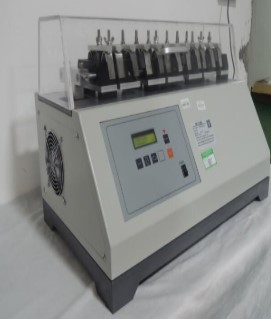
Testing Principles
The core of testing the flexibility and extensibility of leather uppers lies in simulating the stress state of the material during walking. Professional testing instruments, based on mechanical principles, fix the leather sample in a reciprocating fixture and apply periodic bending stress to the sample at specific angles, frequencies, and strokes, while simultaneously monitoring its deformation, crack propagation, and fatigue life.
Taking a typical instrument as an example, its working principle is as follows:
Fixture Design: A 40° V-shaped fixture is used to simulate the stress concentration area at the bending point of the upper. The sample size is typically 64mm × 64mm, covering the key stress-bearing areas of the upper.
Motion Pattern: The clamp reciprocates at a fixed stroke of 19mm at a frequency of 300±30 times/minute, forming a "one-press, four-pull" bending pattern (i.e., each downward press creates one downward crease while simultaneously creating four upward creases), accurately replicating the complex deformation of the shoe upper during walking.
Data Acquisition: High-precision sensors record the number of bends, deformation displacement, and crack propagation in real time. Some instruments can simultaneously monitor the stress-strain curve, quantifying the ratio of elastic to plastic deformation in the material.
For example, a cowhide leather sample, after 20.000 bends in a dry state, developed a 0.5mm microcrack on its surface; while a synthetic leather sample with a polyurethane elastic layer did not show any visible cracks under the same conditions, clearly demonstrating the difference in ductility between the different materials.
Standard System
Different countries and regions have established differentiated standards for the bending and stretching properties of leather shoe uppers. The core differences lie in parameters such as bending angle, frequency, number of bends, and environmental conditions:
1. International Standard (ISO 5402-1:2022)
Applicable Scenarios: Flexible leather with a thickness <3mm (such as shoe uppers and bag leather).
Key Parameters:
Bending Angle: 22.5°±0.5° (simulating natural walking bending);
Test Frequency: 100±5 times/minute;
Number of Tests: 50.000 times in dry condition, ≥50.000 times for automotive leather, ≥20.000 times for furniture leather;
Wet Condition Supplementation: Vacuum immersion treatment according to ISO 5402-2 (pressure <4kPa) to avoid the influence of a humid environment on the judgment.
Judgment Criteria: Macroscopic cracks >0.1mm or coating peeling area >5% are considered unqualified.
2. Chinese Standard (GB/T 39368-2020)
Applicable Scenarios: Specifically designed for shoe upper leather, simulating high-frequency bending scenarios.
Key Parameters:
Test Frequency: 300±30 times/minute (close to actual walking frequency);
Environmental Control: 23℃±2℃, 50%±5%RH. After wet testing, acclimatize for 24 hours and check for "blooming" (surface whitening);
Special Requirements: Children's shoe leather must undergo 10.000 low-temperature bending cycles at 0℃ to avoid low-temperature brittleness.
Judgment Criteria: Crack length ≤3mm is considered合格 (qualified).
3. American Standard (ASTM D2097)
Applicable Scenarios: Decorative leathers (such as automotive seat leather, furniture leather).
Key parameters:
Bending stroke: 32mm (simulating sitting/lying bending radius);
Low temperature test: 100 bends at -20℃ to assess cold resistance;
Sample size: 114mm × 76mm (suitable for decorative leather width);
Judgment criteria: Failure is defined as a crack width > 0.1mm or a tensile strength decrease > 50%.
Instrument Functions
Professional leather bending and stretchability testers typically integrate the following functional modules to achieve multi-dimensional data acquisition and analysis:
1. Multi-parameter Control System
Frequency Adjustment: Supports stepless speed adjustment from 100-480 cycles/minute to adapt to different standard requirements;
Stroke Control: Precisely controls the bending stroke via a servo motor (error <0.1mm);
Environmental Simulation: Some high-end instruments are equipped with a temperature and humidity control chamber, capable of simulating extreme environments from -20℃ to 60℃ and 10%-90%RH.
2. Intelligent Monitoring System
Crack Recognition: Employs a high-resolution camera and image processing algorithms to automatically detect micro-cracks as small as 0.01mm;
Stress Monitoring: Built-in force sensors record stress changes during bending in real time, generating stress-life curves (S-N curves);
Fatigue Counting: A 6-digit LCD counter can record 0-999.999 bends, and data is automatically saved after power failure.
3. Safety Protection System
Overload Protection: Automatically shuts down when stress exceeds a set threshold to prevent sample breakage and instrument damage;
Emergency Braking: Equipped with a manual emergency stop button to ensure operational safety;
Dustproof Design: Fully enclosed structure reduces dust intrusion and extends equipment life.
Operating Procedure
1. Sample Preparation
Sampling Rules: Take 3 samples each from the leather spine (high-quality area) and abdomen (medium-quality area) (avoiding insect damage and scratches), with dimensions conforming to standard requirements (e.g., 100mm × 25mm in GB/T 39368);
Pretreatment: Dry samples need to be conditioned in a standard environment (23℃±2℃, 50%±5%RH) for 24 hours; wet samples need to be vacuum-immersed in water for 30 minutes and then drained.
2. Instrument Calibration
Blank Test: Run the "Air Blank Test" to calibrate the spectral baseline;
Parameter Settings: Select bending angle, frequency, stroke, and environmental conditions according to the standard;
Jig Calibration: Use a standard calibration block (such as a silicone sheet with known elongation) to verify the uniformity of the jig tension (error <5%).
3. Formal Testing
Sample Installation: Fix the sample in the V-clamp, ensuring the grain surface faces outwards and there are no wrinkles;
Start Test: Input the preset parameters and start the instrument for automatic bending;
Process Monitoring: Pause every 5000 cycles, observe the surface condition with a 4-6x magnifying glass, and record the number and morphology of cracks.
4. Data Interpretation
Initial Fatigue Life: The number of bends when a 0.1mm crack first appears;
Final Fatigue Life: The number of bends when the crack extends to 5mm or the sample breaks;
Ductility Grading: Determined comprehensively based on crack length, coating peeling area, and tensile strength reduction rate (e.g., in the ISO standard, Grade 1 is no crack, and Grade 5 is complete fracture).
Application Scenarios
The application of leather bending and stretchability testing equipment has permeated the entire footwear industry chain:
Materials R&D: By comparing the impact of different tanning processes (such as chrome tanning and vegetable tanning) on stretchability using S-N curves, formula design can be optimized;
Quality Control: Random sampling on the production line ensures that each batch of products meets standard requirements;
Failure Analysis: Bending tests are performed on returned products to pinpoint the root cause of cracks (such as uneven tanning agent penetration or excessively high coating hardness);
Environmental Assessment: Testing the performance degradation of biodegradable leather materials during bending promotes the development of green footwear materials.
As consumers increasingly demand comfort and durability in footwear, leather bending and stretchability testing has become a key aspect of quality control. By combining high-precision instruments with standardized processes, companies can not only optimize material performance but also enhance market competitiveness through data-driven labels (such as "no cracks after 20.000 bends" and "low-temperature flexural strength certification"). In the future, with breakthroughs in new materials such as nano-coatings and smart fibers, leather bending and stretchability testing methods will continue to evolve, providing more precise technical support for industry innovation.
Previous: How to test the UV resistance of fabrics
N e x t : What is the core value of the Fat End Type of Thread EndSuction Machine?
