





What is a High Speed Lockstitch Bar Tacking Machine?
2026/01/13
Share:

Working Principle
1. What Is a Bar Tack
A bar tack is a sewing method used to enhance the localized strength of fabrics. It involves forming a short section of dense, interlaced lockstitches at specific positions on the fabric to improve resistance to tearing and tensile forces. Common applications include reinforcing pocket openings, belt loops, and the ends of buttonholes. (Wikipedia)
2. Lockstitch Mechanism
A lockstitch is formed by the interlocking of two threads—the upper thread and the lower thread—and is the most widely used stitch type in both industrial and household sewing machines. Its advantages include structural stability and high tensile strength, making it suitable for joining and reinforcing various types of fabrics. (Wikipedia)
3. Working Principle of the High Speed Lockstitch Bar Tacking Machine
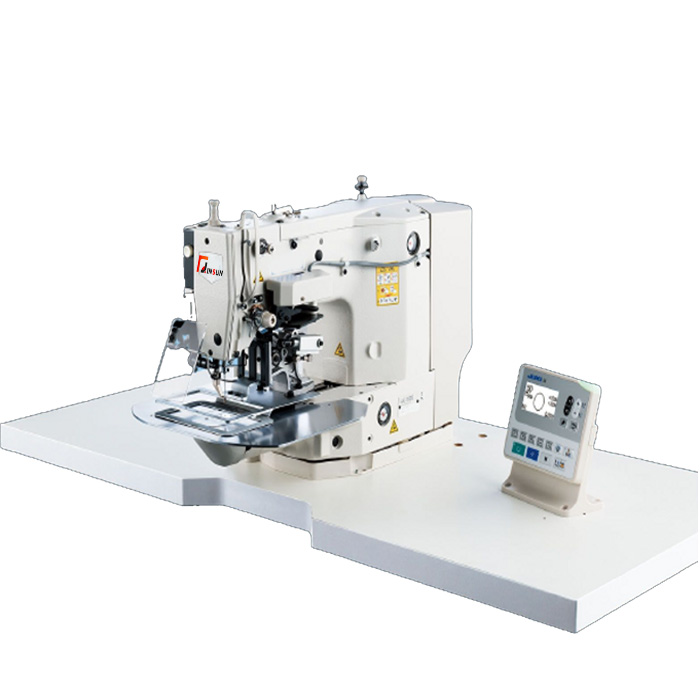
The high speed lockstitch bar tacking machine is an automatic cyclic sewing device that uses control mechanisms to drive a single needle to continuously form dense lockstitches, creating transverse or specific reinforcement patterns. The machine typically incorporates pneumatic components, servo motors, and sensor-based control systems, allowing parameters such as fabric feeding, stitch length, and stitch count to be programmed or automatically adjusted. This enables high-speed, precise bar tacking operations. The typical sewing cycle includes: initial positioning → low-speed start → high-speed dense stitching → finishing and thread trimming. (simacsew.com)
Structural Components
The core structure of a high speed lockstitch bar tacking machine generally includes the following parts:
1. Machine Head and Main Shaft System
The machine head is the core component responsible for sewing power and needle bar motion. It commonly uses direct motor drive or servo motor drive to achieve high rotational speed and rapid response of the needle bar. Direct-drive designs reduce transmission losses and vibration, improving start/stop accuracy. (zoje-america.com)
2. Feeding and Fabric Clamping Mechanism
The fabric clamping mechanism secures the material before and during sewing, while precise feeding is achieved through stepper motors, electromagnetic devices, or servo control. Higher-end models support multi-directional feeding, enabling expanded stitch patterns such as box and cross shapes. (Scribd)
3. Control System and Operation Interface
Modern high speed bar tacking machines are equipped with electronic controllers or touch-screen interfaces. These allow operators to set sewing speed, stitch count, stitch length, and pattern modes, and to store multiple programs, greatly improving production flexibility and repeatability. (sewing.sg)
4. Sewing Function Accessories
These include automatic thread trimming devices, thread waste collection systems, and presser foot pressure adjustment mechanisms, all of which contribute to improved operating efficiency and finished product quality. (zoyer.cn)
Technical Features
Thanks to advanced technologies, high speed lockstitch bar tacking machines offer the following notable features:
1. High Speed and High Efficiency
Modern high speed bar tacking machines can reach sewing speeds exceeding 2.300–3.200 stitches per minute, making them suitable for high-volume, high-intensity production. High-speed stitching significantly increases output while reducing sewing cycle time. (worldengroup.com)
2. Stable Stitch Quality
With low-tension sewing, advanced stitch control systems, and anti-loosening thread technology, these machines produce uniform stitch density and high sewing strength, effectively preventing thread breakage or loose thread ends, thereby ensuring product quality and durability. (zoje-america.com)
3. Automation and Programmability
Many models support computerized control, allowing storage and rapid switching of multiple stitch patterns without frequent manual adjustments. Functions such as automatic thread trimming and automatic presser foot lifting further reduce manual intervention while improving safety and efficiency. (zoje-america.com)
4. Multi-Pattern Sewing Capability
Advanced bar tacking machines are capable not only of straight bar tacks but also of producing curved, circular, and box-shaped reinforcement patterns with appropriate clamps, making them suitable for more complex garment components and industrial webbing applications. (zoyer.cn)
Application Fields
Due to their reinforcement capabilities, high speed lockstitch bar tacking machines are widely used across various industries:
1. Garment Manufacturing
In products such as jeans, outerwear, and shirts, reinforcement is often required at pocket edges, belt loops, and buttonhole ends to ensure durability under repeated wear and tensile stress. Bar tacking machines perform these tasks accurately and efficiently, making them essential equipment on professional garment production lines. (Wikipedia)
2. Home Textiles and Soft Furnishings
Products such as pillowcases, cushions, and tents also require reinforced stitching at stress-bearing points. High speed bar tacking machines can perform dense lockstitch reinforcement on materials of varying thickness, enhancing overall load-bearing capacity.
3. Industrial and Safety Products
In the manufacture of industrial belts, automotive seat belts, lifting slings, and backpack shoulder straps—where high-strength stitching is critical—bar tacking machines provide consistent and reliable sewing results to ensure product safety.
4. Webbing and Special Material Processing
Webbing, nylon straps, and leather materials can also be reinforced using different types of bar tacking machines, meeting the production needs of footwear, luggage, and outdoor equipment industries.
Development Trends
With the advancement of industrial automation and intelligent manufacturing, high speed lockstitch bar tacking machines continue to evolve:
1. Intelligent Control and Networking
An increasing number of machines now support digital control and remote monitoring. By integrating with factory network systems, they enable parameter sharing, real-time monitoring, and fault warnings, improving production reliability.
2. Energy-Saving and Eco-Friendly Design
To address energy consumption concerns, new-generation bar tacking machines adopt high-efficiency servo motors and optimized transmission structures, significantly reducing power consumption and improving operational efficiency.
3. Integrated Multi-Process Capability
In the future, bar tacking machines are expected to integrate more reinforcement sewing processes, such as automatic clamp changes, automatic thread changes, and complex pattern stitching. This will allow multiple sewing tasks to be completed on a single machine, enhancing production line flexibility and integration.
As a key specialized device in modern industrial sewing, the high speed lockstitch bar tacking machine plays a vital role in improving product durability, production efficiency, and automation levels. From traditional mechanical transmission systems to modern electronic servo control, continuous technological advancements have driven the development of this equipment. Whether in garment manufacturing, home textile production, or the fabrication of industrial safety belts and outdoor equipment, high speed lockstitch bar tacking machines have become indispensable due to their speed, precision, and stable performance.
Previous: What is a Button Sewing Machine?
N e x t : What are the four types of drilling machines?
