





Yarn Appearance Board Winder,ASTM 2255
2026/01/23
Share:

Importance of Yarn Appearance Evaluation
Yarn appearance provides a direct reflection of the overall structural uniformity and defect status of the yarn. After spinning, twisting, and winding, yarn may exhibit defects such as thick or thin slubs, hairiness, neps, and variations in thickness, which can cause fabric surface defects and affect fabric aesthetics and performance.
Traditionally, yarn appearance was assessed by visual inspection, but manual evaluation is subjective and can lead to inconsistent and non-comparable results. Therefore, developing standardized and repeatable evaluation methods has become an important task in textile testing. The yarn appearance board winder addresses this need by presenting yarn defects in a visual, standardized manner, allowing more intuitive and scientific observation and comparison.
Definition and Testing Purpose
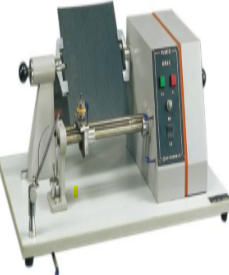
The yarn appearance board winder is a testing device used to wind yarn evenly and at consistent intervals onto a board (usually black), enabling visual inspection or comparison with standard samples. Under the action of the device, the yarn is arranged in regular patterns on the board. Inspectors evaluate appearance defects such as thick slubs, hairiness, neps, and irregularities by comparing the wound yarn with standard samples or reference photographs to determine whether it meets quality requirements.
This method allows assessment of yarn uniformity, surface defects, and overall quality. Unlike other instruments such as yarn strength testers or twisting machines, which focus on mechanical properties, the yarn appearance board winder emphasizes visual and structural consistency.
Basic Working Principle
The working principle of the yarn appearance board winder can be summarized as follows:
Board fixation: A specially designed black test board is fixed onto the device.
Yarn guiding and tension control: Yarn is drawn from a bobbin or sample position through a guiding system, ensuring appropriate tension.
Winding action: The device winds the yarn in parallel coils along the board at preset speed and spacing.
Stopping and observation: Once the board is fully covered to the specified width, the device stops, and inspectors remove the board for visual inspection and comparison with standards.
During winding, the lateral and longitudinal movement of the yarn is achieved by a motor-driven compound motion system, ensuring neat and uniform winding patterns.
Equipment Construction and Core Components
Typically, the yarn appearance board winder consists of the following main components:
1. Board and support structure
The board is the core component, usually flat or slightly tapered, with a dark surface to enhance contrast for visual inspection. Dimensions conform to standard specifications for consistency in testing.
2. Drive and motion system
The device uses mechanical transmission (motor, control board, variable-speed mechanism, etc.) to control board rotation and yarn guidance, arranging the yarn in the specified density and order. Some winders have multi-speed settings to accommodate different yarn counts and winding requirements.
3. Tension control and guiding system
To ensure stable and consistent winding, the device includes tension control mechanisms and guiding devices, maintaining uniform yarn tension to prevent slack, unevenness, or breakage, ensuring clear and legible winding patterns.
Standards and Testing Norms
Testing with yarn appearance board winders typically follows international or national standards to ensure consistency and comparability. Major relevant standards include:
ASTM D2255: An internationally recognized standard specifying methods for yarn appearance evaluation, including winding density, photographic comparison, and evaluation procedures.
GB 9996: A Chinese standard for yarn appearance testing, providing a reference for visual assessment.
These standards define specific test conditions, such as winding densities (e.g., 7. 9. 11. 13. 15. 19 wraps/cm), comparison methods, and evaluation techniques, ensuring comparable results across laboratories and manufacturing sites.
Testing Procedure and Operation
The typical use of a yarn appearance board winder includes the following steps:
Sample preparation: Select representative yarn segments from the test bobbin or sample, ensuring sufficient length to cover the entire board, reflecting true yarn appearance.
Device preparation: Install a board of appropriate specification, adjust winding density, speed, and tension parameters according to standards.
Winding operation: Start the device; it automatically winds yarn evenly onto the board. Operators monitor tension and speed, but manual intervention is minimal.
Observation and recording: After winding, remove the board and visually inspect the yarn pattern, comparing defects such as slubs, hairiness, neps, and impurities against standard samples or photographs. Record observations.
Yarn Quality Evaluation Indicators
Through board winding, the following indicators can be assessed:
Irregularity and slub variation: Check if coil width is consistent and if there are noticeable thick or thin slubs, indicating unevenness.
Hairiness and impurities: Protruding fibers, inconsistent color, or roughness indicate excessive hairiness, potentially affecting subsequent processes and fabric hand feel.
Neps and mixed defects: Neps and fiber lumps are clearly visible on the board and can be compared with standard photographs to qualitatively describe yarn appearance.
Visual uniformity rating: Comparing with standard photographs allows assignment of an appearance grade, qualitatively or quantitatively expressing overall visual uniformity and quality.
Practical Applications
The yarn appearance board winder is widely used in the textile industry, with key applications including:
Production quality control: Manufacturers use it for sampling inspections, detecting unevenness or defects during production, and reducing nonconforming yarn batches.
Incoming material inspection: Downstream users, such as weaving and dyeing mills, can inspect purchased yarn to ensure it meets appearance quality requirements.
R&D and process optimization: During new yarn development or process improvement, the device provides direct evaluation of appearance quality, supporting defect analysis and improvement.
Education and training: In textile education, board-wound yarn results provide intuitive examples for learning yarn quality assessment, helping students understand structure and defect manifestations.
Development Trends
With automation and digitalization in textile manufacturing, yarn appearance board winders are evolving toward intelligent and digital systems:
Automated image recognition: Computer vision identifies slubs, hairiness, and other defects, improving evaluation accuracy.
Digital sample databases: Standard sample libraries facilitate comparison and evaluation.
Networked inspection systems: Results from multiple devices are integrated into quality management systems for batch tracking and big data analysis.
These advancements are expected to further improve efficiency and reliability of yarn quality assessment, making textile quality management more scientific and modernized.
The yarn appearance board winder is an important textile testing device. By providing standardized winding and visual evaluation, it allows intuitive assessment of yarn appearance, uniformity, and defects. It supports production quality control, incoming inspection, R&D, and educational purposes. With ongoing digitalization and intelligent technology integration, this equipment is expected to play an increasingly significant role. Yarn appearance evaluation remains a critical component of textile quality management, with scientific, standardized, and repeatable methods influencing overall yarn quality and market competitiveness.
Previous: How to measure filtration efficiency?
N e x t : What is a light fastness test?
